
Poetry is powerful. Above all, it is emotionally powerful. It touches us deep within. Can it also serve as a catalyst for saving the world? And what does that mean for art and culture?
The cultural sector has remained silent for far too long. It has long been blind to the future. At least, that is how Indian author Amitav Ghosh sees it. Could it also be because the climate crisis and species extinction simply don’t make for compelling storytelling? Or perhaps they do? Do such topics drive audiences away and alienate readers?
Not at all. In this special feature, we highlight people who prove the opposite. And who know how to skillfully harness the power of poetry to create a better world.
[av_heading heading='Climate Change, Take the Stage' tag='h3' style="" size="" subheading_active="" subheading_size='15' padding='10' color="" custom_font="" admin_preview_bg=""][/av_heading]
© Natalie Driemeyer
The German dramaturge and festival director Natalie Driemeyer was among the first to give climate change a prominent platform. In this interview , she explains how naturally such topics are addressed on theater stages in countries that are already grappling with very different climate realities today, such as the Philippines or Indonesia. During her climate theater journey, she witnessed how people lost everything due to the aftermath of a hurricane in the Philippines. And how theater therapy helped them cope with the trauma. In her view, a kind of “sense of global interconnectedness” has emerged as a result of the pandemic. A feeling that, together with the increased interest in climate issues here at home, is creating fertile ground for change.
[av_heading heading='From Shock-Induced Paralysis to "Grounded Encouragement"', tag='h3', style="", size="", subheading_active="", subheading_size='15', padding='10', color="", custom_font="", admin_preview_bg=""][/av_heading]

Teresa Distelberger ©Maria Noi
How can we encourage people to engage culturally with issues that will ultimately shape the future? Inspiring role models have been shown to help. But perhaps we can also spark curiosity about whether the world might not be better if it were different. The Austrian director Teresa Diestelberger has a knack for bringing an encouraging voice to often pessimistic discussions through her “uplifting documentaries.” She portrays people who radiate a “down-to-earth encouragement” and demonstrate how our world could function differently. In this interview , we dive with her into moments of “social beauty” that accompany her work.
[av_heading heading='Slow music movement' tag='h3' style="" size="" subheading_active="" subheading_size='15' padding='10' color="" custom_font="" admin_preview_bg=""][/av_heading]
© Rising Appalachia
Is it possible to successfully release music while still leaving behind the noise and hectic touring schedule of the global music industry? Or, as a musician, even become a self-proclaimed “catalyst for change”? Bands like Rising Appalachia and Manu Delago show where this journey can lead. For example, by sailboat to various American ports on the East Coast. Or by bike to tour stops across Austria. Read more about it in this article.
[av_heading heading='What rhymes is good' tag='h3' style=" size=" subheading_active=" subheading_size='15' padding='10' color=" custom_font=" admin_preview_bg="][/av_heading]
Thanks to the digital tailwind, poetic gems often go viral in the blink of an eye these days. And the desire of various poets and slam artists to save the world is also spreading rapidly. Nevertheless, we won’t be able to save the world with poetry alone, says Samuel Kramer in an interview—a climate poet, spoken-word artist, and activist. We talk with him about tornadoes, displacement, emotionless politics, and the art of concretely describing where the path might lead.
[av_heading heading='More poetic flair, please!' tag='h3' style=" size=" subheading_active=" subheading_size='15' padding='10' color=" custom_font=" admin_preview_bg="][/av_heading]
Frame Talks: How Social Honey Is Made ©W.Zumdick
The shift in thinking that we are already observing in numerous (including cultural) niches of society is described by the art philosopher Wolfgang Zumdick describes in an interview as a “poetic attitude.” What he means by this is an attitude that fuels change—because it is contagious and inspires others. It is an attitude that visionaries such as Joseph Beuys and Rudolf Steiner have already cultivated.
You can learn it by sharpening your perception, by learning to discuss what really matters, and by truly listening. He refers to the connection that this helps to reestablish between people as “social honey,” a term inspired by a performance piece by the artist Shelley Sachs. Read more here.
[av_heading heading='Are we imagining the future wrong?' tag='h3' style=" size=" subheading_active=" subheading_size='15' padding='10' color=" custom_font=" admin_preview_bg="][/av_heading]
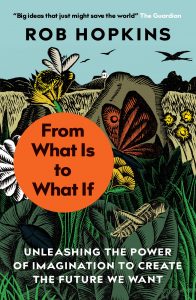
From "What is" to "What if" ©R. Hopkins
Whether it’s the movies, the theater, a concert, or an exhibition: culture feeds our imagination. And that imagination could be a key to success. Rob Hopkins, the founder of the Transition Town movement, even believes that it could unlock the magic door: the door to a better future. In his book“From What Is to What If”(soon to be published in German), he poses the provocative question:
Can we even imagine that things will turn out for the best?
That we'll make the right decisions from now on?
What images then come to mind? In his book, he presents examples that show what kind of change becomes possible when—at first, just a few—people begin to rediscover their imagination in a positive way.
[av_heading heading='Light at the End of the Tunnel' tag='h3' style="" size="" subheading_active="" subheading_size='15' padding='10' color="" custom_font="" admin_preview_bg=""][/av_heading]
"Rediscovery" is certainly a fitting keyword. The pandemic has taught us what it means to be culturally starved. Now that most venues have reopened, there is much to catch up on and rediscover. And we can combine the pleasant with the practical: a hunger for culture with prospects for the future.
That is precisely what this year’s“Vienna Biennale for Change,” with its theme “Planet Love,” invites us to do. “Let’s imagine that our planet has a future.” That is the subtitle of the exhibition“Climate Care,” which is on view at the MAK as part of the Vienna Biennale through October 3, 2021.
The mission statement for this year’s Vienna Biennale, published on the website , leaves no doubt that the cultural sector will by no means be sleepwalking through the crises of our time—staging and curating its way past them. On the contrary. We will be looking even more closely:
“The Vienna Biennale for Change 2021 aims to spark our imagination, advance the vision of ecologically and socially sustainable societies and economies, and offer innovative ideas and solutions: to mitigate the climate crisis, restore and preserve ecosystems, conserve biodiversity, and leverage digital technologies for the benefit of the climate and the environment.” (Mission of the Vienna Biennale for Change 2021)
A balm for the soul of all those who love the future. But it goes one step further:
“It not only encourages us to pause and rethink our approach, but also calls on all socio-political forces and every single person to take decisive action to address the overall climate and ecological crisis.”
There's nothing more to say!
[av_promobox button='no' label='Click me' link='manually,http://' link_target="" color='theme-color' custom_bg='#444444' custom_font='#ffffff’ size=’large’ icon_select=’no’ icon=’ue800’ font=’entypo-fontello’ box_color=“ box_custom_font=’#ffffff’ box_custom_bg=’#444444’ box_custom_border=’#333333’ admin_preview_bg=“]
 About the Author
Dr. Sybille Chiari is a member of the editorial team for “Nachhaltigkeit. Neu denken” and has been engaged in sustainability and climate communication for many years—both through research and writing. She is part of the Scientists for Future movement and chairwoman of the Bele Co-Housing association (a communal housing project featuring organic, regenerative agriculture ; www.belehof.at).
[/av_promobox]