Sustainability is an overused term, usually associated primarily with ecological aspects. In sustainable development, the focus is on satisfying human needs through the sustainable use of resources - a strongly anthropocentric view. Indigenous people, on the other hand, understand sustainability to mean thinking first of all about what they can give to the earth, not what they want to take from it.
What does sustainability mean at LAMPERT?
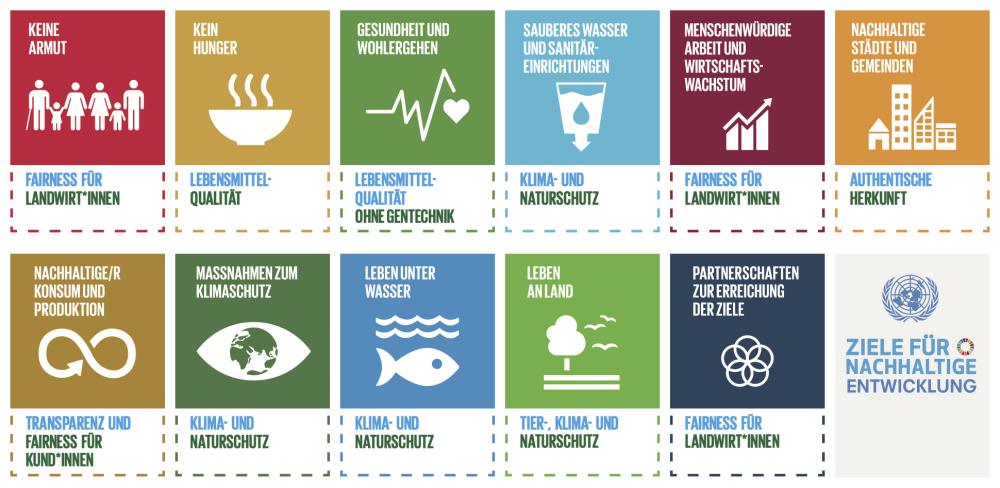
Long before sustainability became a trend, LAMPERT defined eight basic values on which the company bases all its actions and activities. These coincide with 11 of the 17 Sustainable Development Goals of the United Nations, and encompass the four dimensions of sustainability. Our core values come to life in agriculture. Organic is the basis, but must be combined with sustainability and transparency in order to be future-proof.
The four dimensions of sustainability
Dimension 1 - Ecology
We recognize the biodiversity and climate crisis and the responsibility that agriculture bears in this regard. Our way of farming is the solution, not the problem.
Dimension 2 - Economy
We see ourselves as a bridge between science and practice and deliver practical sustainability measures that also make economic sense.
Dimension 3 - Social
Sustainable change requires motivated people. In addition to fair pay, secure working conditions and long-term partnerships, Lampert is considering how we can take people with us on the path towards sustainability. How can we pass on knowledge, how can we inspire?
Dimension 4 - Corporate governance
At LAMPERT, good corporate governance is based on trust and transparency. Responsible action and management requires the disclosure of the flow of goods and production methods.
The 8 core values of LAMPERT in detail
Authentic origin
Humans have been practicing agriculture for thousands of years, but climate change is rapidly altering growing conditions. This makes it all the more important to adopt production methods tailored to local conditions, such as climate and soil. Where food production supports the region’s natural cycles, farming can be particularly resource-efficient. Vegetable-growing regions are typically located in lowland areas on fertile soils; citrus fruits grow in sunny and warm regions; and in cool areas with high precipitation, grasslands thrive, offering the best conditions for grazing ruminants. We refer to this as the authentic origin of food, which we believe also ensures the best flavor in the final product. (see also Food Quality)
Nature and climate protection
More than a third of the land surface is agricultural land. Agriculture therefore has great potential to become a pioneer for climate and species protection. By building up humus and diverse agricultural structures,CO2 can be bound in soils and new habitats for plants and animals can be created. It is also important to adapt agriculture to new climatic conditions and make it climate-ready. This is achieved through the LAMPERT sustainability criteria, which go beyond legal requirements. The guidelines are continuously developed and adapted with experts on the basis of new scientific findings. Project partners grow and develop with the standard.
Without genetic engineering
LAMPERT stands for a consistent freedom from genetic engineering in agriculture and production. Genetic engineering methods strengthen the market power of agricultural corporations, combat symptoms and new genetic engineering also harbors risks. Instead, we want agriculture with a high level of agrobiodiversity and where the choice of seeds remains in the hands of farmers. At LAMPERT, therefore, no genetically modified organisms may be used or be detectable throughout the entire production chain (quantitative detectability limit ≤ 0.1%).
Animal welfare
At LAMPERT, animal welfare means ensuring the well-being and health of farm animals and promoting their natural behavior. After all, high-quality food can only come from healthy animals that are kept in a species-appropriate manner. To this end, animal welfare is defined on the basis of three dimensions:
Physical well-being through e.g. freedom of movement, species-appropriate food, veterinary observation
Mental and emotional well-being through a good human-animal relationship
Natural expression of species-specific behavior through e.g. grazing, social contact with conspecifics, rooting material for pigs
Food quality
You can argue about taste, but not about quality from our point of view. The LAMPERT guidelines determine the production of a foodstuff, from agriculture and processing to the organic end product. Through careful processing, recipes that are largely free of additives and auxiliary substances, and traditional production methods, we achieve a particularly original taste and the highest food quality for consumers.
Transparency
Transparency, honesty, authenticity - important characteristics for people and food production. Lampert records all relevant data along the value chain via its specially developed database and guarantees origin and quality assurance. Some of the information can be viewed online by consumers. The results of scientific sustainability assessments are also made available to them.
Fairness towards farmers
Farmers not only produce our food, they also preserve our cultural landscapes. They deserve full appreciation and respect for this. LAMPERT therefore strives for fair conditions in terms of long-term cooperation and appropriate remuneration for implementing the comprehensive sustainability guidelines.
Trust through fairness towards customers
Trust has to be earned. LAMPERT attaches great importance to disclosing its actions and making them comprehensible. All products are assessed by independent sustainability institutes. Customers can get an idea of how sustainable the Lampert product is and where our strengths and weaknesses lie. Using the LAMPERT database, customers can also enter the batch code or expiration date online to find out which organic farmers, from which regions, supplied the raw materials for their product and where they were processed. It is impressive to see that there are real people behind every product.