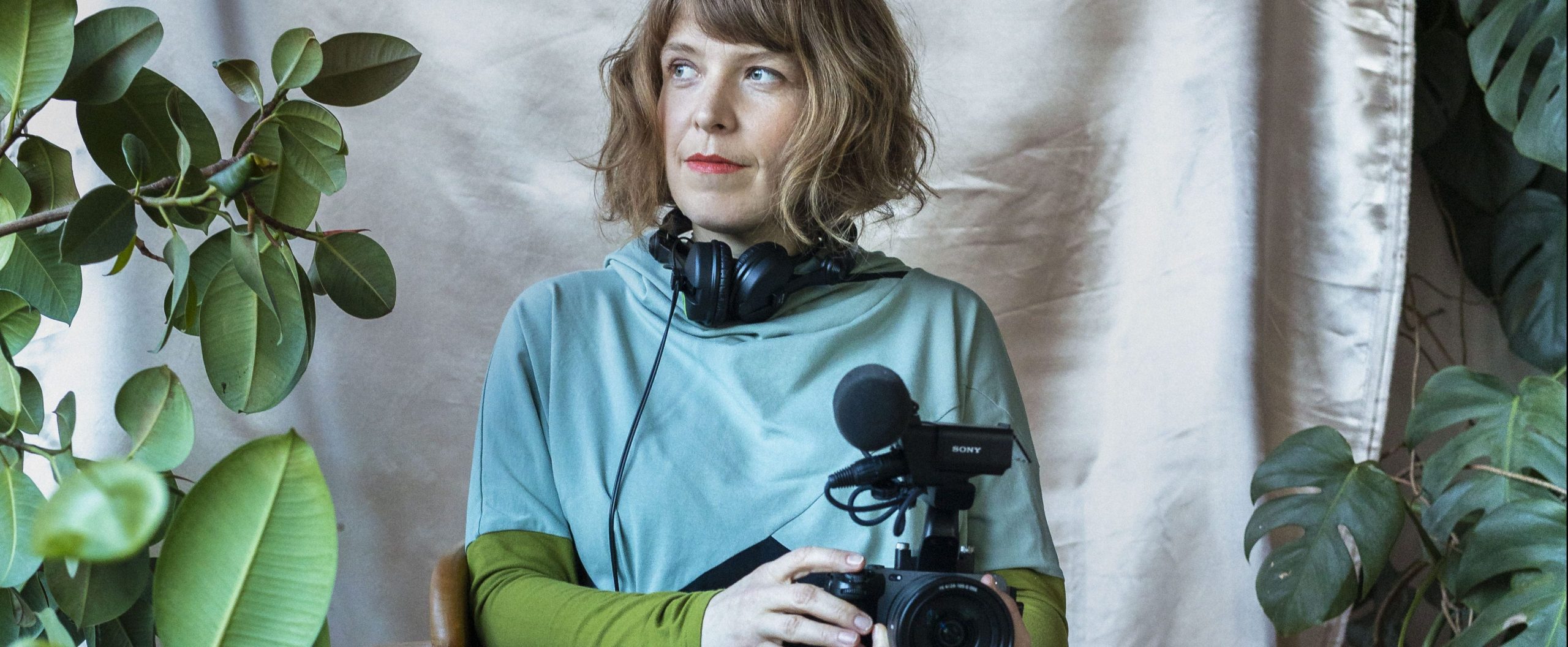
Teresa Distelberger’s inspiring documentaries shine a spotlight on people who identify problems and take action. In this interview, she tells us about moments of social beauty, the “made in Austria” spirit of initiative, and how, as a “cheerleader for change,” she highlights and celebrates heroic deeds.
After finishing my studies and making my first attempts at filmmaking, I wanted to step out of the role of an observer and get involved in creating the kind of world I wanted to live in. In Mexico, I had the opportunity to experience what it feels like to live in a matriarchal society. But working at an eco-friendly company and in a forest kindergarten also had a profound impact on me at the time. A happy coincidence then led me back to filmmaking.
Director Nicole Scherg invited me to join the film crew for the documentary*Life Is Not a Dress Rehearsal*, about GEA founder Heini Staudinger, which is how I came to know Geyerhalter Film Production.
After that, film producer Michael Kitzberger was determined to make an uplifting film featuring inspiring people. This led to *The Future Is Better Than Its Reputation*: a collaborative film project by various directors, which I had the privilege of overseeing for several years. Since many people automatically think of problems when they hear the word “future,” we also wanted to highlight opportunities: for greater participation, organic food, social engagement, or alternative construction.
Here, too, we’ve drawn on the “basic ingredients” of filmmaking: highlighting a problem while also offering starting points for change. We aim to address the upheavals in rural areas and the exodus from them, while also showcasing people who are already doing things differently.
It was especially during the public discussions that I realized I have a knack for bringing an encouraging voice to a discourse that is often already pessimistic.
We’re always looking for people who exude a sense of natural ease in what they do. You can tell when people have found their place—where they’re using their skills for something that feels right to them, but not out of a sense of self-sacrifice. And that comes across in the films as“grounded encouragement.”
There are many things you don’t see, either. But there are people who are willing to do even the things that aren’t heroic for the sake of what matters to them. It would be a different kind of film to show people who see themselves as heroes. Our protagonists often don’t realize just how heroic what they’re doing is. And yet, sometimes I could make an entire film about just one person.
One thing that really impressed me was the story of Fritz Pichler, the mayor of Stanz (Styria). He was just an ordinary citizen who opposed the planned municipal merger. A shared sense of purpose emerged in the town around this issue. As a result, his citizens’ list ran in the election for the first time and immediately won a majority and the mayoral seat.
The Citizens' List team is making great things happen: an on-demand taxi service and a carpool bench, since the town has poor public transportation; a forest kindergarten; and the revitalization of the village store.
Politics often seems distant and out of reach for ordinary citizens. But this example shows that things can happen quite quickly when there is determination, support, a vision, and the right moment.
I’m very curious about other ways of life and people who have a completely different outlook on life than I do. I enjoy embracing a change of perspective. During a public discussion, however, I was put to the test when a conversation arose with a young man who simply didn’t want any “outsiders” in his declining community. His stance was: We want to stay among ourselves, even if our numbers dwindle. The thought patterns behind this—these preservationist ideas—often lead to mechanisms of exclusion. Whether the newcomer comes from another village, state, country, or continent, the mechanism is the same.
In this context, I am also concerned with the topic of borders. How, from the privileged position of having been here before, people say: No. This also applies to national politics. This attitude pushes me to my limits. It deeply saddens me to see how this harshness arises, leaving no room for compassionate humanity. At the same time, I think it’s wonderful that my hometown of Herzogenburg, thanks to the NGO “Seebrücke,” has declared itself a “safe haven” and is calling on the federal government to allow municipalities to take in refugees.
I was recently in Bosnia working as a camerawoman for SOS Balkanroute, producing short films and social media clips. The NGO works with amazing Bosnian women who would definitely be worth making a film about.
I’m thinking, for example, of my encounter with Dženeta, the director of a relief organization in Tuzla. She provides for people who are taking a break from their flight in abandoned train cars. But she doesn’t just provide the obvious necessities of life, such as food, clothing, and medical care; she also offers conversations on equal terms. And with dignity. That is a moment of social beauty.
I am aware of my privileges as a white European woman. I am fortunate to live in a prosperous, reasonably socially equitable country in peacetime. I have benefited from comprehensive social policies, for example during my studies. There are many factors in my life that have come together to allow me to flourish.
This raises the question for me of how I can use these privileges to make these “basic necessities” accessible to even more people. At the same time, it’s important not to lose sight of the broader context. Neoliberal policies are putting more and more people under pressure, which fuels envy and fear.
Making a film is like throwing a stone into water. The film is the stone, but what really matters are the ripples. The film’s theme affects people to varying degrees: some were involved in its making, others watch the film, read about it, or hear about it from others.
When people gather in a place like a movie theater and then engage in a conversation afterward, it opens up a whole new set of possibilities. This allows the villagers to directly apply the insights from the film to their discussions about their own community.
But I don’t want to overestimate my own contribution either. What I can do is take something that’s already there, highlight it, and celebrate it—making it visible so it can inspire others as well . People bring about change themselves. I’m more of an ambassador, or a cheerleader, for change.
I grew up in a communal housing project as a child and wanted to live that way as an adult, too. However, without any inherited wealth, it seemed unrealistic to me to start such a project. When a friend of mine found a plot of land for a housing project in St. Andrä-Wördern, I wanted to get involved—on the condition that a“pooled fund”be part of the financing.
The asset pool is a social and legal innovation created by my father, who is actually a lawyer but describes himself as an incorrigible do-gooder. It can be used as a tool to purchase land, build energy facilities, or even develop housing projects.
In this way, investors have already contributed approximately 5 million euros to the “Auenweide” housing project, which is currently under construction. The investment pool allows us to offer comparatively low rents and helps alleviate the problem that truly eco-friendly living is (still) a luxury at the moment.
A future housemate said, “I think the shared fund is sooo beautiful.” He said it as if he were talking about a painting. “Because it allows people from different financial backgrounds to meet on equal footing, and that creates a kind of social beauty.” When financial interests and the desire to accumulate capital are set aside, construction can be much more environmentally friendly, making life in eco-friendly buildings accessible to far more people.
No matter what movie it is, go to the theater as soon as you can! Once theaters are open again, we need to pitch in, because the next motto is: Save the theaters!
[av_promobox button='no' label='Click me' link='manually,http://' link_target="" color='theme-color' custom_bg='#444444' custom_font='#ffffff’ size=’large’ icon_select=’no’ icon=’ue800’ font=’entypo-fontello’ box_color=“ box_custom_font=’#ffffff’ box_custom_bg=’#444444’ box_custom_border=’#333333’ admin_preview_bg=“]
About Teresa Distelberger
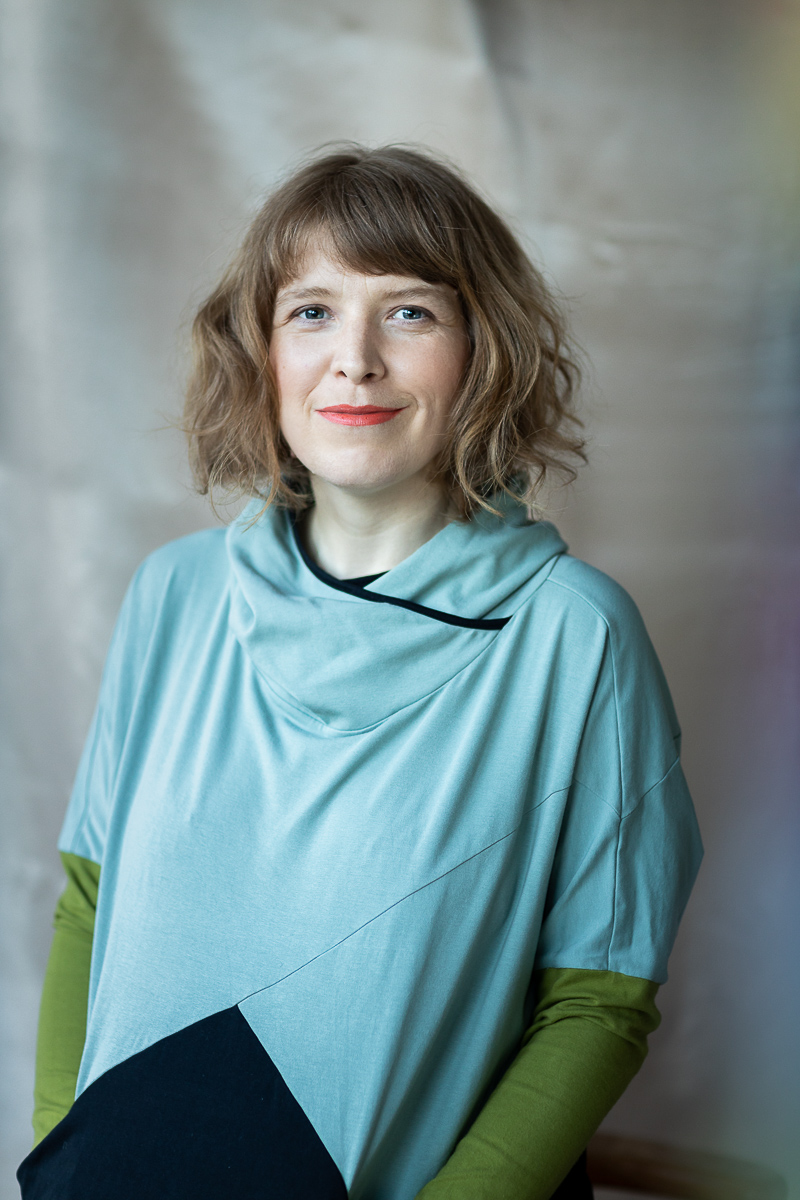
Teresa Distelberger ©Maria Noisternig, marianoi.com
Teresa Distelberger is a filmmaker and artist. Through films such as“Save the Village”and“The Future Is Better Than Its Reputation,”she focuses on positive visions of the future and stories. In her personal life, she is a co-founder of“Die Auenweide,”an alternatively funded, socio-ecological housing project in St. Andrä-Wördern.
[/av_promobox]
[av_notification title=" color='silver' border=" custom_bg='#444444' custom_font='#ffffff' size='normal' icon_select='yes' icon='ue80b' font='entypo-fontello' admin_preview_bg="]
Source: Interview with Teresa Distelberger on April 28, 2021
[/av_notification]
[av_notification title=" color='green' border=" custom_bg='#444444' custom_font='#ffffff' size='normal' icon_select='yes' icon='ue837' font='entypo-fontello' admin_preview_bg="]
Editorial article
[/av_notification]