Photo credit: Nina Werth
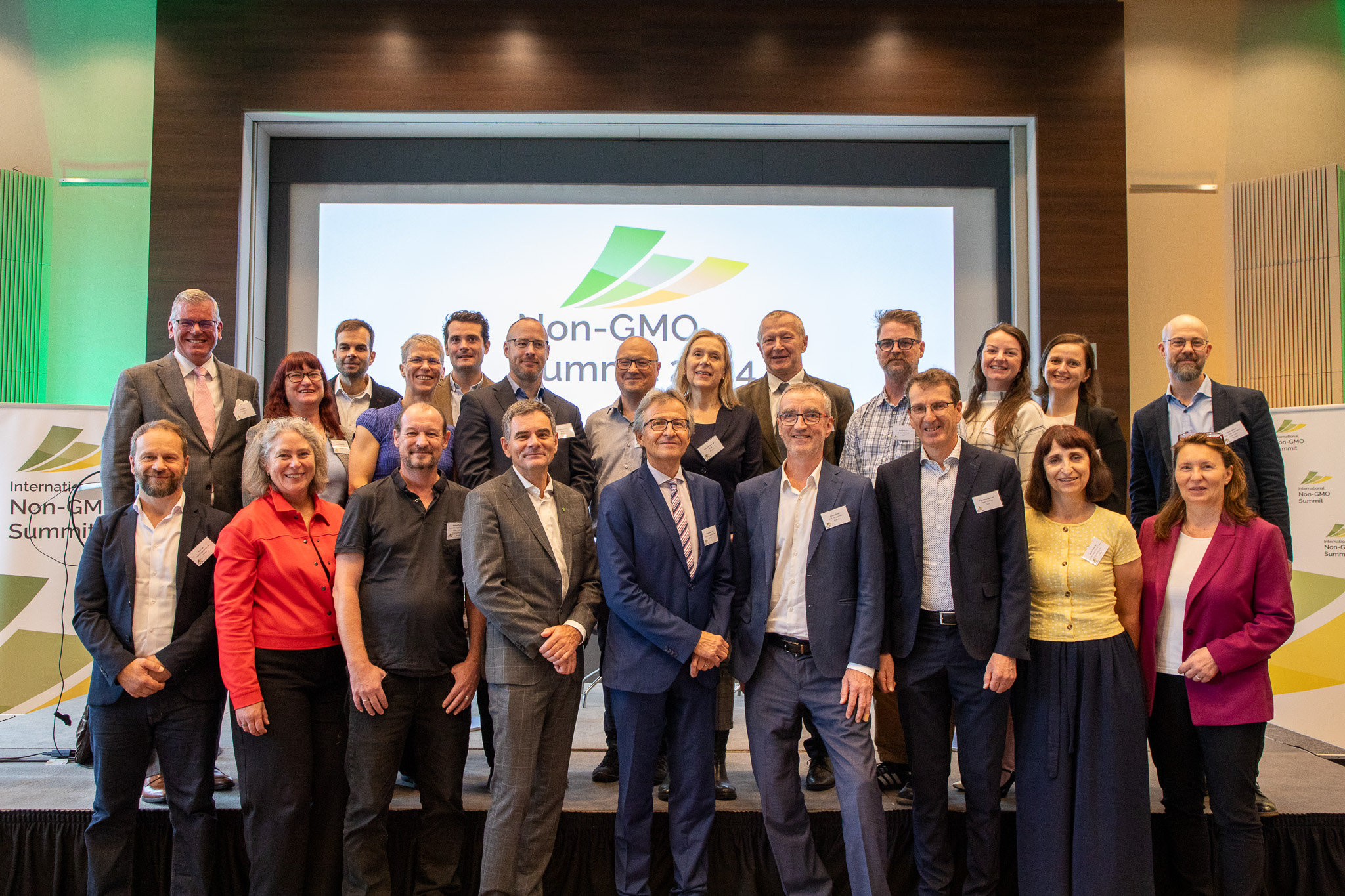
The EU is one of the last bastions to strictly regulate genetically modified organisms. Currently, external pressure is mounting, as new genetic engineering is supposedly and absolutely necessary to ensure our food supply. However, the Non-GMO Summit 2024 provided countless reasons why new genetic engineering must also remain strictly regulated.
In July 2023, the European Commission proposed extensive deregulation of organisms created using new genetic engineering (NGT). As a result, they would no longer be subject to environmental risk assessments or monitoring.
This would apply to genetically modified plants in the NGT1 category.
In theory, this would mean that in a single organism, base pairs of any length could be deleted, 15 sets of 20 base pairs could be inserted, 4 chromosomal segments could be inverted, and a gene from a related organism could be added.
Proponents of NGT argue that these are all changes that could also occur through conventional breeding or natural mutation; NGT merely speeds up the process and makes it more targeted—and thus even safer.
However, in a study published in 2024, the German Federal Agency for Nature Conservation (BfN) warns against so-called NGT1-RNAi plant applications with insecticidal effects, some of which have already been patented. New genetic engineering can genetically modify a plant’s own microRNA in such a way that, through RNAi, essential proteins in insects are deactivated, leading to their death. Incidentally, U.S. biologists Victor Ambros and Gary Ruvkun received the Nobel Prize in Medicine in 2024 for the discovery of microRNA. The BfN analyzed several NGT plants currently in development. In doing so, they encountered an NGT1 plant that uses a molecular mechanism of RNAi to produce non-browning potatoes. They also identified an NGT1 corn plant in which 20 base pairs of a microRNA gene have been modified so that consumption becomes lethal to the European corn borer via RNAi by inactivating its chitinase. This mode of action is comparable to plants modified using “traditional” genetic engineering, such as Bt plants.
These are clearly modes of action that must be subject to a risk assessment, as they could affect not only the target pest but also protected animals.
However, if NGT1 plants were deregulated, as the EU proposes, this would no longer be necessary—that would be grossly negligent! Dr. Samson Simon of the BfN therefore emphasizes that the possibility of the modification occurring naturally must not be used as a free pass for genetically modified plants.
The majority of consumers demand GMO-free food. Alexander Hissting, executive director of the Association for GMO-Free Food (VLOG), puts it succinctly: “The GMO market can only succeed if it hides from consumers.” One member of the audience even suggests that this is why the GMO industry is so desperate to pass itself off as “non-GMO.”
To meet consumers’ demand for GMO-free food, analytical methods are needed to detect new genetic engineering. An EU-funded research project called DARWIN is testing various options. The bottom line is that while this is possible, it is currently very costly and time-consuming. This raises the question: who will pay for it if the EU deregulates?
The EU is still a haven; genetically modified crops are grown only in Spain and Portugal, and the harvest volume is negligible. Many representatives from the U.S.-based Non-GMO Project attended the summit, and their remarks give pause for thought. Hans Eisenbeis described the EU as the last bastion against GMOs and urged us in no uncertain terms not to give it up. In the U.S., there is no turning back, and they must live with the consequences. As a result, they face difficulties in promoting organic and sustainable agriculture because there are such large areas of GMO cultivation. New genetic engineering poses a real threat to sustainable organic agriculture.
Just as with traditional genetic engineering, biotechnology companies promise us that new genetic engineering is safe and that it will end world hunger. And yet, these promises are already being broken. This is also supported by the findings of the BfN. NGT plants currently under development are primarily aimed at lifestyle-related (non-browning potatoes) or industry-related traits (modified starch properties). Research into stress resistance—for example, to drought, which could potentially reduce hunger—accounts for only a very small proportion.
New genetic engineering must not be deregulated! That is why LAMPERT also signed the open letter to the EU Council of Agriculture Ministerscalling for greater transparency and mandatory labeling of genetically modified organisms. The EU must remain GMO-free; truly sustainable agriculture depends on it.
The “International Non-GMO Summit” was organized by the leading trade associations in the non-GMO market: the Association for Non-GMO Foods (VLOG), ARGE Gentechnik-frei, Donau Soja, the European Non-GMO Industry Association (ENGA), and the ProTerra Foundation.
The conference was sponsored by Caramuru, Foodchain ID, Köster Marine Proteins, and Bunge.
GMOs – genetically modified organisms
GMO – genetically modified organisms
NGT – New Genetic Engineering
microRNAs are short ribonucleic acids that play an important role in the complex network of gene regulation, particularly in gene silencing
RNAi – RNA interference is a natural mechanism in the cells of organisms with a cell nucleus (eukaryotes) that serves to selectively silence genes
Bt plants: Plants into which a gene from a soil bacterium has been inserted using “traditional” genetic engineering, enabling them to produce their own insecticides