In the beginning, organic farming was still a theoretical concept that needed to be brought to life with compelling stories to inspire people. Few chose to embrace organic farming as a shared path. Today, organic farming is THE way people will feed themselves in the future. For me, there is no alternative. However, organic farming must continue to evolve and become synonymous with sustainable agriculture and food production.
Werner Lampert has been advocating for organic food production for over 30 years and has initiated and supported numerous regional agricultural projects in Austria. In nature—which fascinates him more than anything else—he champions the need for widespread regional organic farming and attributes great social responsibility to it.
What does sustainability mean to you?
Sustainability has become a buzzword everywhere, whether it’s for tractor manufacturers or in the world of speculation. It is the only way we humans can still have a future on this planet. In agriculture, the goal is to work in harmony with nature, not to fight it as if it were an enemy.
Keyword: Social and economic sustainability. This also includes treating one another with respect and managing our affairs wisely. For example, running a family business in such a way that the children are eager to carry it on.
What is organic food worth to us?
Life. We must ask ourselves, “Can we, as human beings, continue to live this way, treat food the way we do, keep raising animals in this manner, and exploit the planet?” Organic represents a systemic shift that goes beyond agriculture.
What are the criticisms of organic food?
A lot. Organic farming has always been a good alternative to conventional agriculture. It began at the turn of the century, when Rudolf Steiner established biodynamic agriculture as a vision for the future and a way of life. Later, the focus shifted to organic farming.
In the 1980s and 1990s, more and more farmers and agricultural businesses turned to organic farming as an economic model. Naturally, much of the original substance was lost in the process. But by linking organic farming with sustainability, we can return to the original “substantial” form of organic farming.
Keyword: Food sovereignty in times of multiple crises. How can we achieve this?
The war in Ukraine and climate change make it clear: we need an agricultural system that feeds people in their own regions. Food sovereignty means that people have a say in how their food is produced and processed—and in how they want to eat—right where they live. We are currently at a turning point for regional, sustainable organic agriculture.
Food is getting more and more expensive. Until now, industrialized agriculture has been churning out mass production “at all costs,” with no regard for the consequences. The general public is left to clean up the mess it creates.
BSE is a good example. For millions of years, cattle—with their ingenious four-chambered stomachs—have fed exclusively on plants. Then, driven by greed, humans began to feed them “more effectively” with animal meal. The result was that cattle literally went mad. Hundreds of thousands of animals had to be killed and disposed of. This scandal cost billions. The general public paid for it, not those responsible.
Overall, sustainably produced food would be cheaper if the environmental and social costs were factored into our food prices (keyword: true-cost accounting).
The independence of our food system versus the independence of our energy system—which is more important?
Germany, whose entire energy supply was dependent on a single country just a year ago, now says: The country has no future with gas—neither from Russia nor from the Middle East nor from the United States. Germany needs a self-sufficient energy supply.
But food is even more important than energy. Without it, there would be no life on Earth. However, we’re not talking about self-sufficiency here. We still buy our food where it’s cheapest and ship it to Europe.
Self-sufficient food production means that we must treat nature in a far more resource-efficient way than industrialized agriculture does. Currently, the EU requires an additional area of farmland outside Europe—an area the size of Germany—just for factory farming. In Brazil, the Amazon, our “green lung,” is being burned down so that we can feed our livestock.
Is the war in Ukraine being exploited?
No sooner had the shooting started in Ukraine than the fragile seeds of more sustainable agriculture, sown by the European Commission, were immediately trampled underfoot.
The agricultural lobby believes we must produce at “full capacity” in order to feed the population. Instead, it should finally acknowledge the massive damage caused by industrialized agriculture. I consider the “capitalization” of agriculture to be one of the greatest sins, because it jeopardizes food security for future generations. Food and housing simply have no place in the capital market.
The word “responsibility” is rarely discussed in the agricultural sector. Nowhere else would it be more appropriate. This is baffling, given that even the representatives of the agricultural lobby have children and grandchildren.
The ethics of responsibility hold that we need a clear understanding of what we are doing and the consequences of our actions. With this mindset, we would take the step toward a sustainable and self-sufficient food system that ensures high-quality nutrition. The energy crisis will teach us that this must be the next step.
What does ideal agriculture look like to you?
Organic farming, which is increasingly moving toward regenerative agriculture—a practice that can sequester carbon rather than emit it. This involves building up soil organic matter, practicing sustainable forestry, and restoring wetlands.
If agriculture and forestry were to build up 0.4 percent of humus in their soils each year, these areas could theoretically absorb the amount of CO2 that currently enters the atmosphere annually (4-per-thousand initiative from the 2015 UN Climate Change Conference). Bogs serve as important carbon sinks. Over the past 80 to 90 years, nearly all bog landscapes have been drained and converted for agricultural use. We must reverse this trend.
Listening to you talk about it, building up humus and restoring natural habitats don't sound like all that difficult tasks. If they have such a big impact, why aren't they being done?
We would have to move away from today’s agricultural system, take responsibility, and work in a way that conserves resources. This is no easy task. Farmers need to change their mindset, agricultural schools need to teach in a completely different way, and so on. A great deal of profit is made from the current agricultural system. The billions of dollars flowing into the chemical industry, for example, would go down the drain. Consequently, there is a strong interest in continuing as before.
Does digital agriculture have a future?
The problems in agriculture have also arisen because people have increasingly lost touch with nature. If you ask people who have a healthy relationship with their natural environment why we’re destroying everything, they’ll tell you: Our relationship with nature has broken down.
Thinking about using even more technology that distances people even further from nature is the wrong approach.
Digitalization is certainly appealing, but it’s just another version of “How can we save modern agriculture without changing a thing?” It means total dependence on industry. Farmers are reduced to mere laborers who are good for nothing else. That doesn’t lead to food security.
What can consumers still trust?
As a consumer, you’re in a very straightforward situation. Even though not everything about organic food is perfect—and there’s still a lot that needs to change and improve—you’re always on the right track when you choose organic food.
Back to the beginning: What has changed since you first started out half a century ago?
Even as a 10-year-old boy, I had a vegetable garden, berry bushes, and fruit trees that I was solely responsible for. I was fascinated by the fact that I didn’t have to use any chemical fertilizers or pesticides, yet I still had wonderful harvests.
This helped me develop a deep-seated trust in nature and in living in harmony with it. Biodynamic agriculture and its understanding of the interconnections and networks that nature creates have been a part of my life for a very long time.
As a young man, I naturally assumed that everyone else would share my fascination. Unfortunately, that didn’t happen; I suspect that 50 percent of people still don’t get the appeal of organic products.
So we still have a huge task ahead of us. Organic farming is no longer just an idea that farmers work with; it now carries the responsibility to explore every possible avenue to feed humanity in the future. Conventional agriculture will not be able to achieve this.
______________________________________________________
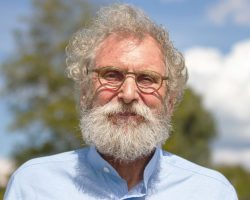
Werner Lampert
(*1946 in Vorarlberg, Austria; † 2025) is considered one of the pioneers in the field of sustainable products and their development in Europe. This organic pioneer has been deeply involved in organic farming since the 1970s. With Zurück zum Ursprung (Hofer) and Ja! Natürlich, he developed two of the most successful organic brands in the German-speaking world.