Modern greenhouses that supply the mass market are producing fewer and fewer natural products. This makes it all the more important that organic farming offers an alternative for health-conscious consumers.
How many times have I heard that:
“Fertile soil is the foundation of all life.”
“No future without soil”
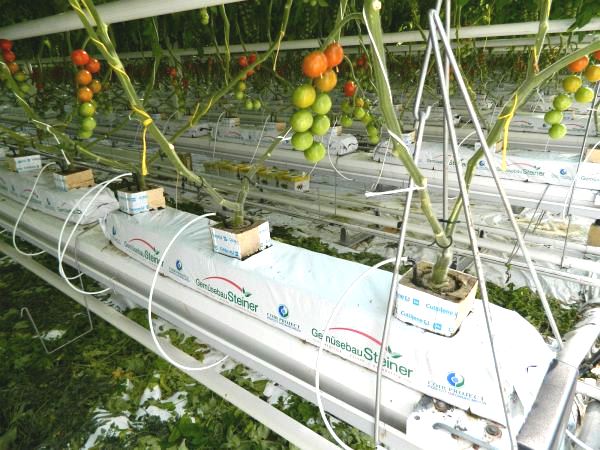
Today’s vegetable gardeners can only laugh at that! They haven’t needed soil for a long time to harvest plenty of cucumbers, tomatoes, peppers, and so on. The plants grow in a sterile medium such as rockwool, are connected to a drip irrigation system that provides them with exactly the right amount of fertilizer, and harmful insects are kept in check by beneficial insects. Pesticides are hardly ever used in modern greenhouses. That’s why many conventional vegetable growers boldly claim that their produce is“actually organic”and that it only fails to receive organic certification because the plants don’t grow in soil.
This claim is completely false, because even if the farmers don’t use pesticides at all, their produce is still far from being organic, since they use mineral fertilizers. The production of these fertilizers is very energy-intensive, and this is the main reason why conventional agriculture (including vegetable farming) has a comparatively poor carbon footprint.
Interestingly , it is also not true that organic plants must be grown in soil! The EU Organic Regulation does not explicitly prohibit soil-less cultivation. Sweden, Finland, and Denmark consider soil-less organic farming using “natural” substrates to be permissible, as reported by the European organic umbrella organization IFOAM EU in 2012. “In greenhouses, tomatoes are simply grown in substrate containers or bags that are fertilized with a nutrient solution—they are marketed as organic tomatoes,” criticizes the German organic association Naturland.
Bio-Austria informed me that there are “a few blueberry and lemon growers” in Austria who farm without soil but are still officially certified as organic. They were certified organic before the Ministry of Health (!) issued a decree (!) clearly stipulating that substrate cultivation is, in principle, not organic. Only young plants, herbs, chicory, and ornamental plants do not necessarily have to grow in soil and still remain “organic.” However, the decree does not apply to imported organic products.
The EU organic label is once again proving to be a half-hearted compromise. Those who want more must look for additional certification labels. All reputable organic farming associations require crops to be grown in the ground. However, the details and exceptions vary.
[av_gallery ids='4185,4182,4181,4184,4186' style='thumbnails' preview_size='portfolio' crop_big_preview_thumbnail='avia-gallery-big-crop-thumb' thumb_size='portfolio' columns='5' imagelink='lightbox' lazyload='avia_lazyload' admin_preview_bg="]
[av_heading heading='But what's so bad about soil-less gardening?' tag='h3' style=" size=" subheading_active=" subheading_size='15' padding='10' color=" custom_font=" admin_preview_bg="][/av_heading]
Without contact with the soil, no fertilizers or pollutants can enter the ground. A closed-loop system helps conserve water. At the end of the season, everything can be easily disinfected, so that pesticides are rarely needed. Organic gardeners, on the other hand, must, if necessary, spray the entire soil with hot steam for hours, which consumes a relatively large amount of energy. Although the rockwool used by “modern” gardeners is also energy-intensive to produce, it is not a necessity; in a large Bavarian greenhouse I visited, tomato and bell pepper plants are grown on coconut fibers.
From an environmental perspective, I see little reason to oppose high-tech, soil-free food production. If we could also “do away with” the plants themselves so that the fruits grow directly in a “test tube,” that would be even more efficient and environmentally friendly.
[av_heading heading='But do we want to eat vegetables from a test tube?' tag='h3' style=" size=" subheading_active=" subheading_size='15' padding='10' color=" custom_font=" admin_preview_bg="][/av_heading]
I’m glad that there are still foods available that are produced in a reasonably natural way. While I don’t think adverse health effects from growing crops in rockwool or coconut fiber are likely, I don’t rule them out either. Humans are still far too complex for scientists’ simulations. That means we’re still learning only through trial and error. Margarine was long considered harmless or even healthier than butter, then people suddenly noticed the effects of trans fats, which were created when the oil was hydrogenated (until manufacturers subsequently changed their processes). Therefore, I believe it is rationally justifiable to prefer foods for which the human body has been designed over millions of years: those that have grown “completely naturally” in the soil. And that should be the very least consumers can expect from organic products!
[av_promobox button='no' label='Click me' link='manually,http://' link_target="" color='theme-color' custom_bg='#444444' custom_font='#ffffff’ size=’large’ icon_select=’no’ icon=’ue800’ font=’entypo-fontello’ box_color=“ box_custom_font=’#ffffff’ box_custom_bg=’#444444’ box_custom_border=’#333333’ admin_preview_bg=“]
 About the author, Mario Sedlak
Born in Vienna in 1975; graduated with a degree in Applied Mathematics from the Vienna University of Technology in 2000; has been a technical expert in the electricity industry since 2008
[/av_promobox]