Johanna Kirsch and Katharina Lampert grew up with their parents’ 1968 ideals: colorful wool sweaters, protests, and the idea of changing the world. What remained a mystery back then—amidst the cravings for cheeseburgers or Monchhichis—is now increasingly taking shape in their own minds: a house in the countryside, growing their own vegetables again, canning food, slowing down—in other words, dropping out as a romantic fantasy. Their parents’ question, “How do we want to live?” quietly became their own, and the documentary “Von hier aus” became a search for the answer.
[av_heading heading='Dawn.' tag='h3' style=" size=" subheading_active=" subheading_size='15' padding='10' color=" custom_font=" admin_preview_bg="][/av_heading]
A rooster is slaughtered, plucked by everyone together, and the child on the balcony is told that this is the only way they’ll be able to eat it later. Hanging on the wall of the Wieserhoisl farm below is a banner that reads: “No human is illegal.” Eight years ago, a small group of people leased the farm in Western Styria to run it as a collective and live there according to their own ideals. So not only do they grow fruits and vegetables, shear sheep, and produce their own meat, but they also convert construction trailers into living quarters, exchange seeds from their own garden during educational events, and continually explore the boundaries of individual and communal life.
[av_heading heading='Sunrise.' tag='h3' style=" size=" subheading_active=" subheading_size='15' padding='10' color=" custom_font=" admin_preview_bg="][/av_heading]
Ute sits on a stone wall, singing one of her own songs with an oriental flair. She has been living in southwestern Portugal for 17 years, after finding even the “Swabian diaspora” far too loud and far too crowded. “I don’t know what it’s all about, but I just need to take a break right now,” says the shaman, who critically examines the world and herself every day. Ute believes it’s a lie that work and money go hand in hand or that there are only two genders. The water comes from the well, a few vegetables from her own garden, and she bakes her own bread, but Ute is anything but out of touch with the world: A car is more practical for shopping than a donkey, and with USB internet on her MacBook, she saves herself a 40-kilometer trip just to check a new email.
[av_heading heading='Sunshine.' tag='h3' style=" size=" subheading_active=" subheading_size='15' padding='10' color=" custom_font=" admin_preview_bg="][/av_heading]
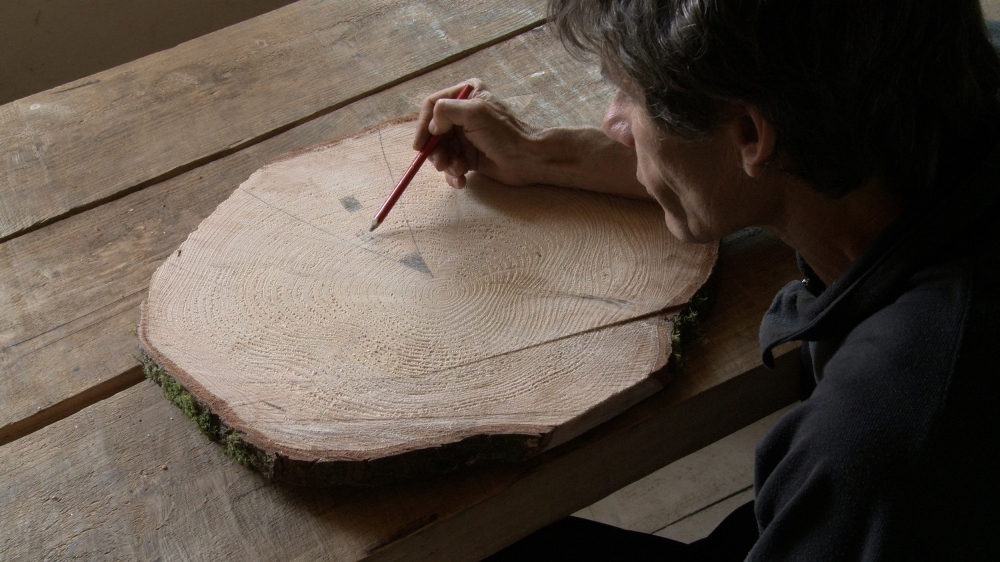
Wim is sharpening his chainsaw, ready to cut down a tree. He counts the rings—it must have been about 50 years old, meaning it was likely planted around the time of the ’68 ideals. For 25 years, Wim worked as an architect, and in addition to designing houses and schools, he focused on public space—a physical space where people can do as they please—which has become almost impossible to find. Wim manages the Montavoix area near Saint-Claude, France, where he lives in a simple but cozy cabin without electricity or running water. With the help of students and young people, he aims to use architectural interventions to create a publicly accessible space for everyone there. Wim sees himself merely as an initiator in this process.
For about a year, Johanna Kirsch and Katharina Lampert searched for people with alternative lifestyles, many of whom they met in person before deciding on the three protagonists. The residents of Wieserhois, Ute and Wim—they had all taken a major step toward living according to their own convictions and aspirations, each choosing a different way of life in their own unique way. Their utopias became the specific places the directors visited as examples, immersing themselves in the protagonists’ daily lives to seek answers to the questions: “What is it like, in practice, to live according to one’s desires?” and further: “How can a film be made under these conditions?” The result is a very quiet film in which, alongside the narrative passages, static landscape shots slow down the action and create space for one’s own thoughts.
[av_gallery ids=’4170,4169,4168’ style=’thumbnails’ preview_size=’portfolio’ crop_big_preview_thumbnail=’avia-gallery-big-crop-thumb’ thumb_size=’portfolio’ columns=’3’ imagelink=’lightbox’ lazyload=’avia_lazyload’ admin_preview_bg=“]
[av_heading heading='Initial Question and a Very Personal Production' tag='h3' style=" size=" subheading_active=" subheading_size='15' padding='10' color=" custom_font=" admin_preview_bg="][/av_heading]
Not only is the directors’ initial question a very personal one, but so is their approach to the very nature of documentary filmmaking itself. Rather than observing people seemingly objectively from the outside, both the directors and the process of creating the images are an essential part of the story. By adjusting the camera, giving a direction, answering a counter-question from Ute about their working methods, or participating in the farmwork themselves, the filmmakers move away from an investigative, detached perspective and turn “Von hier aus” into a personal yet collective journey of discovery.
At the heart of the journey lie the protagonists’ inner journeys—for these are highly personal decisions, a critical examination of boundaries and worldviews; far removed from the dogmatic rigidity that often stands in the way of action in a counterproductive manner. “You have to see what really gets to you,” Ute would say. Because the reality—emptying a composting toilet, melting snow for tea, or butchering a lamb—is often not as romantic as the fantasy of an idyllic life as a dropout. The break in each individual’s life story, often perceived as radical, turns out in the course of the exploration to be more of a logical step emerging in small stages and has much more to do with “diving deeper” (Ute) rather than dropping out—with reflection and conscious living. And as unique as the three life models of those portrayed in “Von hier aus” may be, they should be understood as examples of a larger whole: namely, the universal idea of breaking free from certain structures and moving to where it suits one best.
[av_promobox button='no' label='Click me' link='manually,http://' link_target="" color='theme-color' custom_bg='#444444' custom_font='#ffffff’ size=’large’ icon_select=’no’ icon=’ue800’ font=’entypo-fontello’ box_color=“ box_custom_font=’#ffffff’ box_custom_bg=’#444444’ box_custom_border=’#333333’ admin_preview_bg=“]
Text: Mirjam Bromundt
[/av_promobox]