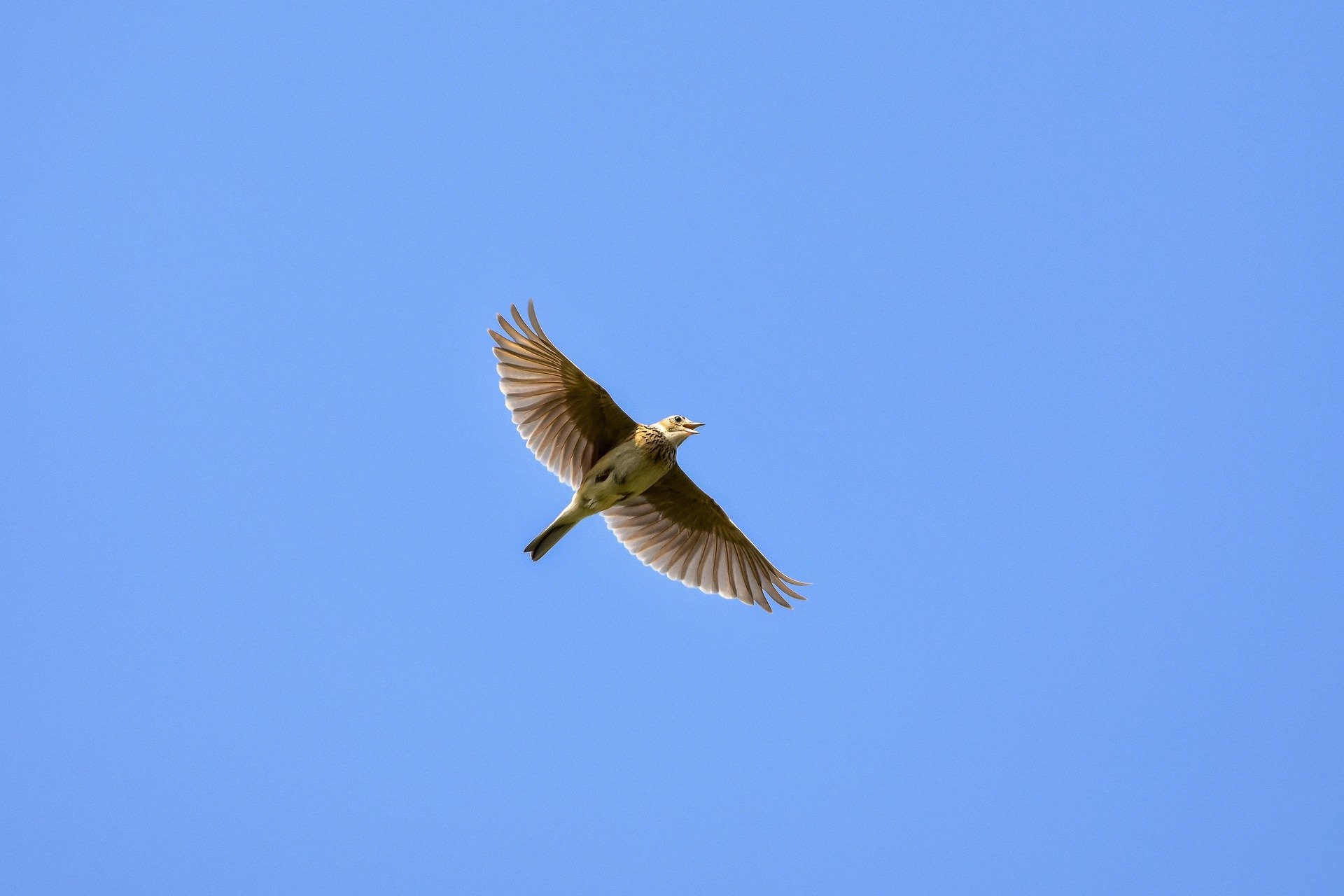
The battle over fallow land has flared up in full force due to the Ukraine crisis. In Austria, since April 2022, approximately 9,000 hectares of fallow land have been permitted to be used “fully” for agricultural purposes again, including the use of pesticides and other chemicals. The pros and cons have been widely covered in the media. But one perspective is missing: that of the feathered creatures affected. We invite the skylark to join the conversation.
(To improve the readability of the text, certain terms in the body of the text have been translated into plain language; the original text appears in italics within parentheses.)
Interviewer: Isn't the "real estate crisis" being blown out of proportion by the media?
Feldlerche: Many people (fellow beings) aren't aware of how much the crisis has escalated. How old are you? This section of text is particularly important, which is why it's highlighted in color. In this case, green.
Interviewer: 42 years old.
Skylark: Then you know what I’m talking about. Over the past 20 years, half of all skylarks in Austria have disappeared. Every other one! And why? Homes (nesting sites) that somehow meet our needs are almost impossible to find here in Austria. But even the shelves in the stores (areas with enough insects, snails, and worms) are often woefully understaffed.
I’m not exactly the type to stay at luxury hotels (a finicky tree-nesting bird); I’m more of a camper (a ground-nesting bird) among birds. So I’m pretty easy to please. A little bit of fallow land, and that’s all I need.
Interviewer: Isn't that an understatement? You guys are kind of "unique," aren't you?
I really don't understand what the problem is. Okay, so I lay my eggs on the ground. That might not have been the smartest decision in the history of evolution, but for a long time, there was no way to foresee that you guys would ever invent machines. Now that's the way it is, and we'll just have to make do.
I just have this thing for insects, snails, and worms. They’re everywhere on fallow land. And this is the only place where I can still breed undisturbed today.
And honestly: am I really the only one who benefits from fallow land? No. It stores a lot of water, which we all need, after all. It also stores a lot ofCO2, which is a definite plus in the midst of the climate crisis.
And I don't think I need to tell you that without fertile soil, we're all—whether lark or human—in big trouble.
Interviewer: You accepted our interview request without hesitation. Why?
Skylark: I’ve been watching this whole situation unfold for quite some time now, with a growing sense of unease—and not just because I’m hungry. And I can see that you yourselves are somehow torn. On the one hand, you shower me with praise and name me Bird of the Year (2019). And then there was your willingness to compromise to help alleviate our housing crisis (lack of nesting sites).
Interviewer: Are you referring to the EU-wide regulation that 4 percent of agricultural land must be set aside as fallow land?
Feldlerche: Exactly, that’s what I mean. But, without wanting to attack you personally, history has shown that good intentions can quickly be thrown out the window. That’s exactly what happened a few months ago.
We’ll be back from Africa in April and moving into an apartment (a nesting site on fallow land) that we’d already moved into last year. So we lay our eggs. We brood, brood, brood. The little ones hatch. And then suddenly a huge plow rolls in. I don’t need to tell you what that meant for us.
Interviewer: I suppose you had the misfortune of nesting on one of the “biodiversity plots” that have been allowed to be used “to their full capacity” again since April?
Feldlerche: That’s exactly how it was. It’s really frustrating. We just don’t know what we can count on anymore. You say you have to secure your own food supply. But honestly, I can’t understand your concerns.
You throw away one out of every three food items. You don’t eat 60 percent of your grain yourselves; instead, you feed it to animals. If you were to eat just a portion of it yourselves, you could be far more generous toward us and all the other inhabitants of the fallow lands.
It’s not exactly rocket science to secure your food supply: throw less food away, eat more of the grains and soybeans you grow yourself, and the squabbling over fallow land could be a thing of the past.
I know the “eat less meat” debate is a tiresome one. I follow a strictly seasonal and flexitarian diet myself; I eat more meat (insects, snails, and worms) during the breeding season, and hardly any in the winter. It’s all a matter of perspective. And ultimately, it’s also a matter of survival.
Interviewer: What helps you keep your head up and stay hopeful in times like these?
Skylark: I cannot and will not imagine a world where our song no longer echoes across your fields. Those of you who know and appreciate us are absolutely crazy about our song. The British composer Vaughan Williams even translated our song into human music —with great success. I get goosebumps when I listen to this tribute to us. It gives me hope.
And it shows me that many of you really care about us. Perhaps it’s also because you realize that we are all interdependent. After all, what would you be without the free services (note: ecosystem services —see box) that we and our colleagues (plants, animals, and others) provide for you?
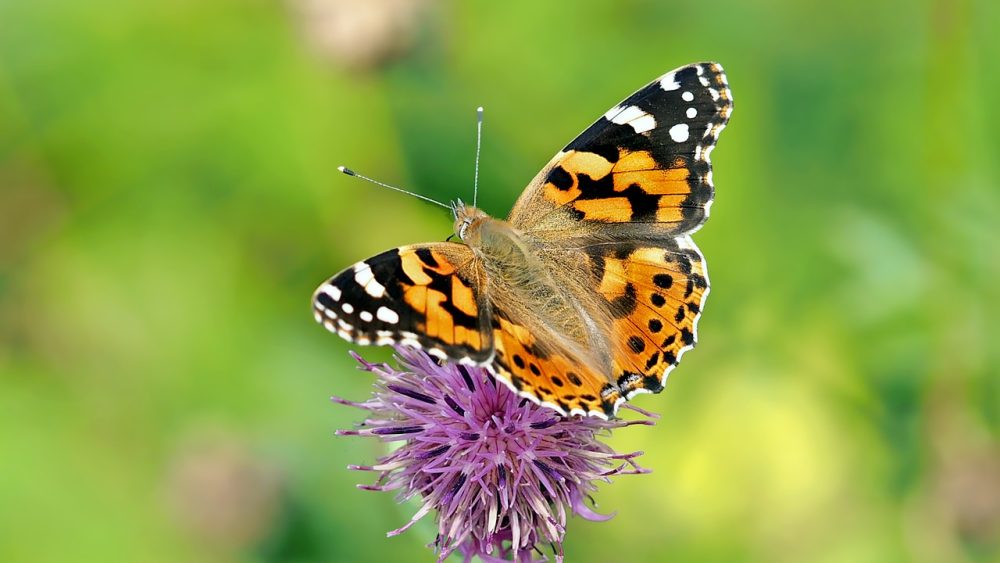
INFO: Ecosystem services refer to the wide range of benefits that humans derive from ecosystems or individual species. Examples include the pollination of fruits and vegetables by bumblebees, wild bees, and butterflies; the natural purification of water; and climate regulation. Recreation and aesthetic enjoyment are also included.
Interviewer: Is there anything concrete that gives you hope for a better future?
Yes, when I read a study onthe “recovery of farmland bird populations,”for example, it’s balm for my soul. Scientists have discovered how our populations could recover significantly—and, if you will, even nearly double: To achieve this, we would need 10 percent fallow land and fewer intensive crops, such as rapeseed and corn. That means no more corn in the fields than was grown around the turn of the millennium. That would be a small step for humanity, but a giant leap for us.
Interviewer: Is there anything else you’d like to share with our readers?
Sometimes I have a strange dream at night: I rise above a field while singing—you know, like a helicopter, chirping as I soar straight up. Then I see a mother with a little boy below me. The boy points at me and says, “Mommy, what kind of strange drone is that? Can it chirp?” And then I always wake up. That’s my personal nightmare. I don’t want it to come to that. I don’t want us to drift even further apart. After all, for thousands of years we’ve been hatching in fields that you’ve laboriously cultivated. We were the soundtrack to your hard work, until you gradually disappeared into your homes and factories during the Industrial Revolution.
I think we could rekindle our old relationship. And throw ourselves wholeheartedly into the cause of a sustainable agricultural revolution: you’ll be well fed, and we’ll keep singing. Or, to put it in aeronautical terms: a soaring flight instead of a nosedive for all of us.
Sources & Further Reading