Since the start of the war in Ukraine, organic products have come under increasing pressure. Due to inflation and rising food prices, the cheaper, conventional product often ends up in shoppers’ carts. Some claim that sustainable agriculture isn’t crisis-proof because it produces overly expensive products and yields too little. But does that math add up? “True-cost accounting” adds up the social and environmental costs caused by food production. It requires some adjustments to the receipt.
Organic food often costs more than conventional food because organic farming usually requires more labor on the part of farmers, and yields are generally lower than in conventional agriculture.
What is missing from this calculation, however, are the costs associated with food production resulting from environmental degradation and health hazards. These “hidden” costs (also known as “true” or “consequential” costs) do not appear in the product price.
We have to pay for them anyway: in the form of taxes, health insurance premiums, or other fees. But not all of that comes out of our own pockets. Often, nature or soil health ends up footing the bill. It’s not uncommon for people in the Global South to bear the brunt of it. Or future generations. Food producers would have to significantly raise the prices of their products if they had to pay for the damage caused by their production methods themselves. Conventional products would then be much more expensive.
Example – Follow-up Costs in Agriculture
When farmworkers spray pesticides in a field, they put a strain on their own health and the healthcare system. The Food and Agriculture Organization (FAO) estimates that follow-up healthcare costs amount to 3,000 euros per farmworker over a 10-year period.
The pesticides end up in the groundwater, and the water utilities foot the bill. They spend billions of euros every year on drinking water treatment to remove pesticide residues. Yet the damage actually originates in the agricultural sector.
The EU’s “Common Agricultural Policy” provides billions in public funds each year to support our food producers. The EU currently continues to support largely unsustainable farming methods. It is thus partly responsible for the damage caused and must subsequently repair it with even more public funds.
The United Nations, theSustainable Food Trust, and a growing number of companies and universities have begun to calculate the hidden costs associated with certain foods. Calculating these costs is no simple task. The“True Cost”initiative is developing methods and standards designed to make it easier for companies to calculate their “true costs” (see guide).
The missing items on the receipt
Researchers at the University of Augsburg have calculated the additional costs resulting from greenhouse gas emissions, nitrogen pollution, and energy consumption, and have factored these into German retail prices from 2016.
Nitrogen inputs from fertilizers have the greatest impact, followed by resource-intensive feed crop production, as well as animal metabolism and livestock farming.
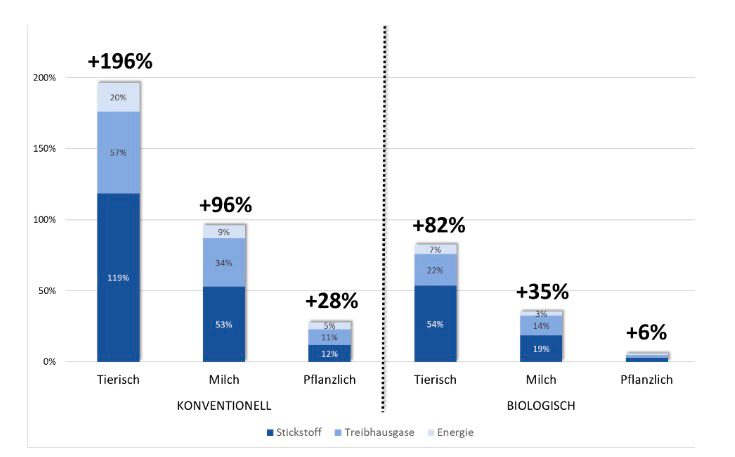
According to their calculations, conventional animal products would have to be three times as expensive! And that’s even though this calculation still leaves out certain factors (e.g., seasonality and regionality, pesticide residues, and loss of soil quality). For organic plant-based products, however, the price premium is only 6 percent. To be fair, it must be said: Since organic products are generally more expensive, the price premiums are naturally lower as well. But even so, when we take all costs into account, organic products are significantly cheaper for us as a society than conventional ones.
Math Problem
Take a look at your last receipt. Choose 6 items from each of the categories shown in the chart and calculate the markups as percentages using the chart. Add them to the amount you paid. Would this change your purchasing decision?
The price of a good is determined by supply and demand. The lower the price of a good, the greater the demand for it and the more of it is sold.
More than 70 percent of people choose the cheaper option when shopping. However, this reality does not preclude the true-cost approach. To steer production toward sustainable farming methods, pricing in the social and environmental costs of production would be an ingenious policy tool. Furthermore, speculation in food commodities on the stock market and the resulting price fluctuations must be scrutinized.
Some banks are already leading the way: they are making targeted investments in environmentally and socially responsible companies, including organic farmers. Social and environmental costs are included in companies’ balance sheets and also factored into creditworthiness assessments.
Suppose the EU designs its agricultural subsidy system according to the principle : “Those who cause environmental damage must pay for it. Those who reduce it will be rewarded.”
Taxes onCO2 emissions and nitrogen use are conceivable, and they should be imposed at the beginning of the value chain. Farmers, fertilizer and seed producers, energy suppliers, and processors would bear the costs of the environmental damage they cause. Consumers and society as a whole would not be burdened.
Tax revenues would be returned directly to producers: the more sustainably they operate, the higher their income from subsidies. The EU would specifically fund those promising farming methods that generate fewer follow-up costs.
Example – Sustainable Farming
Agroforestry systems are areas used for both forestry and agriculture: trees are combined with crops such as wheat. In other places, forest land is also used as pasture for livestock. Among other benefits, agroforestry systems increase biodiversity, promote soil conservation and carbon sequestration, improve animal welfare, and provide multiple sources of income for farms.
For imported products that do not reflect their “true” price, a “compensatory levy” could be paid upon import into the EU to ensure that domestic farmers remain competitive. With regard to one of the cost factors—namely, greenhouse gas emissions—the Carbon Border Tax will begin a gradual transition toward cost transparency starting in 2023.
True-cost accounting would significantly strengthen businesses that operate sustainably. For other businesses, it would serve as an incentive to prioritize sustainability as well.
Example: Ireland
In the Irish region known as“The Burren,” farmers combine the management and conservation of their grasslands and heathlands. Traditional extensive grazing remains attractive to farmers because measures to protect the landscape and ensure good water management are partially funded. They also receive money for successful implementation—that is, for every visible result in nature. Since the start of the funding program, they have been able to reduce soil erosion and protect water resources.
Example: UK
The United Kingdom is focusing on greater nature conservation with its “post-Brexit” agricultural subsidy system. Farmers receive payments for soil improvement, reducing pesticide use, reforestation, etc. Although the new subsidy system has also been criticized, it is a step in the right direction. The EU can learn from this.
There is no question that food must remain affordable for the poorer segments of the population. The overall outcome of “true pricing” is positive. If true pricing were a geopolitical reality, we as a society would have to spend less money on food overall.
Sustainable production would become affordable through the right subsidies, and consequently, so would the products themselves. The prices of organic and conventional products would continue to converge. Demand for organic and plant-based products would rise. Since meat, including hidden costs, would be significantly more expensive, meat consumption would decline. A shift toward a predominantly plant-based diet would result in immense reductions in greenhouse gas emissions.
Due to the current environmental impact of agriculture, a social divide has emerged between farmers—who are seen as climate offenders—and environmentally conscious consumers. This divide could be bridged. To help consumers make informed purchasing decisions, food products could, for example, be labeled to indicate the type and severity of the environmental damage they cause.
It is better to prevent environmental damage from the outset than to clean up and pay for the damage afterward. After all, it is not uncommon for damage to ecosystems to take centuries to recover.
So if you really add it all up, one thing becomes crystal clear: it’s not that sustainable goods are too expensive, but that conventional ones are too cheap!