
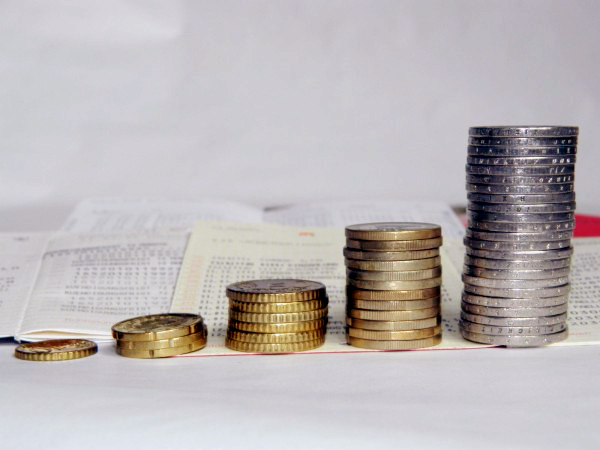
For many, interest rates are the root of all evil: they drive debtors into ruin, redistribute wealth to the wrong people, and create a constant pressure for economic growth—a view I, however, dispute.
Historically speaking, people rarely became wealthy through the returns on savings accounts or similar fixed-interest, virtually risk-free investments. Many critics of the system, on the other hand, calculate how the effect of compound interest allows ever-larger fortunes to be accumulated at an ever-faster rate.
If interest continues to accrue uninterrupted, 100 euros will eventually turn into millions, then billions, and finally into absurdly large sums, at which point it becomes painfully obvious that the interest-based system cannot function in the long run—in other words, it is not sustainable.
However, at an interest rate of 2% per year, it would take 466 years for 100 euros to grow into a million, and it would take another 348 years before the descendants of the person who opened the savings account became billionaires.
The key factor, however, is something that is often overlooked in such calculations: inflation—money is constantly losing value! Let’s assume that the central bank succeeds in keeping inflation close to its target of 2% per year. In that case, while the heirs will indeed be millionaires in 466 years, that million won’t buy them any more than 100 euros would buy the investor today. In the year 2479, 1 liter of organic milk will cost 11,000 euros, lunch at a tavern 100,000 euros, and an annual pass for the Vienna public transit system 3.65 million euros.
This thought experiment is intended to show that interest rates that merely offset the inflation rate are only apparent returns and can therefore be paid indefinitely. The additional money comes from the central bank, which controls inflation through the money supply.
Significantly higher returns can be achieved through investments such as stocks. Over the past few decades, returns have averaged around 10% per year —provided you were able to weather the occasional sharp fluctuations in value.
10% per year is significantly higher than economic and money supply growth. If returns were to remain at 10% per year indefinitely, there might eventually be no real assets or money left to meet the demands of increasingly wealthy shareholders. The system would collapse, just as many critics of interest rates and capitalism predict.
But what would actually happen is something else: as the surplus of investment capital grows, returns decline. After all, no one is obligated to go into debt just so that the wealthy can earn their interest. Companies only raise capital if they can invest it in such a way that they can repay the money plus interest and still have a profit left over.
This surplus of investment capital already exists today! Economist Gunther Tichy blames it for the great financial crisis of 2008. It was not (only) the greed of bankers and investors that brought our financial system to the brink of collapse, but the pursuit of returns that cannot be generated in a legitimate manner, because there is already more than enough free money in the world for legitimate investments.
Even if no one wanted to take out a loan anymore, our interest rate system would not collapse: savings could then be deposited with the central bank. The central bank can credit interest “out of thin air.” This results in the desired inflation.
No matter how you look at it, I don't see any way that interest rates could be blamed for our unsustainable lifestyle and economic practices.
[av_promobox button='no' label='Click me' link='manually,http://' link_target="" color='theme-color' custom_bg='#444444' custom_font='#ffffff’ size=’large’ icon_select=’no’ icon=’ue800’ font=’entypo-fontello’ box_color=“ box_custom_font=’#ffffff’ box_custom_bg=’#444444’ box_custom_border=’#333333’ admin_preview_bg=“]
 About the author, Mario Sedlak
Born in Vienna in 1975; graduated with a degree in Applied Mathematics from the Vienna University of Technology in 2000; has been a technical expert in the electricity industry since 2008
[/av_promobox]