“Every human being is born free. Freedom is awesome (Austrian slang for ‘great’).”
That’s how Hannes Androsch recently summed up what is, for us, arguably the most self-evident achievement of the modern age in an interview. But what if the perceived boundlessness of our freedom causes other, essential things to become rather “un-cool”?
As a species, we consume 60% more globally than our planet can provide in resources each year. If we Central Europeans were to set the standard for the entire human race in terms of lifestyle, we would need to spread out across three Earths to have enough resources. It is becoming increasingly clear that, in the long run, we cannot continue to exceed planetary boundaries in this way. Against the backdrop of the climate crisis, species extinction, and other consequences now being presented to us, a sort of “consumption hangover” is slowly setting in.
A sense of proportion is therefore needed to live within the bounds of what is possible. But (where) does that leave prosperity? And can life within these defined limits still feel self-determined, worth living, and free? Due to the pandemic, many people have declared the word “restrictions” their personal “word of the year to avoid.” These are difficult times to bring up arguments about the finiteness of our planet. Challenge accepted:
[av_heading heading='Guidelines for the Future' tag='h3' style="" size="" subheading_active="" subheading_size='15' padding='10' color="" custom_font="" admin_preview_bg=""][/av_heading]
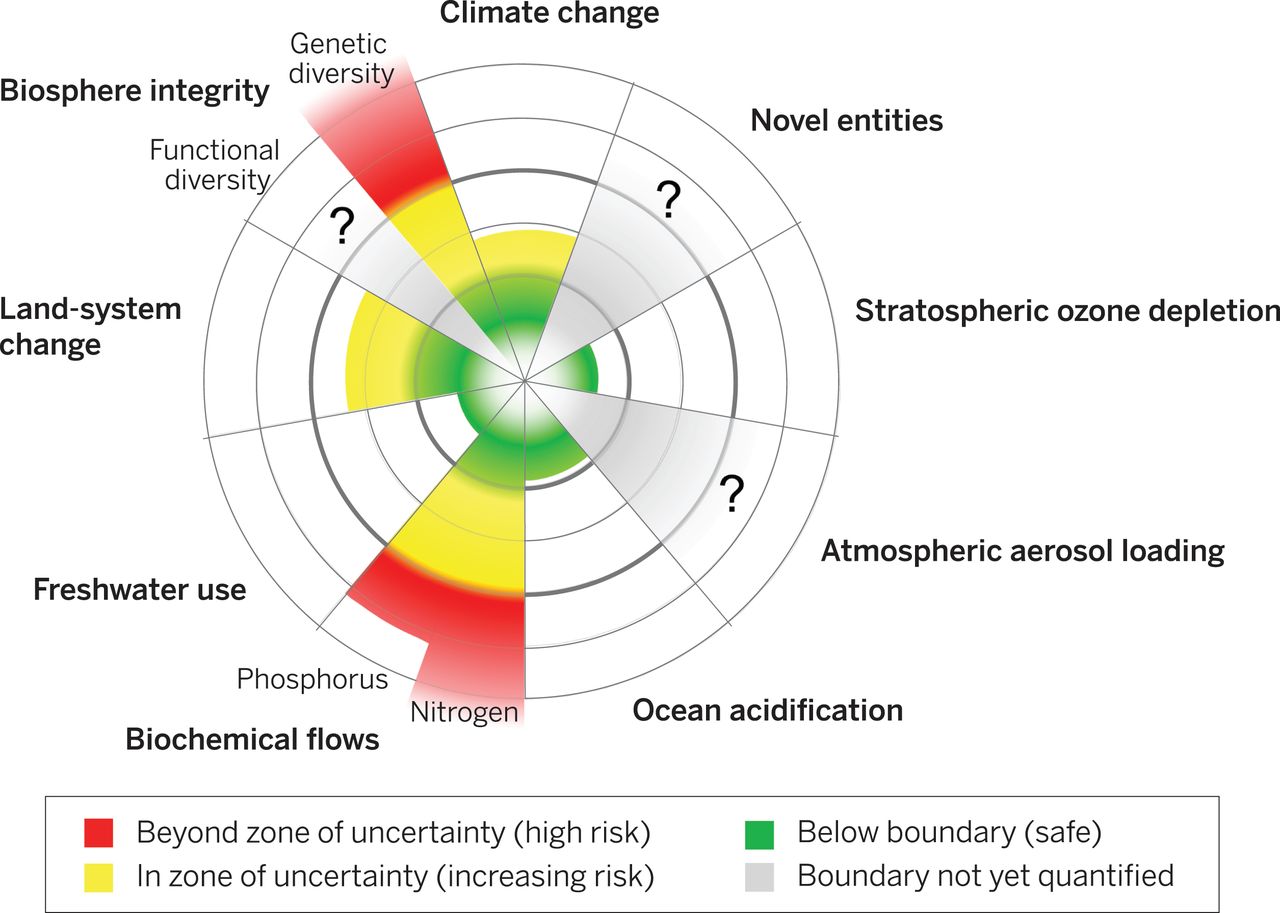
Together with his colleague Will Steffen, the renowned scientist Johan Rockström has mapped out this framework using the concept of“planetary boundaries.” It highlights the areas where our “extraction” has already significantly exceeded limits, and where we are still within safe limits (see figure). The current assessment is not encouraging: in the areas of biodiversity (species extinction) and the nitrogen and phosphorus cycles, the limits have already been massively exceeded. With uncertain consequences.
And yet the approach provides very valuable guidance: it pinpoints our scope for action. It shows what the framework—the “safe operating space for humanity”—looks like. If we want to remain guests on this planet, the freedom of the future will be entirely contained within this framework.
Our current, glaring overshoots have a great deal to do with how we manage our land and, consequently, what we eat. Against this backdrop, it’s no surprise that Rockström has taken to the stove himself and is calling on people to save the world through cooking. His cookbook, *Eat Good: A Cookbook That Changes the World*, openly declares this mission.
[av_heading heading='Freedom in a Donut?' tag='h3' style=" size=" subheading_active=" subheading_size='15' padding='10' color=" custom_font=" admin_preview_bg="][/av_heading]
Cooking alone, of course, won’t be enough. We also need sweeping changes to political and economic systems. If economist Kate Raworth were the “chef de cuisine” of the economy, her recipe would be the doughnut—primarily because of its shape. In her view, this circle with a hole is the ideal representation of a sustainable economic system. The dough ring would be the framework within which a good life can flourish. If an area moves toward the “hole,” it signifies scarcity. If one moves beyond the doughnut’s outer edge, overconsumption occurs.
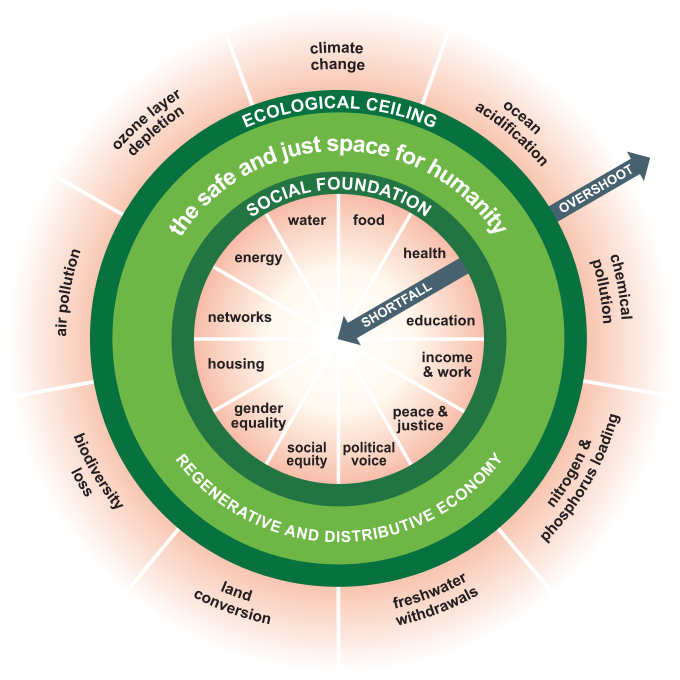
In seven steps, Raworth gives the 21st-century economy a regenerative, distribution-oriented design. And she links this economic transformation to the hope of bringing human flourishing into harmony with nature.
The city of Amsterdam is taking concrete action on the “Doughnut” concept as part of its COVID-19-driven economic recovery: It is no longer relying on the old, crisis-prone model, but is restructuring Amsterdam’s economy according to the principles of the doughnut economy. As a result, for example, the massive housing shortage in Amsterdam is now to be addressed with eco-friendly new buildings (e.g., wooden structures) that do not exceed the ‘doughnut’ in terms of climate impact and resource use.
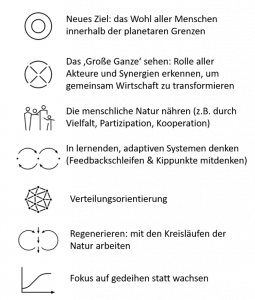
The key to the donut model is that those who value freedom don’t have to fear losing it. Outdated, questionable freedoms (such as overconsumption, food waste, etc.) are being replaced by new, more sustainable freedoms and models, rendering them obsolete with relatively little pain.
[av_heading heading='Outlook' tag='h3' style=" size=" subheading_active=" subheading_size='15' padding='10' color=" custom_font=" admin_preview_bg="][/av_heading]
Of course, we’d love to invite an ambassador from the future right now to find out what this “new freedom” really feels like, all within reason. If he were standing in front of me, I’d be more than happy to ask him whether, “within reason,” we’ve gotten better at distributing resources more fairly? Whether a good life for everyone (worldwide) now matters more than maximizing profits? Whether we can once again casually chat with children about the future, and whether phrases like “You can look forward to what awaits you” seem appropriate again? Whether it isn’t also extremely liberating to be able to look to the future with complete optimism?
Perhaps the ambassador from the future would smile mysteriously at this point. Perhaps he would slip me a fortune cookie as a parting gift and murmur: “Give this a try.” I’d hastily crack open the cookie and, likely bewildered, gaze at the three simple yet incredibly future-oriented ingredients: efficiency, resilience, sufficiency (see box below). Are these the magic words for enjoying a life of freedom despite our planet’s finite nature? That’s up to us. Every single day.
[av_promobox button='no' heading='Three Ingredients That Are Changing Society' admin_preview_bg="]
Three ingredients that are changing the world
Efficiency: Use resources as sparingly as possible and, where possible, recycle them
Resilience: prioritizing social, economic, and environmental resilience (to be able to cope with the unexpected—such as a pandemic)
Sufficiency: “What is enough is never too little” (Heini Staudinger). Saying goodbye to “excess” in our society (keywords: food waste, overconsumption, hypermobility)
[/av_promobox]
[av_promobox button='no' label='Click me' link='manually,http://' link_target="" color='theme-color' custom_bg='#444444' custom_font='#ffffff’ size=’large’ icon_select=’no’ icon=’ue800’ font=’entypo-fontello’ box_color=“ box_custom_font=’#ffffff’ box_custom_bg=’#444444’ box_custom_border=’#333333’ admin_preview_bg=“]
 About the Author
Dr. Sybille Chiari is a member of the editorial team for “Nachhaltigkeit. Neu denken” and has been engaged in sustainability and climate communication for many years—both through research and writing. She is part of the Scientists for Future movement and chairwoman of the Bele Co-Housing association (a communal housing project featuring organic, regenerative agriculture ; www.belehof.at).
[/av_promobox]