
The success story of humankind went hand in hand with the end of the last ice age and the emergence of a new, stable, and warm climate. Without our influence, this stability would likely have persisted for many millennia to come. Yet it seems that, through our careless use of resources, we are bringing an end to humanity’s prosperity.
Despite all our destructive actions, we have managed to turn things around every single time. Regulatory forces—such as scientists, thought leaders, and influential figures—have repeatedly reined us in.
Let us introduce you to the “boundaries” that are practically common knowledge in sustainability circles: the nine planetary boundaries.
[av_promobox button='no' label='Click me' link='manually,http://' link_target="" color='theme-color' custom_bg='#444444' custom_font='#ffffff’ size=’large’ icon_select=’no’ icon=’ue800’ font=’entypo-fontello’ box_color=“ box_custom_font=’#ffffff’ box_custom_bg=’#444444’ box_custom_border=’#333333’ admin_preview_bg=“]
In 2009, a 28-member research team from the Stockholm Resilience Centre, led by renowned resilience researcher Johan Rockström, published “A Safe Operating Space forHumanity.” This concept of planetary boundaries—or ecological limits—was updated in 2015. They defined nine thresholds, the crossing of which would result in unacceptable changes to the Earth and lead to unpredictable new living conditions.
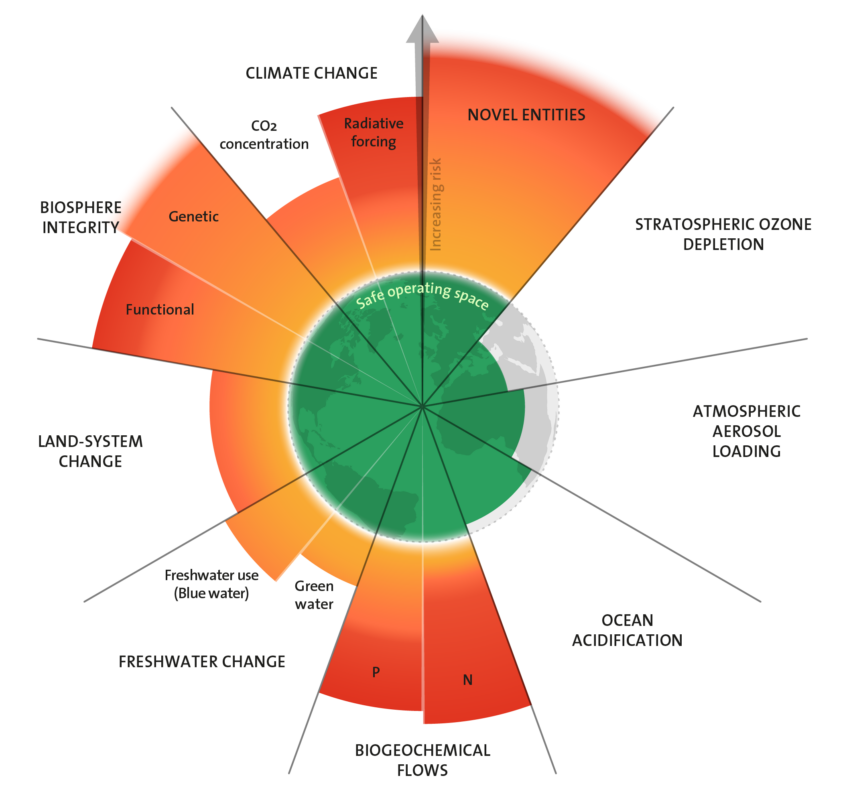
Climate change, the integrity of the biosphere, biogeochemical cycles, land-use change, chemical pollution, freshwater use
Atmospheric aerosol pollution
Ocean acidification, stratospheric ozone depletion
[/av_promobox]
Scientists view climate change and biodiversity as the most critical planetary boundaries, as they are of fundamental importance to our Earth system and are essential to the survival of humanity.
The 350 ppmCO2 threshold for climate change has already been significantly exceeded (403 ppm in November 2017). The loss of ice sheets and glaciers, which previously reflected sunlight back into space, is irreversible; sea levels will rise and our climate will become warmer. The integrity of the biosphere is also no longer guaranteed. The rate of species extinction is already 100 to 1,000 times higher than what would be expected naturally.
Humanity has interfered too much with the nitrogen and phosphorus cycles through industry and agriculture. Both substances are essential for plant growth and are applied to fields in excessive amounts in the form of fertilizer. Plants cannot absorb these quantities, causing the substances to end up in waterways, the air, and ecosystems.
Forests, grasslands, and wetlands have been converted into farmland. The remaining forest area, which is crucial for regulating the climate, is already too small, and we have thus moved beyond the safe margin for action.
A wide range of persistent and toxic substances, such as pesticides, heavy metals, and radioactive materials, have a massive impact on the environment. Their use can have irreversible effects on living organisms. Over 100,000 active ingredients are in circulation.
Aerosols are solid or liquid particles suspended in the air; fine particulate matter is one example. Approximately 7.2 million people die each year as a result of aerosol pollution. Human activity contributes to this pollution primarily through the combustion of various materials and, secondarily, through land-use changes, as these activities release dust into the air.
Due to the highly complex nature of aerosol behavior, it has not yet been possible to define a threshold.
About a quarter of globalCO2 emissions are absorbed by the oceans through conversion into carbonic acid. While this slows down climate change, it also leads to ocean acidification, which has a negative impact on the growth of corals, crustaceans, and plankton. Fortunately, the threshold has not yet been reached.
The freshwater cycle is heavily influenced by climate change. Furthermore, human interference with water bodies and land use are altering global water flows and evaporation rates. As a result, it is estimated that half a billion people will face water shortages by 2050.
The ozone layer protects us from the sun’s harmful UV radiation. Thanks to the global ban on ozone-depleting chlorofluorocarbons, agreed upon in the Montreal Protocol in 1987, humanity appears to have found a way to remain within sustainable limits in the future as well.
Building on the concept of planetary boundaries, an environmentally sustainable and healthy diet was also developed. In 2019, the Lancet Commission published the so-called planetary health diet.
[av_heading heading='Knowledge and Action' tag='h3' style=" size=" subheading_active=" subheading_size='15' padding='10' color=" custom_font=" admin_preview_bg="][/av_heading]
It may sound pessimistic to say that we have already crossed the safe operating space in six areas, but let’s consider the “ozone depletion” threshold! Doesn’t that prove once again that humanity is capable of taking radical action?
By defining thresholds, we have the tools we need to take action. And Swedish scientists, in particular, are optimistic:
“As the risks posed by the Anthropocene to human well-being become clearer, science is reaching a point where a systematic breakthrough is both possible and necessary. By exploring and defining a safe and viable space for action, we can ensure the continued development of human societies.”
“As the risks posed by the Anthropocene to human well-being become clearer, research is reaching a stage where a systemic shift is both possible and necessary in exploring and defining a safe and just planetary operating space for the further development of human societies.”
So is a breakthrough on the horizon? Will the science that started the destruction also save us?