
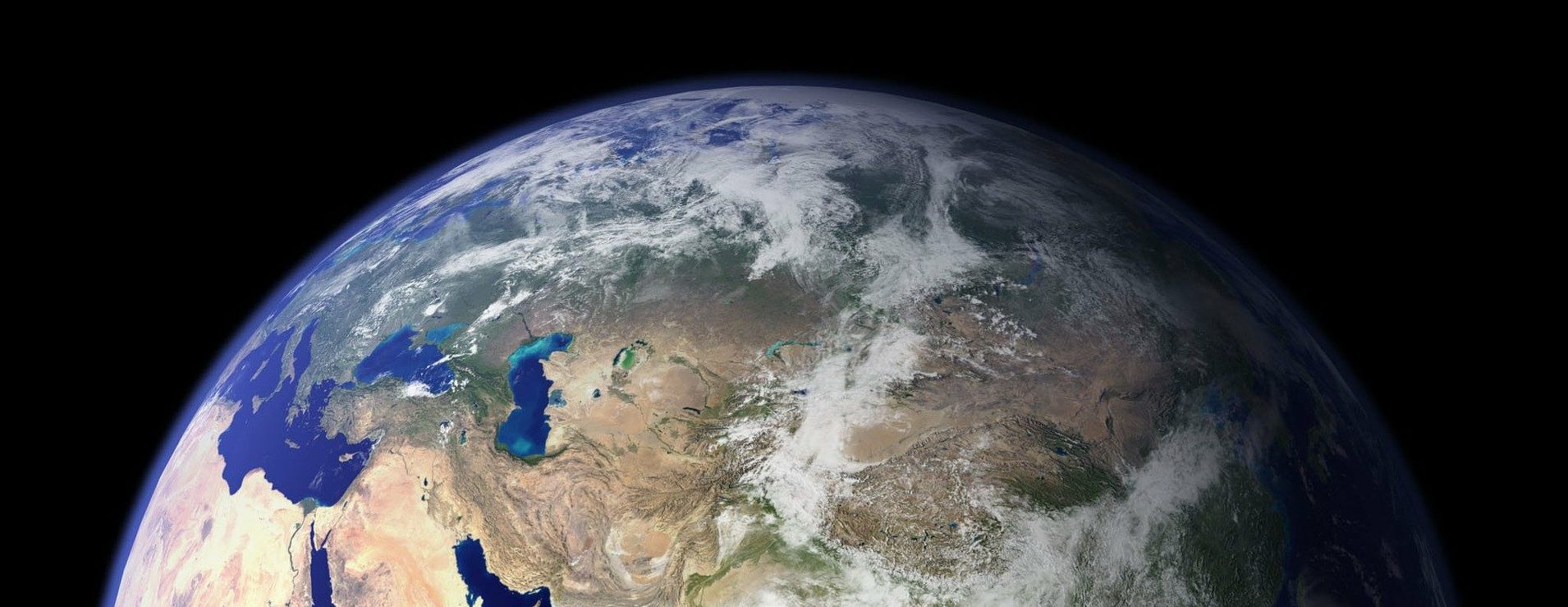
Fifty-fifty: the motto for making peace among siblings and friends. Perhaps having to “share” hasn’t always aligned with our individual desire to decide freely. Nevertheless, fifty-fifty is seen as a symbol of justice and fairness. Recently, however, the idea has also been creeping into other areas: into the relatively messed-up relationship between humans and the environment. And it raises the question: how well can we share with our environment?
In environmentalist circles, the “fifty-fifty” concept has evolved into an ambitious plan to combat the climate crisis, species extinction, and related issues. The slogan “Half Earth” describes the idea of sharing the planet fairly—and placing half of it under protection.
This, of course, is causing some to gasp in disbelief. Especially since only about 10 percent of the planet is currently protected. Is it realistic to increase this area fivefold in a short time? Will it really make a difference? What will happen to the people living in these areas?
A quick fact check:
[av_heading heading='Who and what is behind this idea?' tag='h3' style=" size=" subheading_active=" subheading_size='15' padding='10' color=" custom_font=" admin_preview_bg="][/av_heading]
The “Half-Earth” concept was developed by Harvard professor emeritus Edward O. Wilson (book*Half Earth*). It was subsequently taken up as a campaign by Ricken Patel, founder of the Avaaz platform for global online activism. International research teams have since put forward concrete and well-founded proposals regarding its implementation and impact (*Global Safety Net*). And last but not least, intense negotiations are underway at the UN level regarding a massive expansion of global protected areas.
[av_heading heading='Which half are we talking about?' tag='h3' style=" size=" subheading_active=" subheading_size='15' padding='10' color=" custom_font=" admin_preview_bg="][/av_heading]
“Half” might sound misleading at first glance. Of course, this isn’t about the Northern or Southern Hemisphere. Rather, it’s about a global network of protected areas. Which brings us straight to a central sticking point of the idea: which areas are suitable?
The “Global Safety Network” helps us see the light on this issue. It gives us a clear and precise picture of where these protected areas would need to be located.
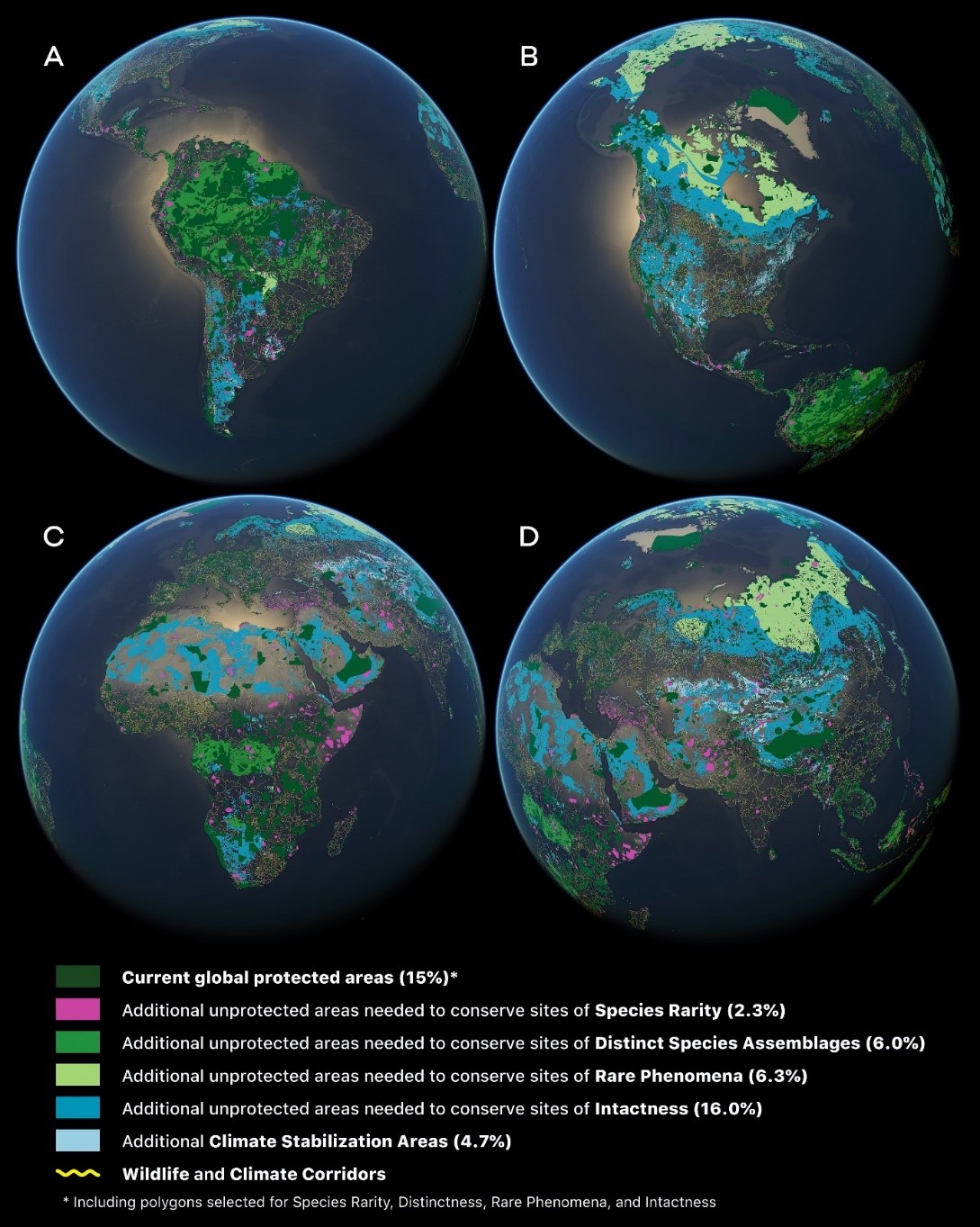
The “superspreaders of biodiversity”—the last remaining large, intact ecosystems and wilderness areas (tropical forests, coastal zones, deltas, wetlands, etc.)—would be the cornerstone of this “safety net.”
Next come areas inhabited by particularly rare species. And then we must not forget the top managers of our ecosystems: large mammals, which, as the apex predators in the food chain, as grazing landscape gardeners, or as nutrient suppliers, play a key role. And we’re not starting from scratch, either. The existing 10 percent of protected areas are, of course, also part of the plan.
[av_heading heading='What's the point?' tag='h3' style=" size=" subheading_active=" subheading_size='15' padding='10' color=" custom_font=" admin_preview_bg="][/av_heading]
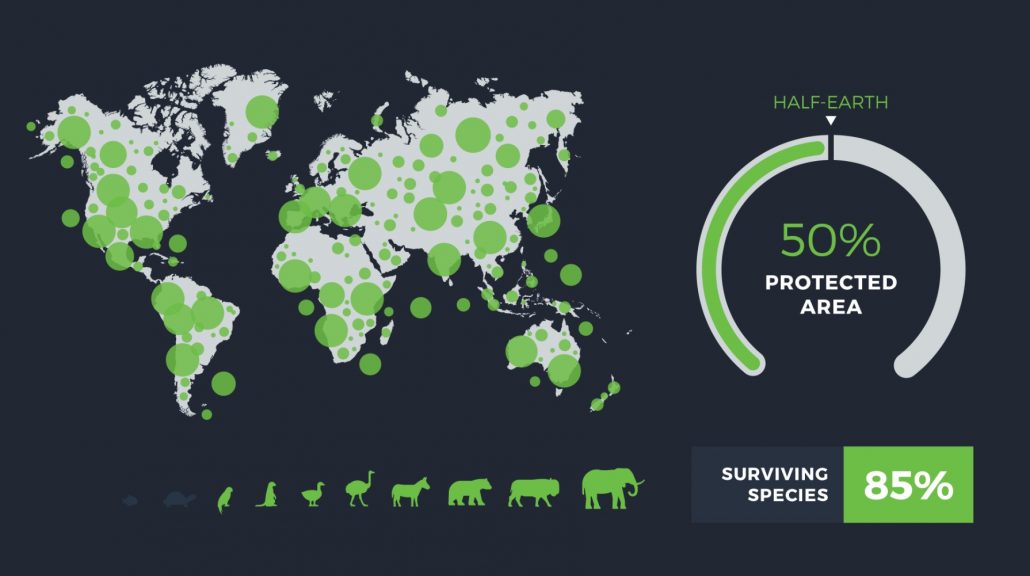
If 50 percent of our planet were placed under protection in this way, further species extinction could be halted or even reversed. According to E.O. Wilson, this would save 85 percent of species, which would be surprisingly good news in the midst of the sixth mass extinction.
But this would also represent a major step forward in terms of climate stabilization. Global protected areas could store a staggering 2,000,000 megatons of carbon.
The effect could be further amplified if degraded areas were also brought on board and converted into regenerated protected areas. For instance, a reforestation project in the Nepal ecoregion shows that by doubling the forest area over 24 years, the amount of sequestered carbon could be more than doubled (from 213 to 502 megatons).
Against this backdrop, the passion—unusual for a scientist—of Global Safety Net founder Eric Dinerstein is understandable: the idea is nothing less than a concrete blueprint for saving life on planet Earth.
[av_heading heading='Goodbye, Natural Resources?' tag='h3' style=" size=" subheading_active=" subheading_size='15' padding='10' color=" custom_font=" admin_preview_bg="][/av_heading]
Rescue or no rescue: wouldn’t this bold plan cause us to miss out on a vast amount of mineral deposits and resources? Of course, money can be made from mineral deposits that haven’t yet been extracted. However, this one-time profit is offset by a much more enduring economic value that is often overlooked: the “services” that ecosystems provide for us humans.
This ‘value’ is overlooked primarily because plants filter dust and pollutants from the air for free, the biofilm in rivers provides nature’s free wastewater treatment plant, insects pollinate our fruit and vegetable plants for free, intact soils store carbon for free, etc.
If nature were to bill us for this service, we’d have to shell out $44 trillion. That is more than half of the world’s gross domestic product. We are becoming more and more aware every year that these “services” are free, but not without cost. Especially since we have to dig deeper and deeper into our wallets and government coffers to pay for environmental and climate damage.
[av_heading heading='What happens to people?' tag='h3' style=" size=" subheading_active=" subheading_size='15' padding='10' color=" custom_font=" admin_preview_bg="][/av_heading]
There is no question that the areas to be protected will continue to serve as habitats for the people living there. Existing agricultural lands would also remain untouched. Examples from numerous biodiversity hotspots around the world—which have long been carefully inhabited and preserved by people—demonstrate that a sustainable way of life is possible even within protected areas.
For instance, one-third of the proposed protected area network would overlap with areas linked to the land rights of indigenous peoples or their habitats. The idea of establishing protected areas could help them preserve their habitats and way of life and strengthen their legal standing.
[av_heading heading='Still, isn't the burden of homework unfairly distributed?' tag='h3' style=" size=" subheading_active=" subheading_size='15' padding='10' color=" custom_font=" admin_preview_bg="][/av_heading]
The fact is: Key ecoregions (e.g., tropical rainforests, taiga, and tundra) bear a disproportionately large share of the responsibility for solving the problem. They would need to set aside comparatively more protected areas than ecoregions that are naturally less species-rich (such as Central Europe).
However, a study examining the social and economic effects of protected areas shows that this need not be a disadvantage. The protected areas in the Global South studied demonstrate that prosperity is demonstrably higher in the vicinity of protected areas, regardless of whether these areas are used for tourism or not. Children are demonstrably healthier when they grow up in the immediate vicinity of protected areas.
[av_heading heading='Can this utopia become a reality?' tag='h3' style=" size=" subheading_active=" subheading_size='15' padding='10' color=" custom_font=" admin_preview_bg="][/av_heading]
All of these approaches are knocking on our door with a common message: the time for radical generosity has come. If we truly want to counter the greatest mass extinction in human history, we need a shift in thinking toward “Nature first.” And there is good reason for hope.
In 2021, at the potentially historic biodiversity summit in Kunming, China’s “City of Spring,” the international community could adopt a science-based“Global Deal for Nature.”This would mean that over the next nine years, 30 percent of the Earth would be placed under protection, and an additional 20 percent would be designated as “climate stabilization zones.”
What can we do to help? For example, we can support the most ambitious plan to date for saving biodiversity by adding our signature . And then, we can look to China with hope.
[av_promobox button='no' label='Click me' link='manually,http://' link_target="" color='theme-color' custom_bg='#444444' custom_font='#ffffff’ size=’large’ icon_select=’no’ icon=’ue800’ font=’entypo-fontello’ box_color=“ box_custom_font=’#ffffff’ box_custom_bg=’#444444’ box_custom_border=’#333333’ admin_preview_bg=“]
 About the Author
Dr. Sybille Chiari is a member of the editorial team for “Nachhaltigkeit. Neu denken” and has been engaged in sustainability and climate communication for many years—both through research and writing. She is part of the Scientists for Future movement and chairwoman of the Bele Co-Housing association (a communal housing project featuring organic, regenerative agriculture ; www.belehof.at).
[/av_promobox]