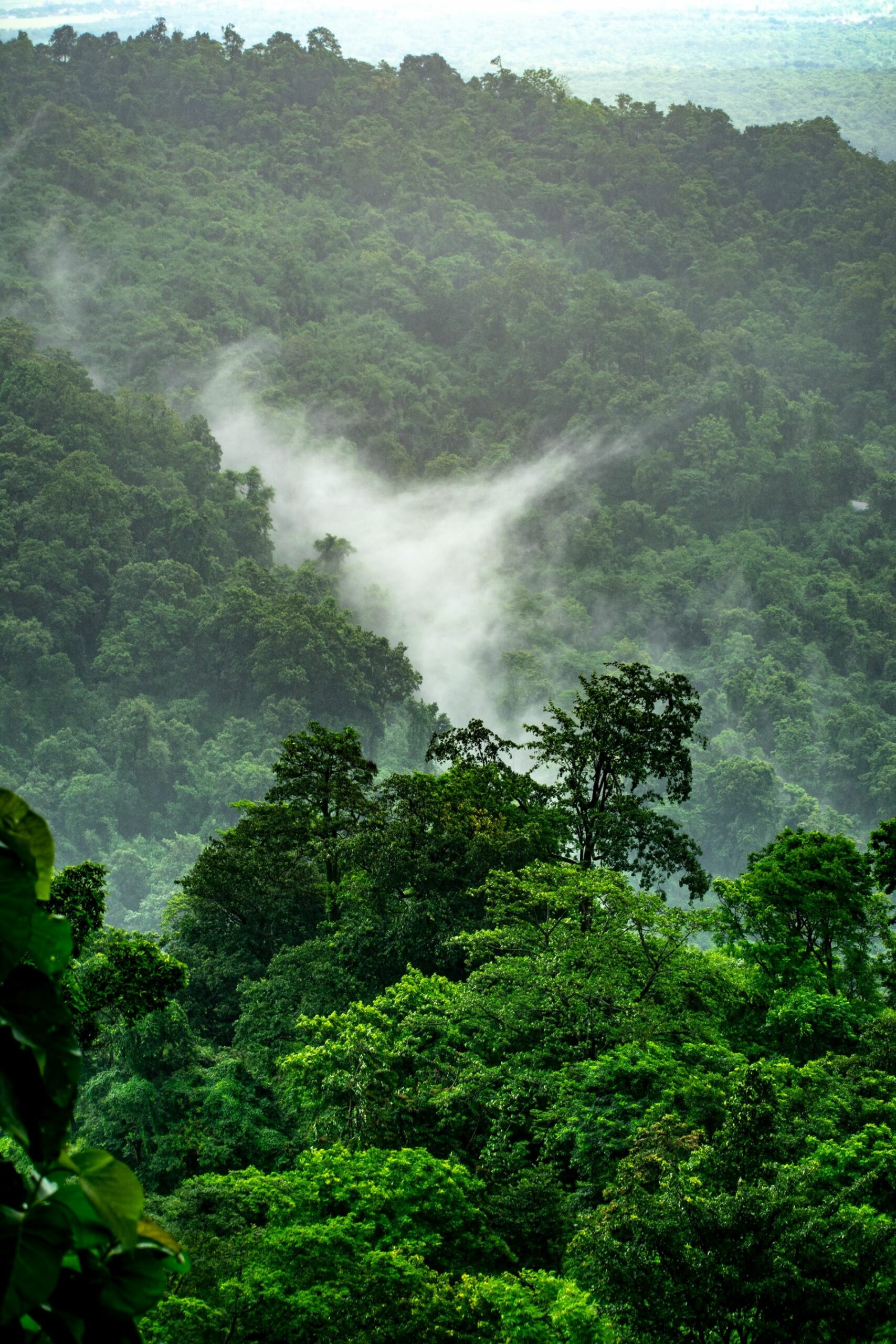
Fallen branches crunch beneath your feet, the soft forest floor cushions your steps, the scent of damp leaves and mushrooms fills the air, and the rustling of an animal breaks the silence. The sun creates a dance of light and shadow as it shines through the leaves of the treetops. A light breeze caresses your skin. All around you, the pure life of a primeval forest pulsates. Inevitably, you feel this strong sense of belonging, feeling like a cell in the entire organism that is Earth, like a part of the web of life.
In the stories of indigenous peoples and in mythology, the Earth is always seen as divine, even spiritual. It is revered as a mother from whom all life springs. The relationship with the Earth is very intense and personal, much like that with a family member. I myself experience this close bond and connection every time I enter natural ecosystems or hear about the interconnections in nature. The complex interplay of animals, plants, and other living beings never ceases to amaze me. Science is only just beginning to understand this.
She discovered that trees “communicate” with one another, allowing trees with high-energy seeds to synchronize so-called mast years. For example, every 6 to 10 years, oak trees produce so many acorns that animals cannot eat them all, leaving enough seeds for reproduction. In the remaining years, they produce fewer, so that the number of animals feeding on them does not become too large. If the trees did not coordinate, their survival would be at risk.
But how do they communicate with each other? Initial studies indicate an exchange of pheromones through the air, as well as signaling molecules transmitted via a fungal network. They even alert each other when one tree is infested by a pest. All the trees in the network then ramp up their defenses, even though they themselves are not yet affected.
Plants even use specific sugar compounds to nourish certain bacteria around their roots—interestingly, these are bacteria from the same four strains that we humans have in our intestines. In return, these bacteria provide the plants with nutrients and protect them from disease-causing fungi and bacteria.
Or let’s take a look at a global network of whales andCO2 —it’s truly amazing! The building blocks of our cells are largely carbon in various compounds, which plants obtain from the air, specifically fromCO2. Through photosynthesis, they convertCO2 into carbon compounds and oxygen. As herbivores, animals obtain carbon directly from plants, and as carnivores, they obtain it indirectly from plants via the animals they eat. In this way, whales—arguably the heaviest animals ever to inhabit the world—store an average of 33 tons of carbon. When they die, they often sink to the ocean floor, where decomposition barely occurs due to a lack of oxygen. The carbon therefore remains down there for centuries. Conversely, we need only nurture and protect the whale population in the oceans to reduceCO2 in the atmosphere.
That’s just brilliant! Our ecosystems are teeming with useful “technologies” and know-how that we could learn from.
To quote Goethe:
Even the humblest of nature’s creations contains within itself the circle of its perfection, and if only I have eyes to see, I can discover these relationships; and I am certain that within a small circle lies a whole, true existence.
Johann Wolfgang von Goethe, Letters to Duchess Louise, December 12–23, 1786, in Goethe’s Letters, Volume 2:31.
Or, to put it simply: Nature is perfect; we just need to recognize the connections—all knowledge is already contained within even the smallest particle of nature.
At the same time, however, it also means:
With every species that […] goes extinct, a wealth of solutions is lost. And with every indigenous community that disappears, we lose a group of people who have been observing, describing, and living by those specific solutions for thousands of years.
Lucas Buchholz in "Kogi"
For some indigenous peoples, such as the Kogi of Colombia, the solution lies in recognizing the Earth as a living being. For this indigenous group, whose culture and traditions have remained virtually unchanged for 4,000 years, everything is alive—the wind, the water, living creatures… In their native language, there is no word for “enemy”; they see it as their duty to restore balance by giving something back to the Earth when too much has been taken. When imbalances occur, they take it for granted that the Earth will strike back through natural disasters.
In the scientific community, too, hypotheses repeatedly emerge suggesting that the world is actually a giant organism. In his work *Theory of the Earth* (1788), the Scottish naturalist James Hutton compared the cycles of matter in the atmosphere, the ocean, and the soil to the circulation of blood in the body. In 1972, the widely acclaimed Gaia hypothesis was published by the British scientist James Lovelock. (In Greek mythology, Gaia is the personification of the Earth and one of the first deities.) In it, Lovelock describes the Earth as a kind of living organism, a planetary unit that reacts as a whole to external stimuli and maintains its state through complex regulatory loops. The hypothesis is sometimes criticized and ridiculed in scientific circles, yet much of it is now accepted and part of science. As in the geosciences, where the term “Earth system” is used.
In a sense, then, it is clear to science that the Earth is a system (=organism). Isn’t it perfectly clear to us as well? Is there any doubt left that the world is not alive? Shouldn’t we then also take the step of perceiving the Earth as a being with its own needs? A living being whose needs we must take into account alongside our own?
If you're honest with yourself, is that idea really so far-fetched? Don't you feel it too— the earth's vitality?