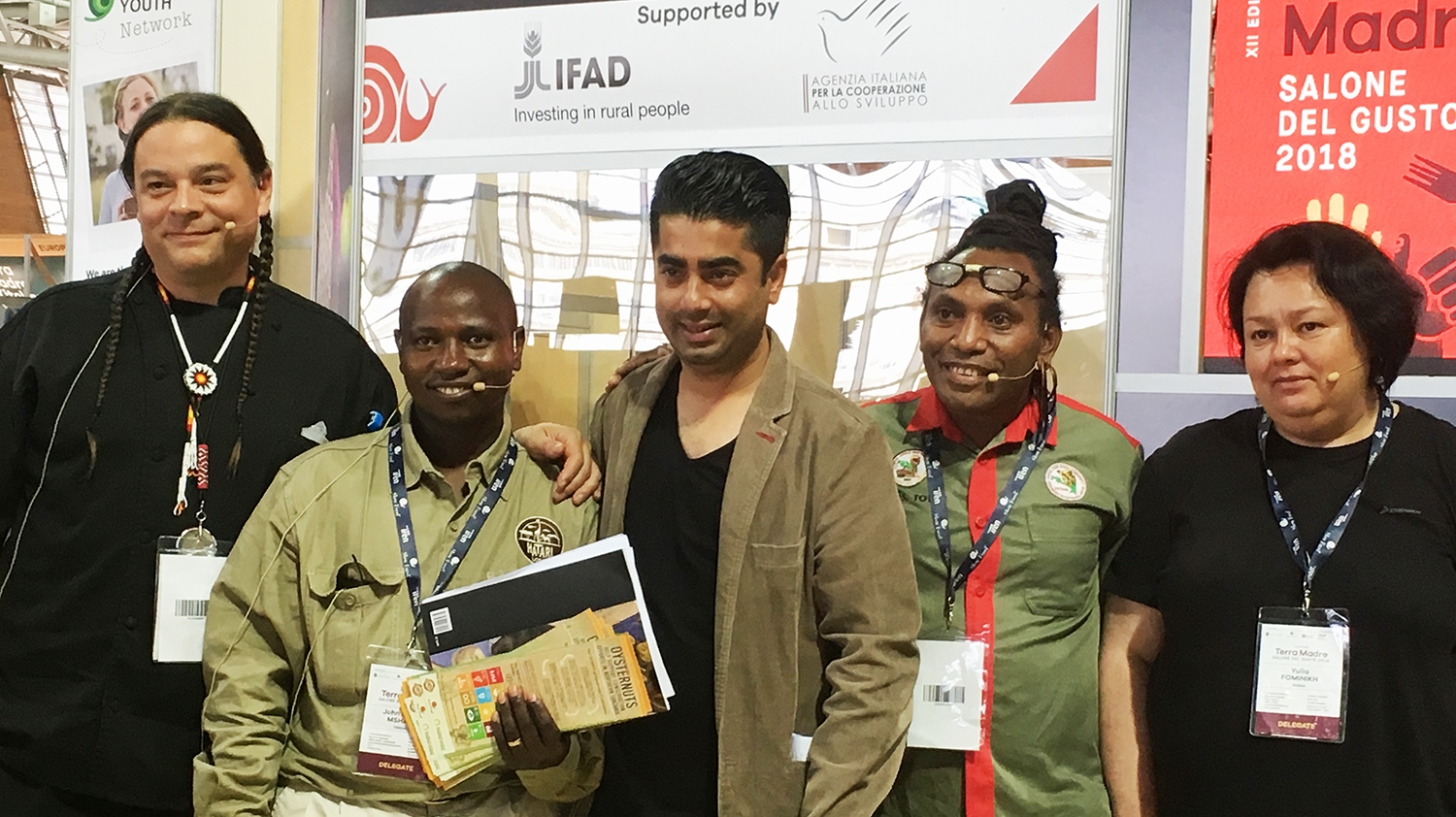
During the Terra Madre conference held in Turin in September 2019, indigenous chefs took the stage at several panel discussions. For some Europeans, the term “indigenous” in the context of cooking initially raises questions. However, the importance of the work carried out by the “Jungle Chefs” or “Sioux Chefs”—as they call themselves—becomes clear when viewed in the context of climate change and food sovereignty.
The first to bear the brunt of climate change are farmers, fishermen, and everyone who produces agricultural products. As the people who prepare these products, chefs can play a crucial role as opinion leaders and role models if they are aware of their responsibilities and act wisely. We have found inspiring examples from around the world.
[av_heading heading='It all started with the idea of carrying less luggage through the jungle' tag='h3' style=" size=" subheading_active=" subheading_size='15' padding='10' color=" custom_font=" admin_preview_bg="][/av_heading]
… but Charles Toto, founder of the “Jungle Chefs” in Papua, Indonesia, soon realized that his offering of freshly prepared meals in the heart of the Indonesian jungle did more than just lighten the load for expeditions and film crews. It was a way back to his roots, to the indigenous people’s ingredients, their knowledge, and their cooking methods.
As a young chef, Toto noticed that expedition participants would survive for weeks in the wilderness on instant and canned food. He thought this was madness, if only because of the extra weight it added to their luggage, but the idea also repelled him from both a health and culinary perspective. Why, he wondered, don’t we cater to these travel groups by offering them fresh, healthy meals along the way? As a trained hotel chef, his first thought was to bring his own meat, but he soon realized better: Food from the forest is more hygienic, cleaner, and more organic. The forest is a market where Papuans shop without spending any money.
Toto thrived in his culinary niche and was constantly learning something new amid the rigors of various trekking tours through largely unexplored areas. As his business flourished and his reputation spread, Toto built a network of like-minded chefs. In 2008, he founded the Jungle Chef Community, which brings together dozens of chefs from across Papua who specialize in preparing meals using ingredients from the forest.
During his speech in Turin, Charles Toto explained: “We train our members to source local ingredients and prepare traditional Papuan dishes. Foraging and hunting locally are widely accepted as sustainable uses of natural resources and help reduce costs and our ecological footprint. In our Jungle Chef Community, we also share knowledge about ancient practices, values, and cultures that are at risk of slowly dying out as younger generations in Papua adopt a more modern lifestyle. The key is being able to preserve and creatively use what nature offers us at this time and in this place.”
Through his work, Toto draws attention to his country’s food sovereignty as well as to environmental protection. However, an ambitious government infrastructure development plan is putting increasing pressure on the “Jungle Chefs” project. The resulting sale of many sago palm farms is leading not only to land loss but also to the loss of a traditional staple food for the people of Papua. An additional threat comes from the clearing of square kilometers of land for palm oil plantations. Charles Toto is taking on all these challenges, because the forests of Papua are rich in natural resources, and through his cooking community, he highlights them, preserving knowledge, culture, and tradition for future generations.
[av_heading heading='Authentic American cuisine is Native American—which makes perfect sense.' tag='h3' style=" size=" subheading_active=" subheading_size='15' padding='10' color=" custom_font=" admin_preview_bg="][/av_heading]

After years of neglect, Sean Sherman—known as the Sioux Chief—set out to explore his heritage and the traditions of his ancestors. During his formal culinary training, he became familiar with cuisines from around the world—from Asian to French to Cypriot. But no one in America paid attention to what the indigenous peoples once planted, hunted, harvested, and ate from the East Coast to the West Coast. Why should they? The history of modern, civilized America is, as in many places, a history of extermination and re-education. European settlers brought their own culture and food. The displacement of the indigenous peoples and the seizure of their lands altered the flora and fauna, leading to the extinction of many species. The indigenous peoples either adapted and became part of modern society or disappeared into small reservations. And with them vanished the knowledge of traditional foods and their customary uses.
Sherman conducted extensive basic research on history and food systems. As part of this, he gathered knowledge about Native American culture:
His goal was to gain a comprehensive understanding of American cuisine and bring it into the modern world. In 2014, Sean Sherman launched his catering and educational venture, “The Sioux Chef,” in the Minneapolis–Saint Paul area. In collaboration with the Little Earth Community, which preserves Native American traditions and culture, he helped develop and launch the Tatanka Food Truck in 2015, which brings Native foods from the Dakota and Minnesota regions directly to local communities. Sherman’s vision of modern Indigenous food has been featured in numerous articles and radio shows both nationally and internationally—from Manhattan to Milan. But he doesn’t want to export this food or take it elsewhere; he wants to share his knowledge of “indigenous” nutrition at events ranging from the renowned Culinary Institute of America to the United Nations. For Sean Sherman, it means a return to the roots.
His Sioux Chef team works tirelessly to make indigenous foods more accessible to as many people and communities as possible and to educate them. Sherman’s goal is to raise awareness of Native Americans and the foods that once sustained them. This requires peeling away the layers of colonial foods—such as sugar, industrial meat, and processed grains—that have overlaid indigenous diets over the centuries. It means finding a way to bring Native American traditions to life within the context of modern urban restaurants.
[av_heading heading='Europe has a relatively intact treasure' tag='h3' style="" size="" subheading_active="" subheading_size='15' padding='10' color="" custom_font="" admin_preview_bg=""][/av_heading]
Austrian and many other European cuisines have preserved numerous “indigenous” foods and traditions. Perhaps this is because we were fortunate enough not to have had an indigenous population driven from their lands and dispossessed of their property.
We are not always aware of this treasure trove of “native” foods and their preparation, nor do we always pay attention to them. The industrialization of agriculture and the global standardization of raw materials have not left us unscathed either. In Austria, too, plants and animals are disappearing at a rapid pace—but it is not too late yet. Austria’s best chefs recognized this long ago and are committed to preserving our indigenous ingredients and the knowledge behind them. The“Koch-Campus”association was founded by seven top Austrian chefs who have made it their mission to preserve the diversity of local livestock and plants and to further develop and preserve culinary traditions with them.
Interesting tastings and “Chef’s Tables” foster dialogue between agricultural producers—who preserve or reintroduce old traditional varieties and breeds—and chefs, as well as consumers. The goal is to showcase and define a contemporary, indigenous Austrian cuisine using ingredients that are native to Austria’s soil and climate and have a long-standing tradition here. A cuisine that is not limited to specific preparation methods or clichés, but rather places the ingredient itself at the center.
[av_promobox button='no' label='Click me' link='manually,http://' link_target="" color='theme-color' custom_bg='#444444' custom_font='#ffffff’ size=’large’ icon_select=’no’ icon=’ue800’ font=’entypo-fontello’ box_color=“ box_custom_font=’#ffffff’ box_custom_bg=’#444444’ box_custom_border=’#333333’ admin_preview_bg=“]
 About the Author
Birgit Farnleitner, who holds a master’s degree in Gastrosophy and is a communications expert, has held a management position at Werner Lampert BeratungsgmbH since 2014. She completed the Advertising and Sales program at the Vienna University of Economics and Business (WU Wien) and later earned an interdisciplinary master’s degree in Gastrosophical Sciences from Paris Lodron University. In her master’s thesis, she explored sustainability and ethics in food production. This field has since had a significant influence on both her professional and personal life. She is part of the editorial team for the online magazine “Nachhaltigkeit. Neu denken.”
[/av_promobox]