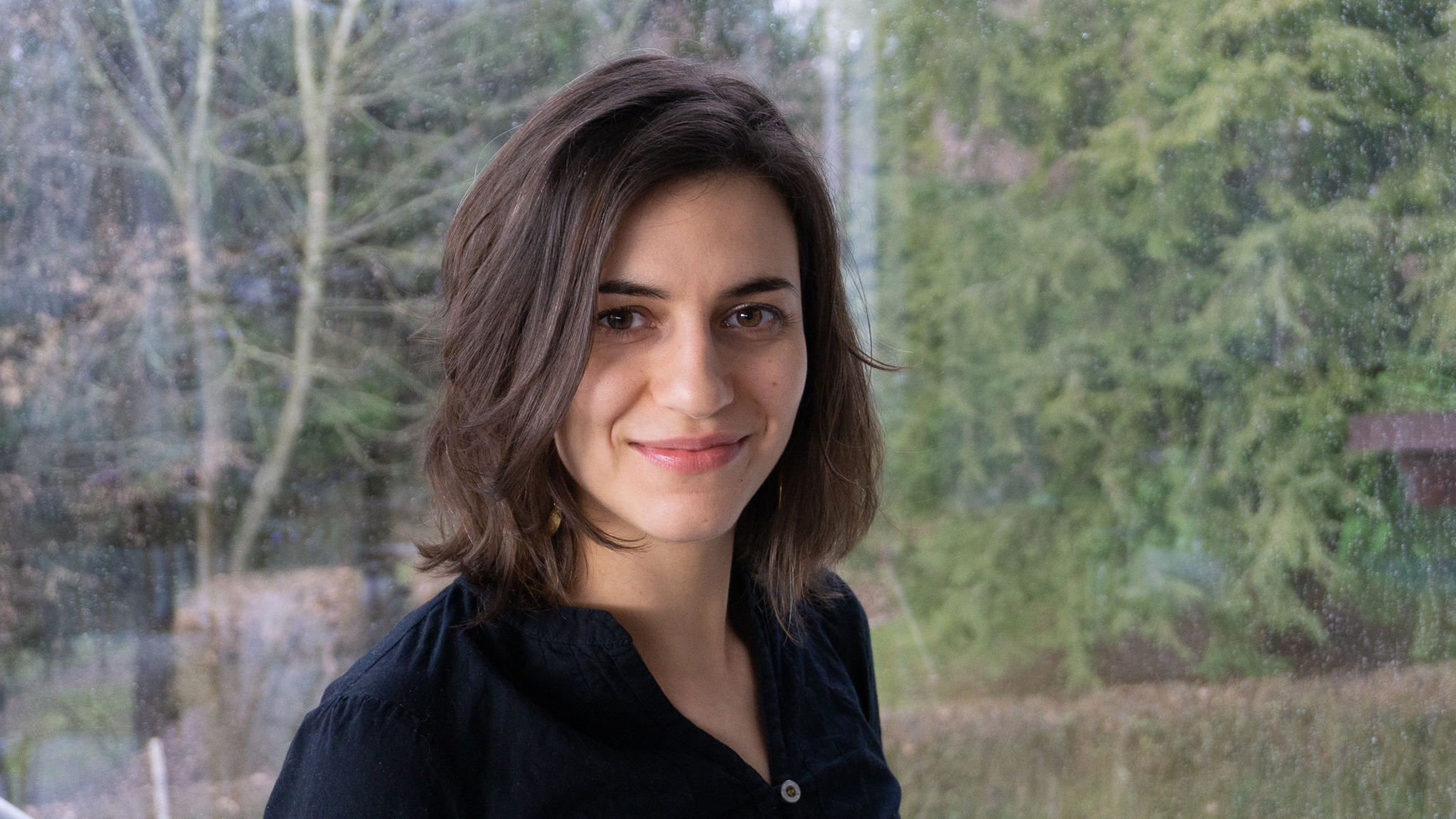

Warning: I'm going to change the way your brain works over the next hour!
Those were Maren Urner’s opening words in one of her many talks on how sustainable behavior begins in our minds. So be warned! Because the neuroscientist takes us on a journey into our Stone Age brain.
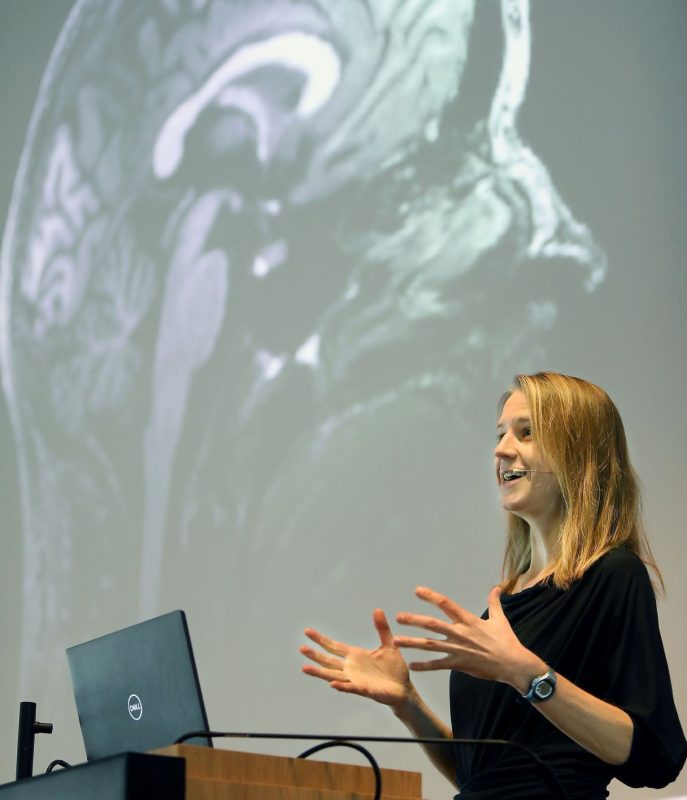
All of the world’s crises stem from the fact that we humans don’t communicate well enough and because some functions of our Stone Age brain aren’t quite as useful these days. In fact, our brain functions haven’t changed significantly since the Stone Age, explains Maren Urner, citing a scan of her brain.
A brief introduction to this expert is in order: Maren Urner is a neuroscientist and professor of media psychology at the Cologne University of Applied Sciences for Media, Communication, and Business. The bestselling author and founder of the magazine Perspective Daily explores the question of why we treat crises—especially the climate crisis—in such a contradictory manner. For although we know that the climate crisis is the greatest threat to humanity, we “set” a new record for CO2 emissions every year. Why do we behave so paradoxically?
Every human brain is unique in its structure and the way it functions. As a result, everyone perceives the world differently (through taste, smell, etc.) and interprets it in their own way. Since we can’t just swap brains to see how others experience the world, we have no choice but to communicate our view of things: through speech, facial expressions, gestures, writing, social media, and so on. And, as Maren Urner pointedly notes, we’re (still) pretty bad at communicating.
An example of “poor” communication: the glut of negative news. As a result, we perceive the world as being much worse than it actually is. Why are we so quick to focus on the negative and don’t report much more on the positive?
This is where the Stone Age comes into play: If a saber-toothed tiger is standing in front of you, you’d be wise not to focus on the beautiful grasslands or the fresh air, but to focus all your senses on protecting yourself from the saber-toothed tiger.
Today, we’re battling a “digital saber-toothed tiger” in the form of a flood of negative news pouring directly into our smartphones.
Our brain’s response is the same in both situations: fear and uncertainty. We switch to survival mode. When we feel fear, our brain has only three responses; here’s an example using the climate crisis:
When we switch to survival mode in the fight against the “digital saber-toothed tiger,” our higher cognitive abilities—the ones that make us so smart—are blocked, and our brain activity is reduced to basic functions.
On top of that, our Stone Age brain wants to operate as energy-efficiently as possible. After all, Stone Age people didn’t have the luxury of knowing when their next meal would be. Turning activities into habits simply makes our brain more energy-efficient.
Even helplessness becomes a habit that paralyzes us, preventing us from taking action. We constantly hear: “The problem is too complex,” or “We won’t be able to solve it in time.” The sad result is that 56 percent of young people believe humanity is doomed and are convinced that they can no longer look forward to a future worth living.
The neuroscientist speaks of a sense of helplessness that pervades the world, from which we must break free in order to overcome our paradoxical behavior in the face of crises.
The good news is that our brains continue to change throughout our lives—every moment, with every thought. Even well into old age, we can “rewire” our brains through learning and new experiences, developing new behaviors and habits. But how? Through better communication, for example!
Talking about problems creates problems; talking about solutions creates solutions.
Steve de Shazer, American psychotherapist and author
“From a neuroscientific perspective, it makes a big difference whether we view things from a problem-oriented or a solution-oriented perspective,” explains Urner. This doesn’t mean we ignore the problem. On the contrary, we address the problem, but we ask ourselves different questions: not “Who is to blame?” but “Who can do what?”
Maren Urner advocates for a “for” rather than an “against.” If you’re against something (e.g., war), you automatically adopt a defensive stance. If you’re for something (peace), your perspective shifts to “where should we be heading, and how do we get there?” The focus is on the future, not the past.
Saying “no” automatically creates a “us versus them” mentality: good versus bad, friend versus foe. No one wants to be seen as a bad person (a climate sinner).
A “Yes” fosters a different kind of group thinking: We seek common ground to achieve a shared goal (climate neutrality). On a cognitive level, we build a sense of connection; on a behavioral level, we foster better listening, greater trust, and a willingness to engage with the issue.
When we look for solutions that don’t yet exist, we tap into our imagination —the very thing that makes us human. This process involves cognitive activities that foster dynamic thinking. However, imagining something that doesn’t yet exist requires brainpower—in other words, energy. Much like in sports, new—sustainable—behavior must be practiced until it becomes a new habit. The advantage: Just as in sports, the reward system kicks in after the training.
“Our brains love stories,” explains Maren Urner. To overcome our own sense of helplessness in a seemingly hopeless situation (such as the climate crisis), we need to feed our brains stories that make our self-efficacy tangible. “Because self-efficacy is the antithesis of helplessness.” We need to hear, read, or see how we can shape our lives and create a fully sustainable world.
Maren Urner calls on the media to take responsibility here. Approaches such as constructive journalism and new formats for solution-oriented news are gaining increasing traction. But each and every one of us must also do our part to overcome our paradoxical behavior in the face of major crises.
The first step is to reflect on how we process news ourselves and whether it makes a difference when (only) negative news is reported versus when positive news and proposed solutions are included as well. Give it a try—you’ll find reading material and more tips here and below. Or ask your favorite media outlet for solutions or positive examples if they’re missing. This way, we can outsmart our Stone Age brain with its penchant for the negative and, in the process, gain greater capacity for action.
P.S.: Has your brain already changed after reading this article?