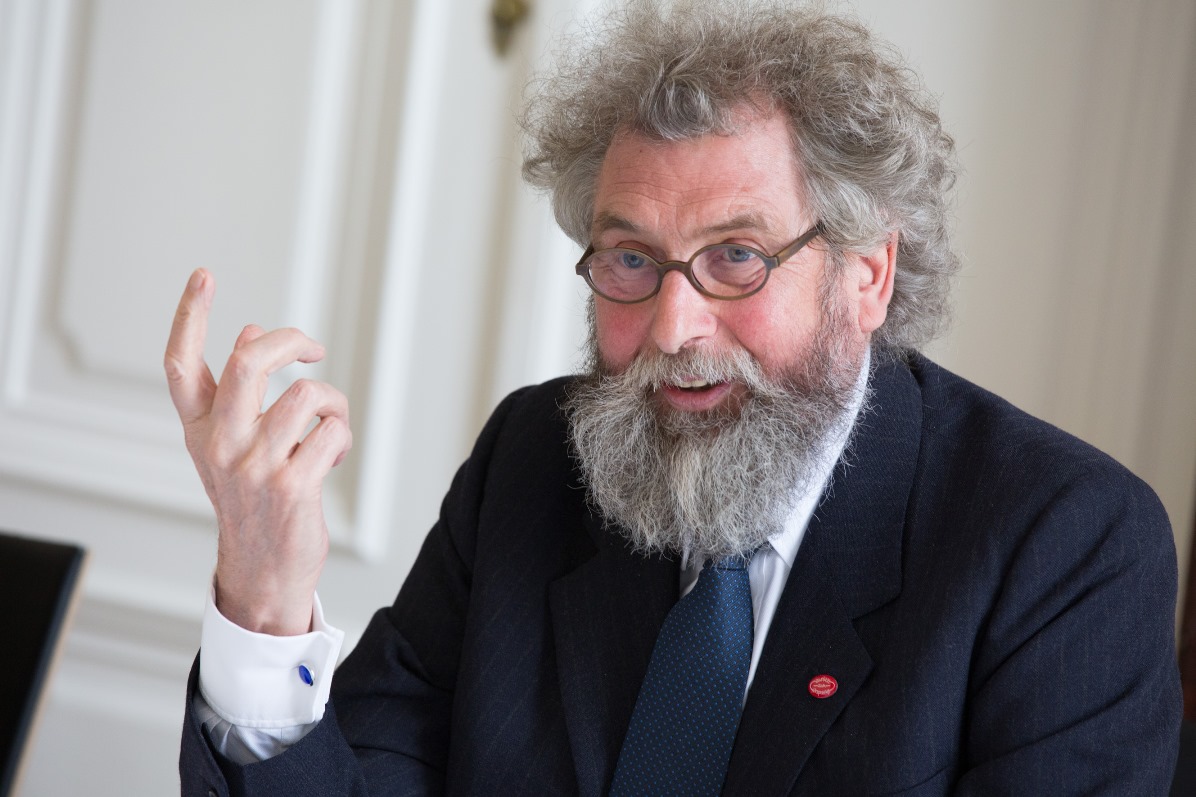
“It’s not that I’ve realized my dreams here; what we’re doing today goes far, far beyond anything I could have ever dreamed of, hoped for, or expected,” Werner Lampert said at the press conference celebrating the 10th anniversary of “Back to the Roots.”
Feel free to ask me anything "Back to the Roots" is, I have to tell you, it’s the most extraordinary project in agriculture that I know of.
What drives us, and what challenges lie ahead? What does the future hold?
[av_heading heading='As everyone is aware, we are heading into a period of instability:' tag='h3' style=" size=" subheading_active=" subheading_size='15' padding='10' color=" custom_font=" admin_preview_bg="][/av_heading]
Lifestyles, consumer behavior, and the way agriculture provides for our food supply are set to undergo massive changes. Economic systems that have brought us prosperity will no longer be able to feed us or satisfy our needs in the future.
Across the EU, 115 million hectares of agricultural land are at risk from water erosion and 42 million hectares from wind erosion.
A civilization can only survive as long as it has enough fertile land to feed its people.
The onset of climate change and the way agriculture is often practiced today will exacerbate this situation.
[av_heading heading='And the other problem:' tag='h3' style=" size=" subheading_active=" subheading_size='15' padding='10' color=" custom_font=" admin_preview_bg="][/av_heading]
Our agriculture is far, far too dependent on external energy sources, on proteins in livestock farming, on the petrochemical industry—including industrial fertilizers, pesticides, and so on—as well as on investment.
The ratio of agricultural output to the energy required to produce it is disastrous.
For example: a smallholder farmer in the heart of Africa generates 65 times more energy from his field than he puts into it. According to a study, that figure is only 0.37 for a dairy farmer in Europe.
An American study states that small-scale farming is 60 times more productive than industrialized agriculture.
The 2008 World Agriculture Report puts it even more clearly: it states that only an ecological, regional, and community-based agricultural system will be able to feed future generations.
It is therefore not surprising that we see our mission as developing a model to demonstrate how our population—and future generations—can be fed, regardless of what climate change and global political and economic upheavals may yet bring.
[av_heading heading='Here, an example from salutogenesis can be helpful.' tag='h3' style=" size=" subheading_active=" subheading_size='15' padding='10' color=" custom_font=" admin_preview_bg="][/av_heading]
This is a concept that originated in medicine, which views health not as a state but as a process and describes the use of one’s own resources to promote health.
This concept teaches us how and why agriculture will be able to feed us in the future despite various challenges, and how we need to shape it so that we can preserve its resources.
First and foremost, we need to create an agricultural system that does not act as an adversary or destroyer of other ecological systems, but rather harnesses them and is strengthened by them.
For thousands of years, agriculture has operated and been practiced within the framework of the CONTINUUM.
We need to revive this awareness. Through our work—or at least that is the intention—we aim to enhance the adaptability of our farmers’ agricultural systems so that they can meet the challenges ahead, such as climate change and economic and political upheaval.
We also strive to support farms through reliability, openness, and consistency. We believe that if external factors are predictable, farmers can plan their own resources and use them to meet the demands placed on them.
This provides a sense of security and the assurance that their efforts and dedication are worthwhile. This makes the challenge manageable for farmers.
[av_gallery ids='4003,4002,4001’ style=’thumbnails’ preview_size=’portfolio’ crop_big_preview_thumbnail=’avia-gallery-big-crop-thumb’ thumb_size=’portfolio’ columns=’3’ imagelink=’lightbox’ lazyload=’avia_lazyload’ admin_preview_bg=“]
[av_heading heading='Yes, and why all these considerations? Why are we working in this direction?' tag='h3' style=" size=" subheading_active=" subheading_size='15' padding='10' color=" custom_font=" admin_preview_bg="][/av_heading]
Many people who are concerned about our future and the future of food are aware that we could face food shortages in a few decades.
We are convinced—and this is why we refer to salutogenesis—that our work and our dedication can have a significant impact on our future.
This conviction and certainty that our agriculture has a responsibility to ensure food sovereignty for the local population guides us in our work toward authentic, regional, sustainable, and organic agriculture.
That is our mission, our responsibility, and our goal. To that end, we want to set an example that inspires others to ensure our population has access to high-quality food.
[av_promobox button='no' label='Click me' link='manually,http://' link_target="" color='theme-color' custom_bg='#444444' custom_font='#ffffff’ size=’large’ icon_select=’no’ icon=’ue800’ font=’entypo-fontello’ box_color=“ box_custom_font=’#ffffff’ box_custom_bg=’#444444’ box_custom_border=’#333333’ admin_preview_bg=“]
 Werner Lampert (born in 1946 in Vorarlberg, Austria) is considered one of the pioneers in the field of sustainable products and their development in Europe. This organic pioneer has been deeply involved in organic farming since the 1970s. With Back to the beginning (Hofer) and Ja! Natürlich—he developed two of the most successful organic brands in the German-speaking world.
[/av_promobox]