
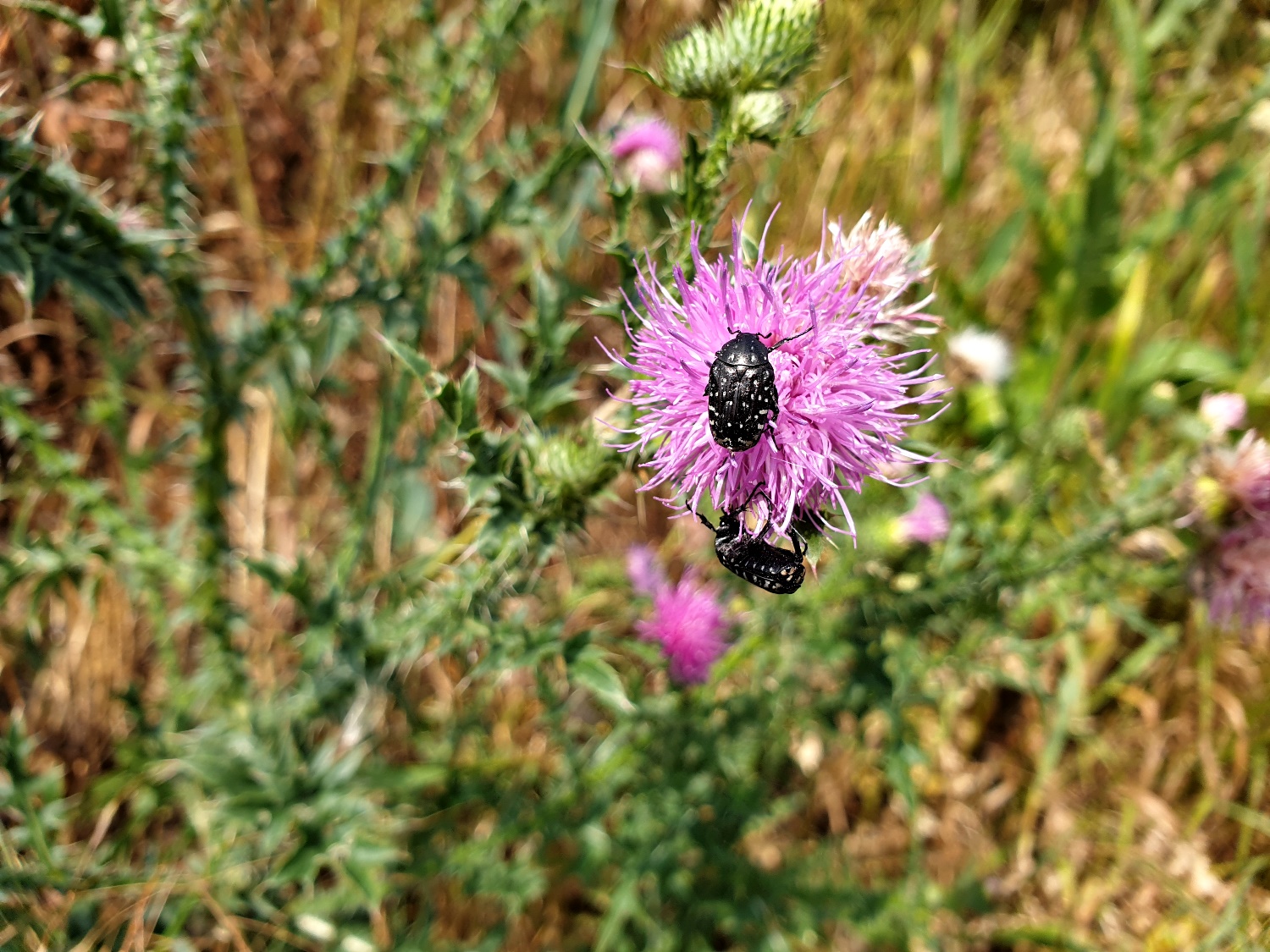
Drivers have long noticed it: the number of insects is declining. Compared to the past, the windshield is hardly smeared with those pesky critters anymore after speeding down the highway. What may be pleasant for German speeders has the potential to develop into a global ecological catastrophe. To some, this may sound alarmist, and that is exactly the point: It is safe to assume that with a massive reduction or even the extinction of insects, life on this planet as we know it would no longer be possible.
Our food, fresh water, hygiene, and cleanliness—all of these are threatened by the disappearance of insects. This is because insects are, in a sense, the multitaskers of our ecosystem: both cultivated and wild plants rely on them for pollination (according to the Intergovernmental Science-Policy Platform on Biodiversity and Ecosystem Services (IPBES), five to eight percent of current food crop production depends directly on pollination by insects. This corresponds to an annual market value of many hundreds of billions of euros), the breakdown of waste and our excrement is largely carried out by insects, and many animals—especially amphibians, birds, and fish—depend on insects for food; in other words, without insects, there would be no frogs, larks, or trout. But without insects, there is also no decomposition of cow or wildlife droppings. Just imagine for a moment that excrement is lying around everywhere. When cows were imported to Australia, this scenario became a reality. This is because the beetles that would have broken it down did not exist there. The native beetles were specialized only in kangaroo dung. The problem could only be solved by importing dung beetles from South Africa. Experts in Germany sounded the alarm as early as 18 months ago.
[av_heading heading='Studies Report Dramatic Decline' tag='h3' style=" size=" subheading_active=" subheading_size='15' padding='10' color=" custom_font=" admin_preview_bg="][/av_heading]
A study based on data from countless volunteer insect counters concluded that insect populations in Germany are declining dramatically. Did anyone notice? Did the media report on it extensively? Or was Germany perhaps just an isolated case? That last question has now been answered by a scientific review study conducted by researchers led by Australian ecologist Francisco Sánchez-Bayo of the Sydney Institute of Agriculture. This is the first comprehensive scientific analysis of the decline in insect populations worldwide. The authors present an overview of 73 historical reports, mainly from North America and Europe, and systematically evaluate the drivers behind the decline. Their report reads like a horror story. It highlights the dramatic declines that could lead to the extinction of 40 percent of the world’s insect species in the coming decades. These include butterflies (decline of over 50 percent), beetles (decline of nearly 50 percent), and hymenoptera—which include ants, wasps, and bees (down 45 percent)—as well as numerous aquatic insects. Insect populations are declining for nearly half of all species. The total global insect biomass is shrinking by 2.5 percent per year. If this trend continues, virtually all insects could be gone within a century, according to the authors.
“The impact this trend will have on the planet’s ecosystem and on the survival of humanity will be catastrophic,” says Sánchez-Bayo.
According to the scientists, the main causes of species decline are (in order of importance):
It is rare for scientists to be so specific in their statements, to use such clear language, and to link their work to a call for concrete action. “We want to wake people up,” says Sánchez-Bayo. Reviewers and editors were in agreement on this point. The report explicitly recommends a shift in thinking regarding current agricultural practices in order to slow down or even halt the current dramatic trends and preserve the ecologically vital functions of insects. The authors specifically mention moving away from monocultures and significantly reducing pesticide use. To halt insect decline, agriculture would need to undergo a large-scale transformation. We must once again create more structurally diverse habitats, such as meadows, scrublands, etc., instead of just wheat fields and apple orchards. Fields would need to be designed to be more insect-friendly, for example with flower strips and hedges along their edges. A more sparing use of pesticides and fertilizers must protect the insects’ habitats.
The scale of global insect decline has shocked even experts. It is important to note that studies on insect populations are often subject to significant uncertainty. Insect populations can fluctuate significantly from year to year, depending on the weather (for example, cold winters with heavy snowfall can decimate populations). That is why studies conducted over long periods of time are important, even though they are very costly and labor-intensive. It is equally important to then synthesize these many local studies to identify a global trend. Bayo’s study has now done this for the first time.
[av_heading heading='Media and politicians react hesitantly' tag='h3' style=" size=" subheading_active=" subheading_size='15' padding='10' color=" custom_font=" admin_preview_bg="][/av_heading]

© Robert Hausmann
As is so often the case, both the journalistic and political communities have been slow to react. The report received barely any mention in the daily press, and when it did, it was only on the back pages (with the exception of the British *Guardian* and the *Huffington Post*). Our mainstream news rarely covers significant scientific developments, while the annual, pointless gathering of a self-proclaimed global elite in Davos or a baseless two-page pamphlet by opponents of pollution limits is described in great detail. Politicians like German Agriculture Minister Julia Klöckner, for their part, simply brush the issue aside and demand further research before concrete political initiatives can be launched. It’s always the same pattern: by demanding more knowledge, necessary steps are delayed further and further until it’s too late. Yet one can hardly expect the former wine queen to read such scientific studies herself. Where are those who will inform her about the actual state of research?
But the example of the January 2019 citizens’ initiative to protect bees in Bavaria shows that we, as citizens, can take matters into our own hands to take decisive action against alarming developments when politicians and governments are too slow to act, too narrow-minded, or controlled by powerful lobby groups. People lined up to sign this initiative, as if Helene Fischer were handing out free tickets to her next concert. The initiators from the Ecological Democratic Party (ÖDP) are thus putting massive pressure on the CSU-led Bavarian state government. With this study, they have now gained another strong scientific basis for their argument.
[av_promobox button='no' label='Click me' link='manually,http://' link_target="" color='theme-color' custom_bg='#444444' custom_font='#ffffff’ size=’large’ icon_select=’no’ icon=’ue800’ font=’entypo-fontello’ box_color=“ box_custom_font=’#ffffff’ box_custom_bg=’#444444’ box_custom_border=’#333333’ admin_preview_bg=“]
About Lars Jaeger

© Gsell Photography
Lars Jaeger studied physics, mathematics, philosophy, and history, and spent several years conducting research in quantum physics and chaos theory. He lives near Zurich, where—as an energetic maverick—he has built two companies of his own that advise institutional financial investors, while also maintaining a regular blog on science and current events. He also teaches at the European Business School in the Rheingau, among other places. His enthusiasm for the natural sciences and philosophy has never waned. His thinking and writing repeatedly revolve around the influence of the natural sciences on our thinking and lives. In September 2019, his latest book, “Mehr Zukunft wagen!” (Dare to Envision a Brighter Future!), was published by Gütersloher Verlagshaus.
[/av_promobox]