
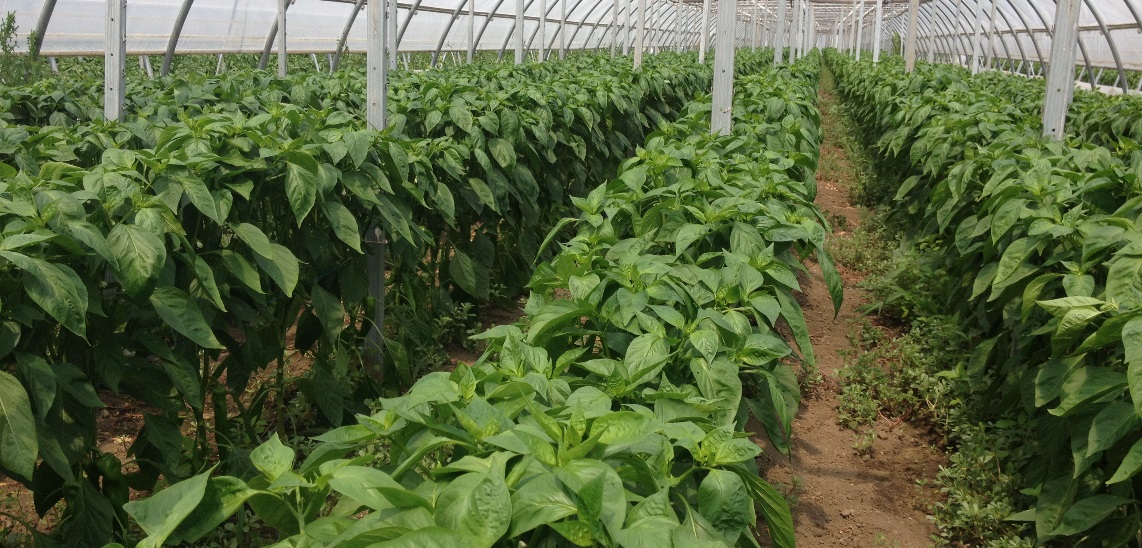
There is growing enthusiasm for the idea that, in the future, greenhouses will be stacked on top of one another to grow vegetables right in the city. Yet hardly anyone stops to consider whether this is even possible or practical.
You wouldn’t need to build special high-rises for mushrooms, asparagus, or chicory, because they grow just fine in dark basements that already exist. The top floor is, of course, ideal for growing plants. But you wouldn’t need to erect a tower just for that—existing rooftops would suffice. The idea here is to grow plants on multiple floors stacked on top of each other on a large industrial scale. I don’t count green facades as part of this. Nor do I include other forms of vertical farming where plants that don’t need much light are grown on a single floor, with conveyor belts ensuring each plant gets the same amount of time in the sun. This is already working in Singapore (the“Sky Greens”project). When the sky is overcast or in winter, there won’t be enough light for all the plants. In this country, therefore, this concept would be virtually impossible to implement in this form.
[av_heading heading='Artificial Light' tag='h3' style=" size=" subheading_active=" subheading_size='15' padding='10' color=" custom_font=" admin_preview_bg="][/av_heading]
Visionary Dickson Despommier wants to make agriculture completely independent of sunlight. Artificial light is what makes the vertical farms he envisions possible. Mirrors or similar devices would cause the land requirements to grow back to the size of ordinary greenhouses. After all, no matter how clever the design, you can’t increase the amount of sunlight, and plants need plenty of it. You can’t grow lettuce at home on your kitchen table. Furthermore, the enormous technical effort involved argues against gigantic mirror systems. With artificial lighting, on the other hand, the energy consumption is enormous, as I calculate below, and therefore I don’t see the benefit of vertical farms.
The calorific value of the finished food product provides a lower limit for the amount of energy required. For example, wheat grains contain about 14,000 kilojoules per kilogram. This energy must be supplied to the wheat plant via the lamps if it is to grow without sunlight. Ideally, that would amount to 3.9 kilowatt-hours, which would cost 78 cents per kilogram. In practice, the plant stores only about 1 percent of the energy in its usable parts. The wheat from the “incubator” would therefore cost €78/kg—just for the lighting! Even if one could produce the electricity oneself at one-tenth of the retail price (2 cents/kWh), it would still be wildly uneconomical, because the construction of the building and the highly efficient lighting are not free either. The indoor gardener does not seem to be able to compete with a farmer who uses the sun as a free energy source.
Okay, so vertical farming with artificial light isn’t an option for high-energy crops, but what about lettuce, for example? It’s already being grown successfully in England without natural light. However, I can’t find any information anywhere on how much energy that requires. So I’m doing the math myself again, this time from the other side: sunlight has 1,000 watts per square meter, but only the red and green light is used by plants for photosynthesis. Efficient lamps therefore only need to produce these colors and can generate an intensity similar to sunlight with just around 100 watts per square meter. Not all plants need this intensity. According to a brochure, lettuce grows even at 10 watts per square meter. This corresponds to an overcast sky, but is still ten times more than the typical brightness in (lit) indoor spaces. Only at the beginning of its life does lettuce need 25 watts per square meter. After 3–8 weeks, it is ready for harvest. With 16 hours of lighting per day, the lighting energy totals around 5 kWh/m². This energy can be saved—with the same result—in a single-story greenhouse, as is currently standard.
[av_heading heading='Environmental Benefits' tag='h3' style="" size="" subheading_active="" subheading_size='15' padding='10' color="" custom_font="" admin_preview_bg=""][/av_heading]
What is the environmental benefit of the additional energy expended? People often point to the reduced land use associated with vertical farming. But energy is the biggest environmental problem. This is precisely what we would be exacerbating by growing crops in dark, high-rise buildings, while achieving only relatively insignificant savings in other environmental factors (assuming that agricultural land would actually be returned to nature as a result, which I doubt). The reduced transport requirements are not an argument for glass skyscrapers, at least not for cities like Vienna, where greenhouses can also be located at ground level on the outskirts. In general, transport accounts for only about a quarter of the carbon footprint of fresh vegetables (see the example of broccoli). Tomatoes from Spain cause fewerCO2 emissions than those from a local greenhouse—even accounting for transportation—if the greenhouse needs to be heated. Regional sourcing is only a third-choice option. What matters most are: the type of production (preferably organic) and seasonal cultivation.
Fortunately, there is not yet any large-scale vertical farming using artificial lighting. Even without doing the math, it’s clear that this concept would be uneconomical simply because artificial lighting isn’t even used in Austrian greenhouses to extend the growing season for vegetables. It certainly wouldn’t be worth it if virtually all the light had to come from the power grid.
Nevertheless, there is already empirical evidence that starkly illustrates the scale of the energy required: For illegal drug production, hemp is grown under artificial lighting, isolated from the outside world. This requires an estimated 300–900kWh of electricity per plant until it is ready for harvest. At a price of €10 per gram of cannabis, it pays off. Ecologically, however, it is a disaster. It is estimated that in the U.S., 1 percent of total electricity consumption is attributable to clandestine hemp plantations. 1 percent! Just for a few hemp flowers! It’s easy to imagine how bad things would look if all our vegetables came from illuminated greenhouses…
Am I just not enthusiastic enough, or are vertical farms with LED lights instead of sunlight really a crazy idea? Even if (in the distant future) the costs were to drop to zero, wouldn’t everyone just set up their own automated growing systems at home? Why build dedicated towers?
[av_promobox button='no' label='Click me' link='manually,http://' link_target="" color='theme-color' custom_bg='#444444' custom_font='#ffffff’ size=’large’ icon_select=’no’ icon=’ue800’ font=’entypo-fontello’ box_color=“ box_custom_font=’#ffffff’ box_custom_bg=’#444444’ box_custom_border=’#333333’ admin_preview_bg=“]
 About the author, Mario Sedlak
Born in Vienna in 1975; graduated with a degree in Applied Mathematics from the Vienna University of Technology in 2000; has been a technical expert in the electricity industry since 2008
[/av_promobox]