
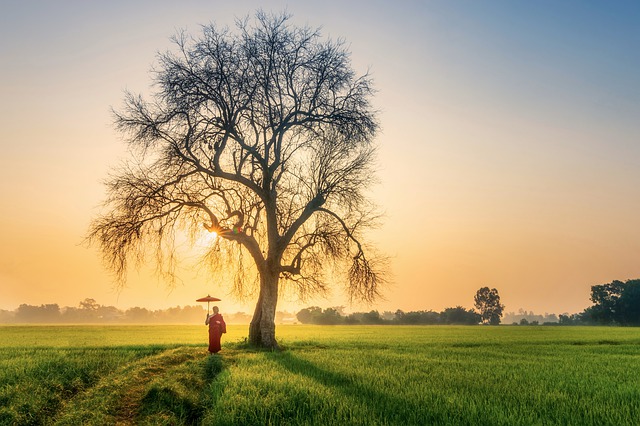
*A Cloud Never Dies* is the title of the documentary that traces the life of the Buddhist monk Thich Nhat Hanh, who passed away in January. Not only did he survive the Vietnam War, found “engaged Buddhism,” and write over 100 books, but he was also personally nominated for the Nobel Peace Prize by Martin Luther King Jr. We follow the cloud—for a moment.
It all began with a picture: the image of a Buddha statue on the cover of a newspaper. When the young Thich Nhat Hanh saw this picture, he was magically captivated by the serenity on the Buddha’s face. A spell that would never leave him for the rest of his life. At the age of 16, he became a monk. He immersed himself in the depths of Zen meditation and, on the side, tended buffalo.
Times in his homeland could not have been more turbulent back then. In his youth, he experienced it all—from colonial rule, war, and invasions by foreign powers to a great famine. Despite all the turmoil, he found solace in the study of ancient Buddhist texts. In doing so, he realized that Buddhism had time and again contributed to peaceful turning points in history, and it was precisely this treasure he wanted to revive.
Since Buddhism had become increasingly stagnant and marginalized in Vietnamese society during that period, Thich Nhat Hanh set out to completely revitalize it. He wanted to revitalize its outdated image and restore Buddhism to a living tradition of peace.
He realized that in times of great crisis, monks had to offer people more than just songs and prayers. That is why, as a young man, he chose the name Nhat Than for himself, which means “action.”
During the Vietnam War, bombs were falling outside the meditation halls. He found it difficult to come to terms with the scale of the violence and war, and he meditated intensely to combat his anger and grief. When he discovered the practice of mindful breathing in an ancient text, it became the key to overcoming his suffering.
Based on this, he developed a walking meditation that combines mindful breathing with each step. This type of meditation, along with other methods that help people cope with painful emotions, became central to his teachings.
While the war in Vietnam raged, he founded a peaceful community in the mountains of Vietnam with like-minded people. The name they chose reflected the spirit of the times: Puang Boi, meaning “fragile palm leaves.” They wanted to defy the violence and despair outside, revive Buddhism, and take it to the next level. A few years later, however, the war reached their mountain refuge as well, forcing them to flee.
In 1961, while the war was still raging, Thich Nhat Hanh went to the United States to study and teach at Princeton and Columbia University. There, he deepened his meditation practice and discovered the possibility of true peace: freedom from hatred, fear, and worry. In the heart of the present moment. For him, these were the first tender blossoms of awakening.
After the war, he was called back to Vietnam to lead the peace movement there. He founded a university, a publishing house, and a Buddhist newspaper. The peace poems he wrote were set to music by well-known Vietnamese singers.
He was also a co-founder of a movement that actively promoted reconstruction in devastated rural areas, established communities, engaged in agriculture, and cared for orphans.
In the 1960s, he founded a new Buddhist order as a spiritual resistance movement: the “Order of Interbeing.” Interbeing describes the interconnectedness with everyone and everything else that is. Feeling this interconnectedness while simultaneously practicing letting go was always a central focus of Thich Nhat Hanh’s mindfulness training. This involved letting go of all ideologies, including Buddhist ones.
In 1982, he founded the now world-renowned Buddhist meditation center “Plum Village” in southern France. Retreats and seminars are still offered there today to teach his mindfulness practices.
Thich Nhat Hanh passed away on January 22, 2022. Thousands of monks and followers attended the funeral in Hue, Vietnam, and the procession, which was adorned in bright yellow and red.
The documentary "A Cloud Never Dies" (available for free online) offers a moving account of his remarkable life story. Rating: a must-see.
Mindfulness means being aware of what is happening. Everyone is capable of being mindful. Mindfulness always refers to being mindful of something. If you are angry and you know that you are angry, that is mindfulness of the anger. Being mindful in that moment makes the moment safer and less dangerous.
You can be mindful of anger, sadness, joy, drinking, walking, breathing, and cooking. Mindfulness can be practiced in every moment of daily life. In this way, you cultivate the energy of mindfulness.
And this energy can, in turn, bring out the energy of concentration. If you are mindful—for example, when looking at a flower—you can focus your full attention on it. For as long as you like. And if you are truly mindful, you will discover the inner nature of things when you touch them. Without mindfulness, there is no concentration and no insight into the inner nature of things.
If you'd like to read more about and by Thich Nhat Hanh, here is a list of books that have also been published in German.