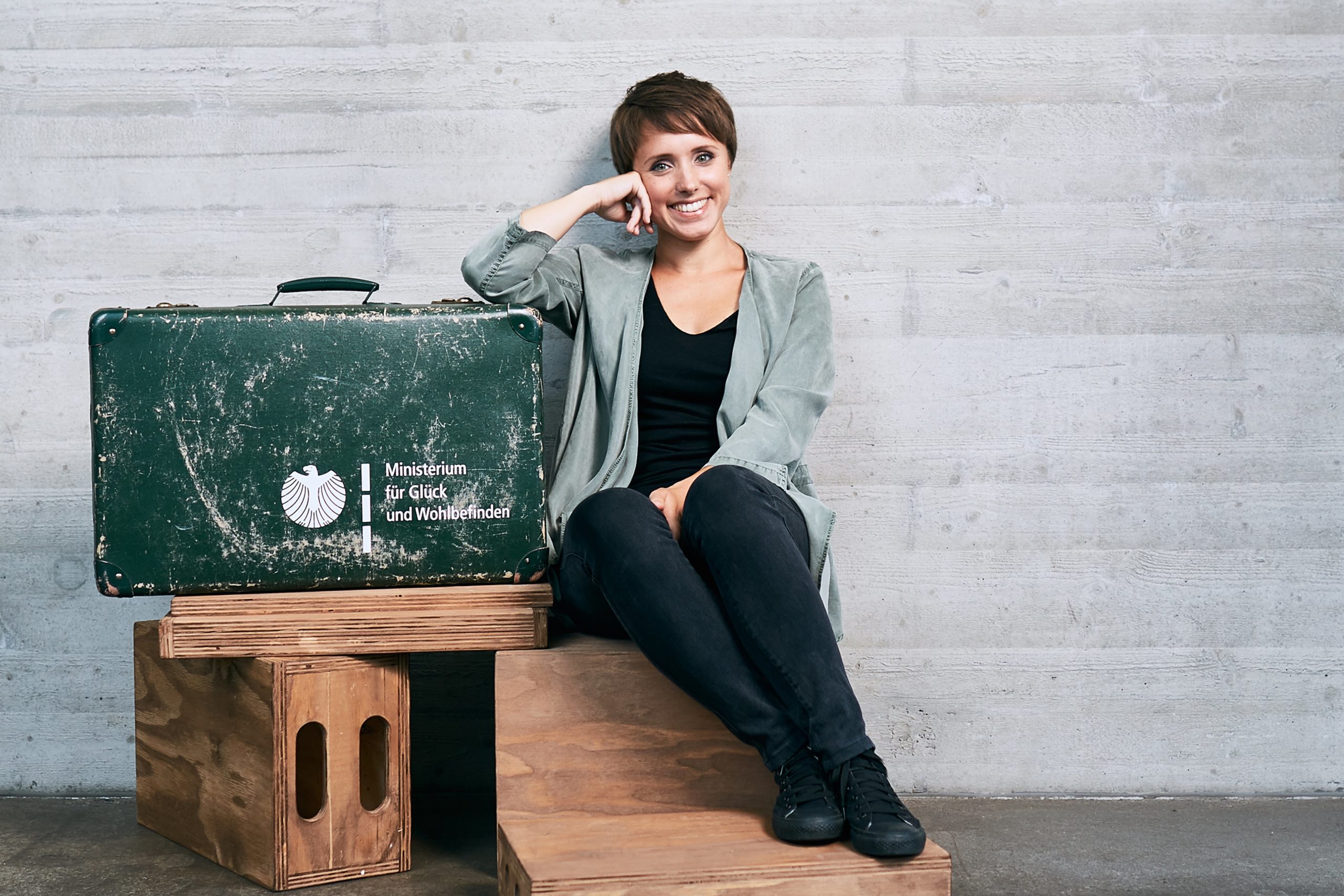

Germany has a “ministry” with a catchy name: the Ministry of Happiness and Well-being. This independent initiative focuses on “raising awareness of the good life.” We sat down with founder and Minister of Happiness Gina Schöler for an interview.
It certainly doesn’t mean that we all have to be happy-go-lucky all the time. In social and political discourse, people sometimes talk about “toxic positivity.” So when I talk about “happiness,” I don’t mean that everything always runs like clockwork and that everyone is forced to be happy.
My goal is to build a solid foundation of personal and social values that make it easier for us to lead fulfilling lives. Promoting happiness means creating the conditions necessary to experience as many positive emotions as possible—whether within the family, in education, or in business and politics. It is also about approaching our own well-being and that of the world in a thoughtful and healthy way.
I stumbled into this 10 years ago. As part of our master’s program in communication design at Mannheim University of Applied Sciences, we were assigned the task of devising ways to use communication design methods to bring about a positive shift in societal values.
Back then, Bhutan was in the media spotlight thanks to its Gross National Happiness index. We realized that our “higher, faster, further, more” approach was neither ecologically nor socially sustainable. That was a game-changer for me. Especially at the highest political levels, we need to ask ourselves: why are we doing all this? And I hope the answer is: to ensure the best possible life for people and nature.
That’s how the provocative, political metaphor of the “Ministry of Happiness” came about. In the Western world, not much had been done in this area yet. From a branding perspective, it was also interesting to fill that gap. It turned out to be a runaway success and has stayed with me ever since.
Right now, the need for happiness is immense. There are crises everywhere. I’m a very empathetic person. I have to be careful not to take too much of it home with me at night. Because when it comes to personal issues, all boundaries are down.
But I also realize that, of course, I can’t be solely responsible for everything. I encourage people to take responsibility for themselves. After all, I’m not in a position to wave a magic wand and solve the nation’s problems; I’m a catalyst who points out paths and possibilities, asks questions, listens, and encourages people to take their first steps toward happiness.
At the start of the pandemic, we asked ourselves as a team: Is it even appropriate to talk about happiness right now? Isn’t that a bit simplistic? But we quickly realized—and received feedback from the community confirming—that we’re needed right now to keep people from burying their heads in the sand. Optimism is like a high-performance sport these days. It’s exhausting to keep the flag flying, but I’m happy to do it.
Appreciation and gratitude are my biggest passions. I like to pull them out of my hat even when I’m not feeling my best. It’s important to show appreciation, for example, to a neighbor, a coworker, or a partner. To tell them how important they are and how they contribute to a fulfilling life. And that gets lost far too often in the hustle and bustle of everyday life. From the perspective of happiness research, this is a very important building block.
According to Joseph Beuys, everyone is an artist—including those who are masters of the art of living. Creativity doesn’t necessarily mean being able to paint beautifully or play an instrument. Creativity is reflected in the way we think and act: trying new things, making new connections, thinking outside the box, doing things differently… Nor do I claim to have to reach everyone. I open up my vendor’s tray and offer this very repertoire of workshops, events, books, and creative methods. My goal is for people to help themselves to these resources as needed. But I don’t force them on anyone. For this to be sustainable, a dose of intrinsic motivation is needed. Where the door is already slightly open, I’m happy to knock. But where everything is locked and bolted shut, I tell myself: everyone has their own time.
But generally speaking, creative approaches work even within conservative event settings. I work a lot with tactile objects, don’t use PowerPoint presentations, and enjoy bringing out the inner child. This works—even within rigid structures—better than you might think.
Over the past 10 years, some of the craziest things have happened. Once, a 50-member delegation from Thailand came specifically to learn about the work of our Ministry of Happiness. I had told them that we weren’t a real political institution, but they wanted to get to know us. I had rented a hall at Mannheim Palace specifically for the occasion to make sure the event was proper and representative. It was a great event. Other highlights included our collaboration with the Ministry of Justice and the invitation to the OECD conference in Paris.
But what really moved me most were those “mini-moments”—the times when I could set off a small chain reaction. When a tear rolls down someone’s cheek, a realization suddenly hits, a career change takes place, or people travel halfway around the world to see a family member again.
On my computer, I have a folder called “Digital Praise Bank.” That’s where I save all the screenshots of nice comments, feedback, or emails, and I pull them out whenever that little critic inside me starts to speak up. I also have an analog version of it, with all the little notes I’ve been given or sent.
Next to me is a bouquet of flowers that a dear friend gave me. I buy them for myself regularly, too. Things like that really make a difference in everyday life.
Iceland, Scotland, and New Zealand have formed an alliance to give “well-being” a more prominent role in public policy. And here in Germany, too, we like to ask: “[1]What if?”
So far, we’ve mostly been met with an open ear, even in political circles. Of course, there have been a few critical voices here and there, and accusations of “forcing happiness” when our approach wasn’t understood.
There are many people around the world who have realized that political decisions also require a holistic approach. And maybe our idea isn't so crazy after all—maybe we're just ahead of our time (laughs).
It’s not yet a widespread movement, but the first tentative steps are being taken. Not just in politics. There’s also a strong push in the education system and within companies. Everywhere, a fundamental building block is the idea that people should be allowed to be human—that they should feel seen, valued, and part of a system. Happiness, well-being, healthy relationships, and contentment form the foundation—more and more people are recognizing this. It’s starting. And I’m very optimistic.
Try something that seems a little crazy! It takes a few tests of courage and small challenges to figure out what really does you good and makes you happy.
And that’s exactly what I’m all about: encouraging people to embark on this journey, this process that lies at the heart of a fulfilling life. Such processes can also be grueling and exhausting. I always say that happiness comes with its own set of challenges. But it’s worth it. And when you bring others along for the ride, it creates an incredibly strong bond.