
It is a cold December day in the Hainburg floodplain. Thousands of people are undeterred as they wander through the floodplain forest. They bring with them loud chants, defiant signs, and a great deal of passion. The destruction of this natural wonder to make way for a Danube power plant must be stopped—because the excavators are already standing by. Their commitment will pay off: thanks to the public outcry, the clearing of the forest was prevented in 1984. Civil society’s first major victory has long since become an Austrian legend.
[av_heading heading='The Fire Still Burns' tag='h3' style="" size="" subheading_active="" subheading_size='15' padding='10' color="" custom_font="" admin_preview_bg=""][/av_heading]
But were the Hainburg protests a one-off event in recent history? Not at all. For anyone who looks more closely will see that the flame of protest has never quite stopped burning among the Austrian population—even if it sometimes seems that way. This is demonstrated, for example, by a recent research project by political scientist Martin Dolezal of the University of Vienna. His study, “The Austrian Protest Arena in the 21st Century,” counts around 8,500 protest events in Austria between 1998 and 2016. The most common reason for protest, accounting for over a fifth of cases, is environmental issues. This includes demonstrations against nuclear energy and genetic engineering in agriculture, as well as actions by animal rights activists.
[av_promobox button='yes' label='Learn more about SOS Mitmensch' link='manually,https://www.sosmitmensch.at/' link_target='_blank' color='theme-color' custom_bg='#444444' custom_font='#ffffff’ size=’medium’ icon_select=’no’ icon=’ue800’ font=’entypo-fontello’ box_color=“ box_custom_font=’#ffffff’ box_custom_bg=’#444444’ box_custom_border=’#333333’ admin_preview_bg=“]
SOS Mitmensch – Lights of Hope for All
In mid-November 2017, around 10,000 people marched into the Austrian government district carrying candles, torches, and flashing lights to raise their voices in support of humanity and a socially just society. The march was organized by SOS Mitmensch. The pressure group’s mission: to fight together for human rights. Founded on December 10, 1992, SOS Mitmensch is committed to equality and equal opportunities for all people.
[/av_promobox]
[av_heading heading='Three Ingredients That Are Changing Society' tag='h3' style="" size="" subheading_active="" subheading_size='15' padding='10' color="" custom_font="" admin_preview_bg=""][/av_heading]
So one might get the impression that the fire is burning, at least to some extent. Only one question remains: What does it take for a few demonstrations to truly become a movement that politicians must take seriously? Ingredient number one: public concern. The activists in Hainburg, for example, identified with the threatened natural environment and stood up for it. Another ingredient: the desire for a promising future. Will we leave our children a free, democratic society in an environment worth living in, or will the deluge break out behind us? A question that today seems to be prompting many citizens to rise from their comfortable sofas once again. For this discontent to ultimately truly give rise to a movement, a third ingredient is crucial. This conviction must be shared by diverse social groups. Only when women and men, old and young, workers, ordinary citizens, and the educated are equally outraged will decision-makers be forced to act.
[av_heading heading='The civilian population isn't sleeping on the job internationally either' tag='h3' style=" size=" subheading_active=" subheading_size='15' padding='10' color=" custom_font=" admin_preview_bg="][/av_heading]
The climate marches of recent years have demonstrated that this approach is effective on an international scale as well. When hundreds of thousands of people took to the streets in 150 countries on September 21, 2014, to advocate for climate protection, it was the largest demonstration of its kind worldwide to date. Further “Global Climate Marches” followed a year later—in total, there were more than 1.5 million participants in 2014 and 2015. Activism without consequences? On the contrary: the wake-up call was heard. Christiana Figueres, Executive Secretary of the UN Climate Change Conference in Paris, saw it as a show of support: “When we saw the massive demonstrations, we knew we had the people on our side.” This, in turn, gave conference participants additional motivation to take action. In December 2015, the Paris Agreement was signed by all nations of the world.

[av_heading heading='Internet platforms mobilize the masses' tag='h3' style=" size=" subheading_active=" subheading_size='15' padding='10' color=" custom_font=" admin_preview_bg="][/av_heading]
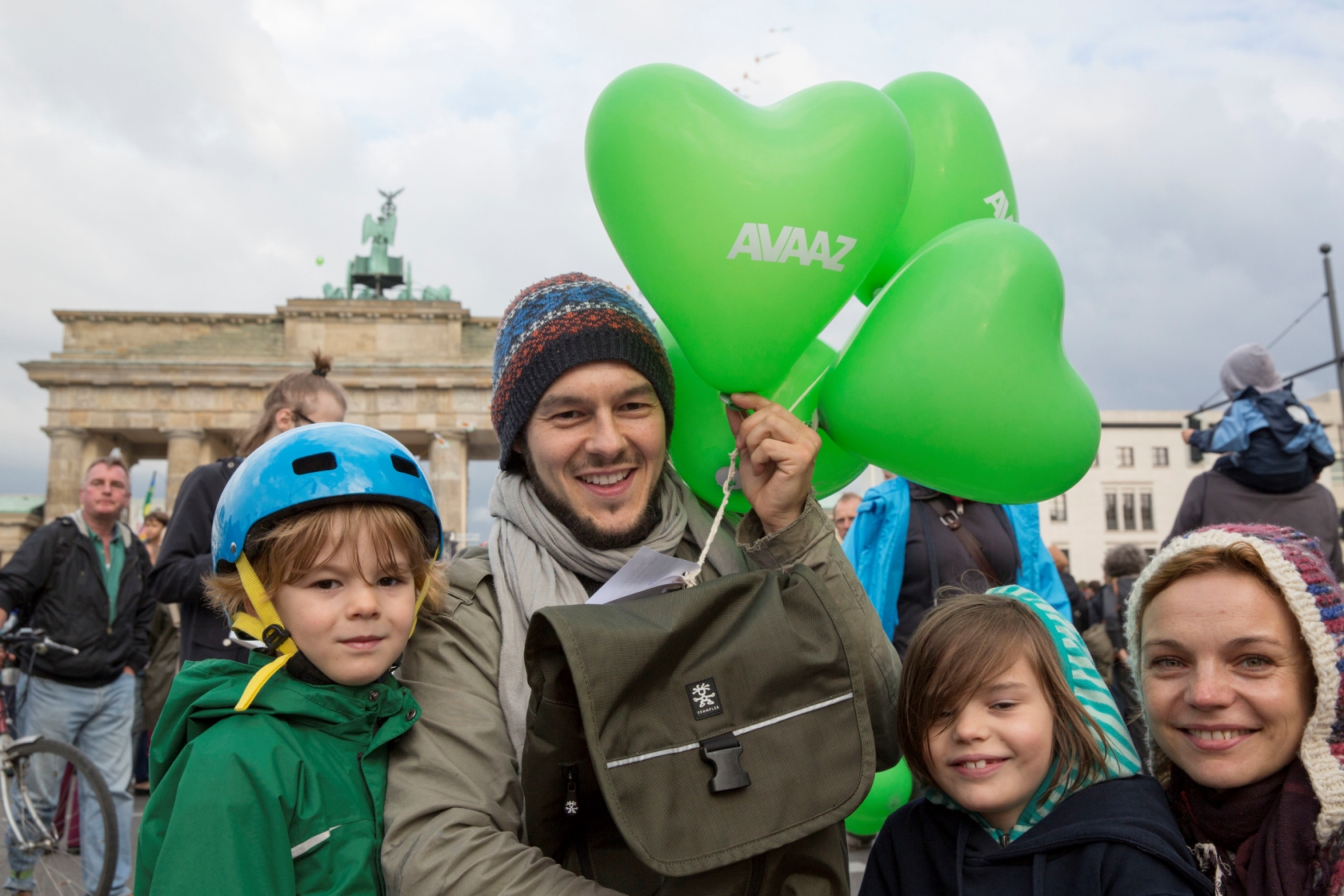
The global climate marches are a prime example of how civic engagement makes a difference. Compared to the protests in the Hainburger Au in the 1980s, however, one difference stands out. Thanks to the technological possibilities of the internet, the younger generation has a clear advantage when it comes to mobilizing like-minded people. For the climate marches, for example, the necessary platform was provided by the global citizen movement Avaaz.
[av_promobox button='yes' label='Learn more about Avaaz' link='manually,https://secure.avaaz.org/page/de/' link_target='_blank' color='theme-color' custom_bg='#444444' custom_font='#ffffff’ size=’medium’ icon_select=’no’ icon=’ue800’ font=’entypo-fontello’ box_color=“ box_custom_font=’#ffffff’ box_custom_bg=’#444444’ box_custom_border=’#333333’ admin_preview_bg=“]
Avaaz – the world on one platform
Avaaz currently has more than 46 million members—that’s how many supporters it has. Anyone who has ever signed a petition is counted as a member. Founded in 2007, this citizens’ movement mobilizes people around the world. Its goal is to take action against environmental, political, and humanitarian injustices that would otherwise not garner enough public attention. The organization operates with a small core team across all continents, supported by thousands of volunteers, and is active in 17 languages.
[/av_promobox]
Millions of people around the world feel a shared responsibility for the pressing issues of our time. In the digital age, networking can create a tremendous snowball effect. People who don’t know each other and live in different places can be rallied to take collective action. Avaaz harnesses this potential by having the movement determine its annual priorities through a member survey. It also sends campaign ideas weekly to 10,000 members selected at random. The issues that generate sufficient interest are pursued further. In total, over 2,800 campaigns have already been launched. The citizen movement is active in Austria as well.
[av_promobox button='yes' label='Learn more about #aufstehn' link='manually,https://www.aufstehn.at/' link_target='_blank' color='theme-color' custom_bg='#444444' custom_font='#ffffff’ size=’medium’ icon_select=’no’ icon=’ue800’ font=’entypo-fontello’ box_color=“ box_custom_font=’#ffffff’ box_custom_bg=’#444444’ box_custom_border=’#333333’ admin_preview_bg=“]
#aufstehn – Online campaigns across Austria
From the “Chain of Lights” campaign against right-wing extremism to an open letter against misogyny and an initiative against plastic waste: #aufstehn is an Austrian community that works together to promote positive coexistence and social, economic, and environmental justice. At its core is a community of over 50,000 dedicated individuals who take part in online campaigns, join public protests, or represent their shared interests at rallies.
[/av_promobox]
[av_heading heading='Getting things done is just more fun' tag='h3' style=" size=" subheading_active=" subheading_size='15' padding='10' color=" custom_font=" admin_preview_bg="][/av_heading]
At the moment, it seems that civil society protests are gaining momentum again in Austria. Only time will tell what impact they will have. The fact is: We live in circumstances that enable us to take action and bring about change—whether for the environment or a more just society. The public can—or should we say must—step up and take responsibility where politics fails. And ultimately, everyone should ask themselves: Isn’t it much more fun to shape the world we live in than to simply endure it?
[av_notification title=" color='silver' border=" custom_bg='#444444' custom_font='#ffffff' size='normal' icon_select='yes' icon='ue80b' font='entypo-fontello' admin_preview_bg="]
Source: Among other things, an interview with Daniel Boese [/av_notification]
[av_notification title=" color='green' border=" custom_bg='#444444' custom_font='#ffffff' size='normal' icon_select='yes' icon='ue837' font='entypo-fontello' admin_preview_bg="]
Editorial article
[/av_notification]