

Neonicotinoids—a word few people can pronounce—are now considered by scientists to be just as dangerous as DDT, which was banned in the early 1970s. While the debate surrounding glyphosate centers on just how harmful it is to organisms, the same has already been proven for neonicotinoids. For a sparrow, consuming just 1–2 treated seeds is enough to reach a lethal dose.
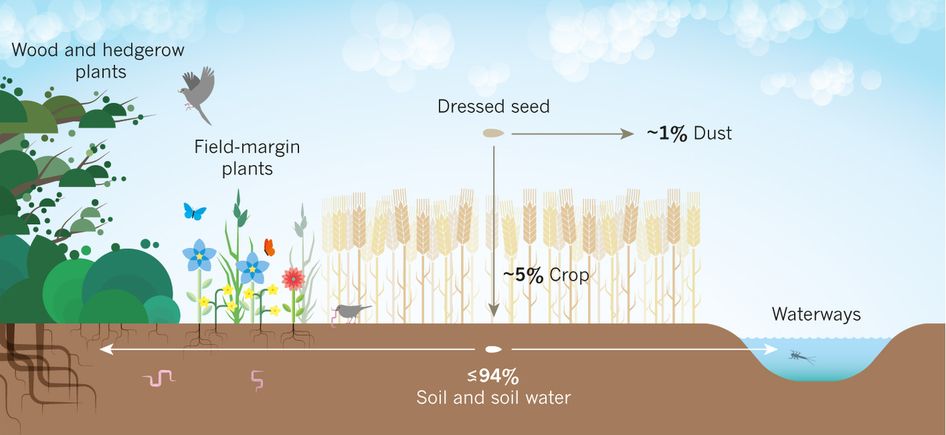
Neonicotinoids were discovered in the 1970s and commercialized in the 1990s with imidacloprid by Bayer AG. “Neonicotinoids” are synthetic nicotine compoundsthat act as neurotoxins. They are pesticides with a “systemic effect,” meaning that the active ingredients used to treat seeds before planting (i.e., seed dressing) do not remain on the seeds. Due to the high water solubility of neonicotinoids, they are transported further within the plant and distributed throughout all parts of the plant, including the pollen and nectar. This is also intentional, as it ensures that all pests that feed on plant parts—whether the root or the leaf—die.
Their ease of use and perceived low toxicity to mammals quickly made neonicotinoids very successful, and imidacloprid is now one of the most widely used insecticides in the world.
[av_heading heading='The Harm Is Obvious' tag='h3' style=" size=" subheading_active=" subheading_size='15' padding='10' color=" custom_font=" admin_preview_bg="][/av_heading]
A growing number of studies show a link between the use of neonicotinoid insecticides and the collapse of bee colonies and the decline of pollinator species. In 2008, the neonicotinoid clothianidin, a successor to imidacloprid, caused a mass die-off of bee colonies in the Upper Rhine Valley because the pesticide did not adhere well to corn seeds.
When used correctly, neonicotinoids are not directly lethal to bees, but they do cause behavioral changes, such as poorer brood care, reduced foraging, and disorientation. Of course, the insecticides applied are not only ingested by bees, but also by other nectar-gathering and plant-eating insects and organisms.
[av_heading heading='Neonicotinoids Are Everywhere' tag='h3' style=" size=" subheading_active=" subheading_size='15' padding='10' color=" custom_font=" admin_preview_bg="][/av_heading]
[av_heading heading='Aren't neonicotinoids already banned!?' tag='h3' style=" size=" subheading_active=" subheading_size='15' padding='10' color=" custom_font=" admin_preview_bg="][/av_heading]
After the European Food Safety Authority (EFSA) also confirmed the harmful effects of neonicotinoids on bees, the European Commission restricted the use of three neonicotinoids in 2013 and banned them outright in 2018. This restriction applies to clothianidin, thiamethoxam, and imidacloprid. However, five other neonicotinoids remain approved for use in plant protection. These include acetamiprid, dinotefuran, nitenpyram, nithiazine, and thiacloprid. They are considered to be less toxic to bees.
Furthermore, emergency authorizations for the use of neonicotinoids have been granted in various EU countries, such as for sugar beets in Austria. In doing so, the Federal Office for Food Safety yielded to pressure from the agricultural sector. The authorization was granted on the grounds that sugar beets do not flower, and therefore do not harm bees. But what about the source of the poison, Hongitau, for bees? And what about all the other animals that ingest the neurotoxin? Don’t forget that 94 percent of the neonicotinoids applied end up in the soil, water, and other organisms instead of on the treated plant. Why isn’t a ban on all neonicotinoids possible, as in France?
[av_heading heading='Is there a way out?' tag='h3' style=" size=" subheading_active=" subheading_size='15' padding='10' color=" custom_font=" admin_preview_bg="][/av_heading]
In Austria, 25 percent of the conventional sugar beet harvest was lost to pests in 2018—despite the use of neonicotinoids, it should be noted. In the organic sector, the figure was as high as 86 percent, due in part to a shortage of farmhands to weed the fields.
Does that mean we can’t do without pesticides? No, unfortunately it means that we have long since strayed from good agricultural practices and, through decades of pesticide use, have wiped out natural predators. In Austria, 70 percent of vertebrates have been lost over the past 30 years, with farmland birds being particularly affected. The decline in insect populations is also enormous. Diverse agricultural structures such as hedgerows, fallow land, and thus refuges for beneficial organisms have been destroyed; even the current rise in organic farming can only slowly compensate for this. Sensible practices, such as growing humus-depleting crops like sugar beets only every six years, have fallen into disuse.
If we want to restore biodiversity and break free from the vicious cycle of dependence on chemical companies, we need an agriculture system free of pesticides. A positive example is organic farming, which uses almost no synthetic chemical pesticides—or, in the case of “Prüf Nach!” certification, none at all. It is no coincidence that organic farming is by far the most superior to conventional farming in terms of biodiversity. According to a study published in January 2019, the average number of species of arable flora is 95 percent higher in organic farming, the number of field birds is 35 percent higher, and the number of pollinating insects is 23 percent higher. The biomass of earthworms was 78 to 94 percent higher.
We need a farming landscape with diverse structures, such as individual trees, hedges, uncultivated or mowed fallow land, and meandering streams. Training and raising awareness among farmers plays a key role in this, as does ensuring that the measures implemented are affordable for farmers. This can be achieved either through state subsidies or through cost transparency. If farms had to share the environmental costs they cause—for example, through pesticide use—this would quickly be achieved. Environmentally friendly and nature-conserving products would be the most affordable.
Farming used to be part of the natural landscape, not part of industry. In fact, it increased biodiversity rather than reducing it. It would be nice if we could return to that understanding.
[av_promobox button='no' label='Click me' link='manually,http://' link_target="" color='theme-color' custom_bg='#444444' custom_font='#ffffff’ size=’large’ icon_select=’no’ icon=’ue800’ font=’entypo-fontello’ box_color=“ box_custom_font=’#ffffff’ box_custom_bg=’#444444’ box_custom_border=’#333333’ admin_preview_bg=“]
 About the Author
Dr. Isabell Riedl has served as Sustainability Officer and worked in communications at Werner Lampert GmbH since 2012. She studied ecology at the University of Vienna, specializing in nature and landscape conservation and tropical ecology. Her dissertation focused on the importance of tree lines in agricultural areas for forest birds in Costa Rica. Throughout her life, she has been particularly dedicated to ecological sustainability. She is part of the editorial team of the online magazine “Nachhaltigkeit. Neu denken.”
[/av_promobox]
[av_notification title=" color='silver' border=" custom_bg='#444444' custom_font='#ffffff' size='normal' icon_select='yes' icon='ue80b' font='entypo-fontello' admin_preview_bg="]
Sources
[/av_notification]