
It all began with a walk in Vienna’s Augarten… at least, the research for this article did. In this historic city park, which was originally a species-rich floodplain landscape, you can immerse yourself in the world of biodiversity. A QR code leads to short audio clips that share interesting facts. In the process, I came across an important aspect of species conservation that was new to me:
Infrastructure? Well-maintained, safe roads, nearby hospitals and shopping centers, good cell phone and internet reception? No, “green” infrastructure! So, wind turbines and public transportation? Not that either. Connected natural landscapes and ecosystems where animals and plants can migrate, spread, and maintain their symbiotic relationships!
Imagine there was an endless concrete wasteland right outside your front door—a place where you could theoretically walk, but it’s far too hot and far too far to make it to the nearest supermarket alive. But you have to get out of there no matter what, because you can’t turn off the heat in your house. It’s getting unbearably hot. The tap has run dry, and you’re running out of food in the fridge. That’s roughly how countless plants and animals are faring right now.
Global warming and habitat destruction—the two main causes of the current mass extinction—are forcing many species to leave their current habitats and migrate to cooler regions. Over the past 50 years, half of all natural habitats have been lost.
“Biodiversity is best served when it has habitats … and when those habitats are connected,” explains zoologist and biodiversity researcher Christian Raffetseder in an audio recording at the Augarten. This very concept could become a small but important component of a“Global Safety Net”that spans the planet—a global safety net for biodiversity. Just as a transportation network connects populated areas, this network would consist of nature reserves and sustainably managed ecosystems, connected by “nature roads” (Science).
Just as we humans depend on good infrastructure to get through our daily lives, animals and plants also need“green”infrastructure to survive.
The principle is simple:
The rule of thumb for urban living: less manicured lawn, more wilderness!
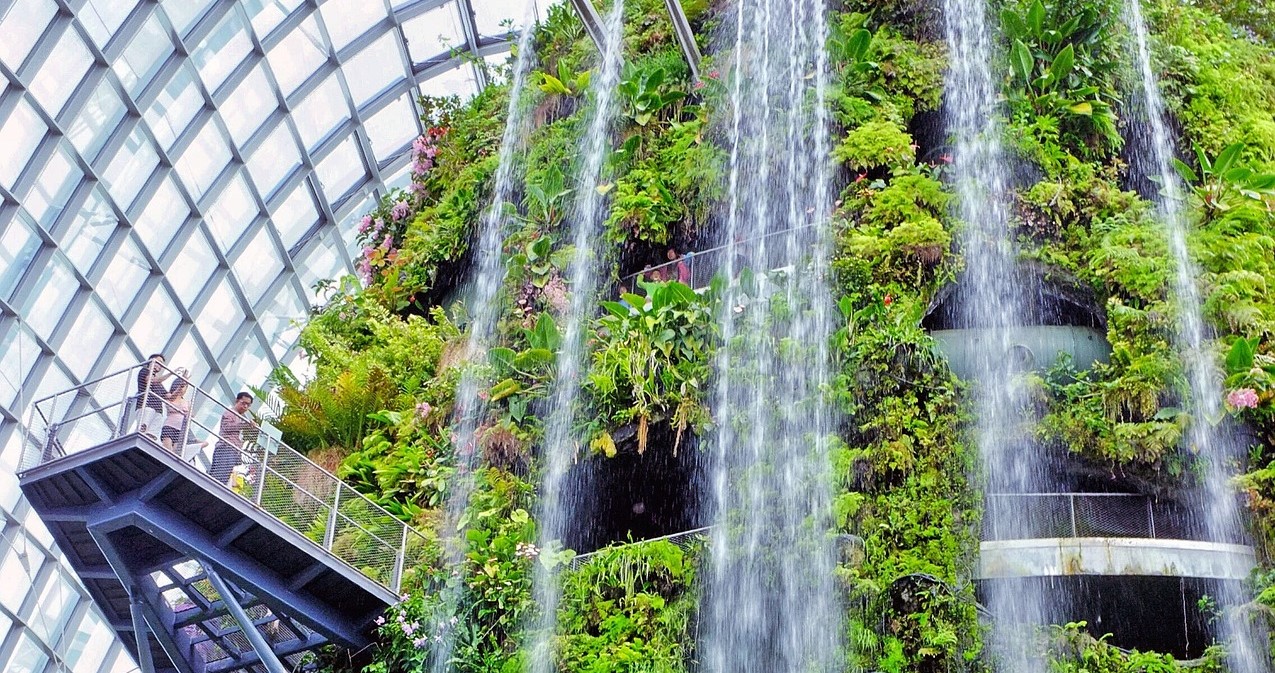
Hedges, flowering meadows, old trees, green roofs, and “breathable,” permeable paving instead of asphalt surfaces. This would allow rainwater to replenish groundwater reserves instead of running off (GreenCityClimate).
If road infrastructure were replaced with green corridors, the Augarten wilderness could be connected to the Prater or the Danube Island—creating many small and large ecological bridges that would allow insects, animals, and plants to migrate from one natural habitat to another.
While cities are not natural hubs like large nature reserves, they are an important part of green networks. Numerous species have adapted exceptionally well to the diverse urban habitats (Umweltdachverband, “Discovering Diversity”):
The common swift feels just as at home in building niches as it does on rock faces. The city blackbird is more resilient to the hustle and bustle of city life than its forest-dwelling counterpart and has even adapted its digestive system to the unique food sources found in the city. Endangered species often find it easier to thrive in urban gardens than on farmland: orchids, snowdrops, hedgehogs, or butterfly species such as the swallowtail.
Urban areas have doubled in size over the past 30 years. Urban ecosystems therefore play a crucial role in species conservation (IPBES).
Did you know that the Augarten is equipped with excellent air conditioning? In one of the audio clips, I’m encouraged to feel the cooling effect of trees by consciously noticing the difference in temperature between a sunny spot and a shady spot. On hot summer days, trees can lower the temperature in the shade by 11 to 25 degrees Celsius. Water evaporates from the tree’s leaves, absorbing heat from the surroundings and cooling the air, the voice in my headphones explains. Green roofs and green walls have similar cooling effects. Biomass also acts as an important CO2 sink (Science). Green infrastructure is therefore extremely relevant for mitigating and adapting to global warming (CCCA).
Why not take a virtual city tour and check out famous landmarks that are quickly transformed into green oases in animations by visual designer Jan Kamensky: Visual Utopias!
In his books, Lino Zeddies, author of *Utopia 2048*, takes readers on a journey into green urban jungles: a trip back in time to the year 2048
Read the fascinating story of the 100-year-old man who created Barcelona’s first rooftop garden over 60 years ago, where more than 40 fruit trees thrive:The Guardian – The centenarian who built Barcelona’s first roof garden
Everyone can help build this network of infrastructure for nature. Start by looking out your window: Where on your street or in your courtyard could concrete be replaced with greenery? Is there room for green facades, which are even financially supported in some cities (e.g., Vienna)? Advocate in your community for promoting biodiversity and urban greening in public spaces. If you have a garden or balcony, fill it with plants or leave part of it entirely to nature. By the way, natural gardening actually requires less work (NDR)! Or you could start, like me, with a walk in the park…