What do a chef from the jungles of Papua, mountain farmers from Upper Austria, French agricultural scientist Gérard Choplin, and organic farming pioneer Werner Lampert have in common? They all care deeply about our food supply. But they’re not just concerned with ensuring we have enough to eat every day—they’re focused on food sovereignty.
Background knowledge and understanding of food sovereignty are not yet widespread. The term is often simply equated with food security, but this causes much of the substance of this important concept to be lost. That is why we are dedicating an entire special feature to this complex topic.
The term is a very recent one, dating from the late 20th century, but the developments that made its emergence necessary naturally go back much further. Industrialization, the Marshall Plan, and trade agreements played a significant role in this (More on the history of food sovereignty). Agriculture became increasingly globalized, and small family farms found themselves under growing pressure. In 1993, the small farmers’ organization “La Via Campesina” was formed in Mons, Belgium.
“Following the 1994 GATT/WTO Agreement, it became clear to the farmers of La Via Campesina that they would have less and less control over their own farms in the future,” writes Gérard Choplin (former policy advisor on food sovereignty for the European Coordination of La Via Campesina). In 1996, the organization presented the concept of food sovereignty for the first time at the FAO World Food Summit in Rome.
The small farmers’ organization La Via Campesina defines food sovereignty as follows: “Food sovereignty is the RIGHT of all peoples, countries, or groups of countries to define their own agricultural and food policies, without engaging in dumping against third countries.” (More on the concept of food sovereignty)
[av_heading heading='Food Sovereignty Today' tag='h3' style="" size="" subheading_active="" subheading_size='15' padding='10' color="" custom_font="" admin_preview_bg=""][/av_heading]
The term was originally coined by small farmers, but a wide variety of institutions and individuals have since taken up the idea and are advocating for it. In the SMART scientific sustainability assessment by the Research Institute of Organic Agriculture, food sovereignty is even one of 58 subtopics of sustainability. (The scientific aspect of food sovereignty)
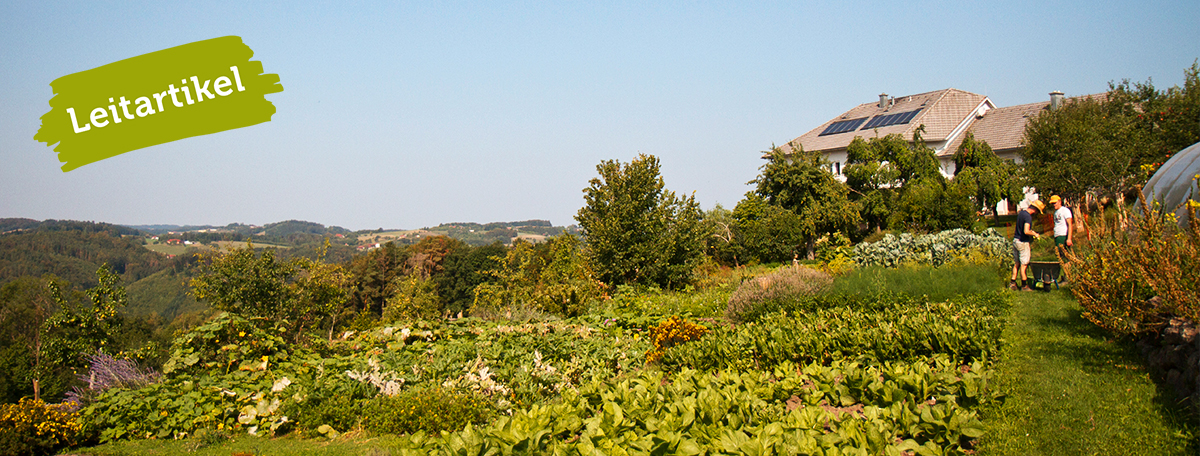
This ideology is embraced and supported by anyone who upholds the principles of food sovereignty—namely, “a fair, ecologically harmonious, and local food and agricultural system” (FAO 2014)—even if they have never heard the term before. This could be a farm in Upper Austria with 50 employees (Introducing the Loidholfhof), but also a so-called indigenous chef in faraway Papua (Chefs Preserve Traditions).
Agricultural scientist and author Andrea Heistinger sees it this way: “You have to look at it from a human perspective: Some people feel comfortable in smaller groups, while others thrive in large teams or are able to grasp the big picture. Food sovereignty is possible in both cases; the main thing is that people can realize their potential and that the system is built on mutuality and relationships.” (Read the interview with the author of “Basic Knowledge of Self-Sufficiency from Organic Gardens”)
[av_heading heading='Take control of your nutrition' tag='h3' style=" size=" subheading_active=" subheading_size='15' padding='10' color=" custom_font=" admin_preview_bg="][/av_heading]
Even if you don't run a farm, you can still contribute to food sovereignty.
Food sovereignty is both political and emotional; it is closely intertwined with economic, social, and environmental factors. It embodies rebellion and revolution, and calls for healthy food that is produced sustainably and under conditions that respect human dignity.
It certainly offers enough interesting material to make it worth focusing on.
[av_promobox button='no' label='Click me' link='manually,http://' link_target="" color='theme-color' custom_bg='#444444' custom_font='#ffffff’ size=’large’ icon_select=’no’ icon=’ue800’ font=’entypo-fontello’ box_color=“ box_custom_font=’#ffffff’ box_custom_bg=’#444444’ box_custom_border=’#333333’ admin_preview_bg=“]
 About the Author
Dr. Isabell Riedl has served as Sustainability Officer and worked in communications at Werner Lampert GmbH since 2012. She studied ecology at the University of Vienna, specializing in nature and landscape conservation and tropical ecology. Her dissertation focused on the importance of tree lines in agricultural areas for forest birds in Costa Rica. Throughout her life, she has been particularly dedicated to ecological sustainability. She is part of the editorial team of the online magazine “Nachhaltigkeit. Neu denken.”
[/av_promobox]