
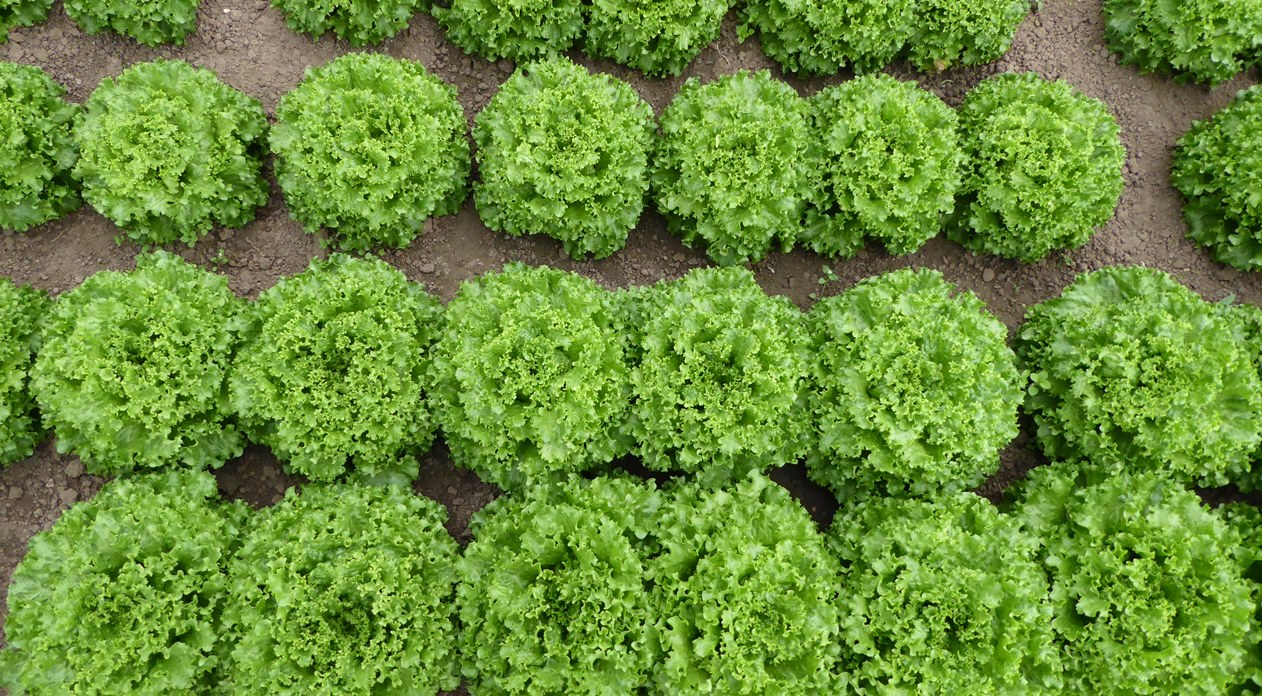
Near New York, three entrepreneurs are currently working on the world’s largest vertical farm. They are combining high-tech solutions with traditional farming methods. Others are also developing new ways to grow lettuce and other greens, drawing on cutting-edge technology and innovative solutions. Reason enough to take a closer look at the “lettuce of the future.”
The founders of the world’s largest vertical farm grow lettuce and herbs in a former steel mill that has now been transformed into a high-tech farm. The founders’ concept: the lettuce plants’ roots hang in the air and are automatically misted. Fertilization is also carried out in this way. Software-controlled LED lights and small fans provide the lettuce with fresh air and sufficient light. A computer records all processes, allowing every step of production to be systematically analyzed. According to the company, productivity is 70% higher than with conventional farming methods.
[av_heading heading='High Tech Meets Agriculture' tag='h3' style="" size="" subheading_active="" subheading_size='15' padding='10' color="" custom_font="" admin_preview_bg=""][/av_heading]
Speaking of technology and agriculture: What few people know is that Fujitsu, a high-tech company, also combines cutting-edge technology with agricultural ambitions. The company has converted a Japanese factory—which manufactured semiconductor wafers until about a year ago—into a 2,000-square-meter farm for growing lettuce. Lettuce plants are grown in cleanrooms that are completely free of dust and bacteria and, most importantly, entirely devoid of sunlight. Fujitsu’s developers are also working on new varieties, such as a low-potassium lettuce for patients with kidney disease or lettuce heads with low nitrate content to make the taste less bitter. According to Fujitsu, the lettuce also has a longer shelf life, and since it is grown in a sterile environment, it requires no pesticides—making it more sustainable than many conventionally grown lettuce varieties.
[av_heading heading='High-Tech Factories and Greenhouses: Agriculture 2.0' tag='h3' style="" size="" subheading_active="" subheading_size='15' padding='10' color="" custom_font="" admin_preview_bg=""][/av_heading]
Fujitsu is by no means alone in this venture in Japan. There are now nearly 400 high-tech vegetable farms in the country. Numerous competitors from the electronics industry have already entered the agricultural sector, such as Toshiba and Panasonic. Toshiba is also focusing on lettuce cultivation, while Panasonic aims to revolutionize the agricultural sector with fully automated greenhouses.
The MITCityFARM project takes a similar approach: The research team at the Massachusetts Institute of Technology is exploring new ways to grow plants using minimal resources—such as light and water—and few nutrients. A high-tech greenhouse is designed to be able to determine at any given moment how each plant is growing and what nutrients it needs. This is intended primarily to save water and fertilizer, and subsequently pesticides. Inside the greenhouse, state-of-the-art sensors and LED lighting ensure that even the amount of light is adjusted to the plants’ needs. As a result, the vegetables no longer need to form stems to grow toward the sun.
NASA is also exploring new cultivation methods: NASA astronauts have successfully grown and cultivated red romaine lettuce aboard the International Space Station (ISS). Incidentally, the astronauts’ lettuce was also illuminated using colored LED lights.
[av_heading heading='UndergroundLow-Carbon Farming Methods' tag='h3' style=" size=" subheading_active=" subheading_size='15' padding='10' color=" custom_font=" admin_preview_bg="][/av_heading]
© nemo’s garden
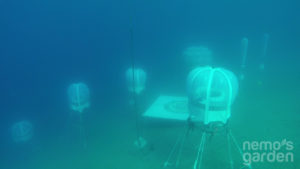
But greenhouses also have a downside— conventional greenhouses are not very climate-friendly. One kilogram of lettuce produces more than 30 times as much carbon dioxide as the same amount grown outdoors. In field cultivation, on the other hand, pesticides are often used. The “Nemo’s Garden” project is working on an underwater cultivation system for lettuce and herbs. With the help of transparent, open-bottomed balloons that are filled with air underwater and anchored to the seabed, greenhouses are created right in the middle of the ocean. The nearly constant temperature of the water provides ideal conditions. The plants do not receive water directly: sunlight shining through the balloons onto the seeds causes the seawater beneath the plant platform to evaporate. The resulting vapor collects at the top of the balloon as salt-free droplets, which then irrigate the plants. Underwater cameras monitor the plants as they grow and thrive.
[av_heading heading='Urban Farming 2.0: Growing Lettuce in Air-Raid Shelters' tag='h3' style="" size="" subheading_active="" subheading_size='15' padding='10' color="" custom_font="" admin_preview_bg=""][/av_heading]
In London, lettuce and other vegetables—such as radishes, garlic, and various herbs— are grown entirely without natural light in eight air-raid shelters located 33 meters below the Clapham neighborhood. Energy-efficient LED lights provide artificial lighting. Additionally, hydroponic systems supply the lettuce plants with nutrients, and recyclable coconut fiber mats serve as a substitute for potting soil. According to the company, this concept saves fertilizer and up to 70 percent of the water used in above-ground cultivation.
Current figures and statistics also show that such conceptual exercises—such as those proposed by leading high-tech providers, as well as innovative research projects outside the realm of conventional agriculture—are indeed worthwhile: The UN estimates that the world’s population will grow by more than 2.5 billion people over the next 35 years. Already today, nearly 800 million people worldwide are going hungry. According to the FAO, IFAD, and WFP, there has been little progress in the fight against hunger.
Furthermore, nearly 75% of the population will live in urban areas in the future—and especially in cities, the space available for agricultural use appears to be limited.
[av_notification title=" color='custom' border=" custom_bg='#e2e8ca' custom_font='#444444' size='normal' icon_select='yes' icon='ue837' font='entypo-fontello' admin_preview_bg="]
Editorial article
[/av_notification]