
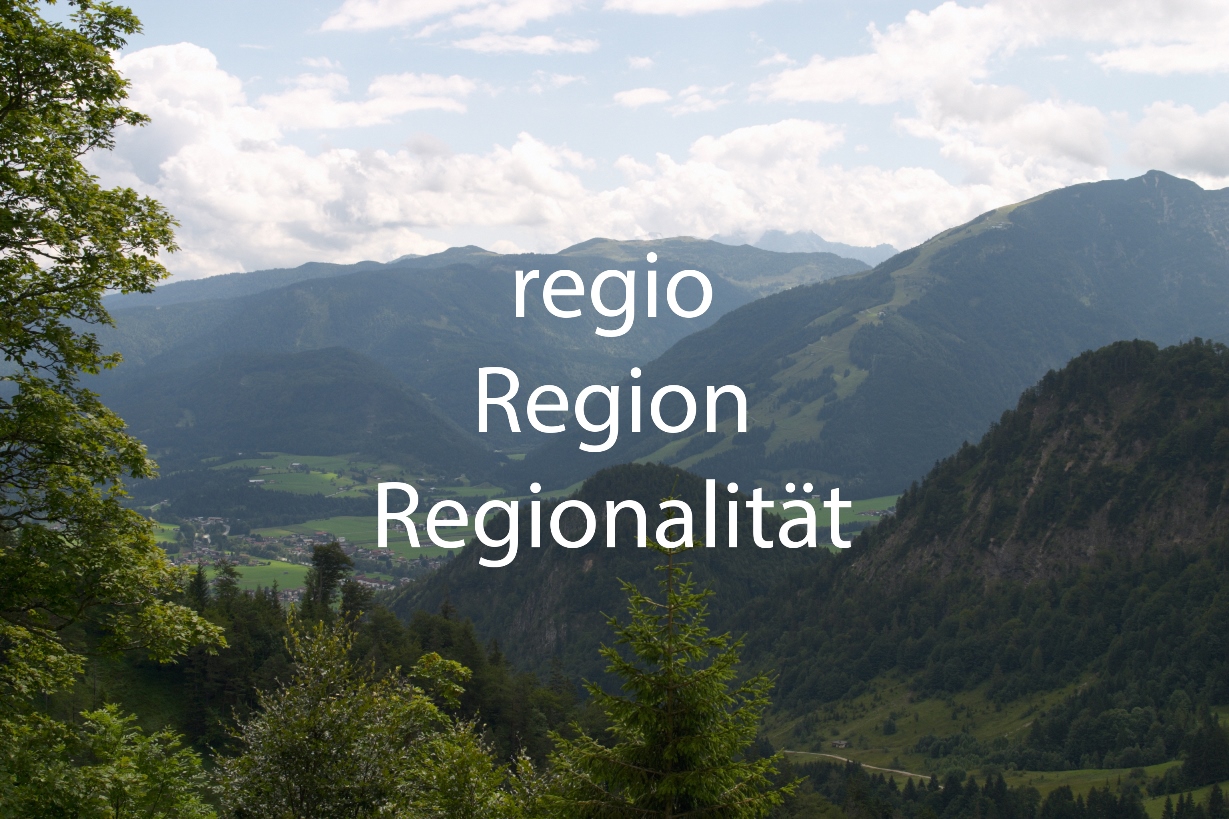
Buying regional food is all the rage. For several years now, the increasingly popular concept of “regionality” has come to represent an alternative to globalization—and thus to the spatial and social alienation of people. But what lies behind the idea of the region, where does the term come from, and what does it actually mean today?
[av_heading heading='Definition – The Region as a Delimited Area' tag='h3' style="" size="" subheading_active="" subheading_size='15' padding='10' color="" custom_font="" admin_preview_bg=""][/av_heading]
The term “regionality” derives from the concept of a region itself. A region refers to an area or territory that forms a unit—usually geographical, but also ecological, cultural, political, or administrative. A region can cover just a few square meters or be very large, extending across national borders, such as a global climate region. In addition to referring to a spatial area, “region” is also used in everyday language as a synonym for “home” or “landscape.”
[av_promobox button=’no‘ label=’Click me‘ link=’manually,http://‘ link_target=“ color=’theme-color‘ custom_bg=’#444444′ custom_font=’#ffffff’ size=’large’ icon_select=’no’ icon=’ue800’ font=’entypo-fontello’ box_color=“ box_custom_font=’#ffffff’ box_custom_bg=’#444444’ box_custom_border=’#333333’ admin_preview_bg=“]
In a nutshell: Four terms related to the region
[/av_promobox]
[av_heading heading='From Territorial Domains to Regional Economic Structures' tag='h3' style="" size="" subheading_active="" subheading_size='15' padding='10' color="" custom_font="" admin_preview_bg=""][/av_heading]
The term “region” first appears in the 15th century—it derives from the Latin “regio” (“domain”). Since the 18th century, people’s relationship to their surroundings has changed; industrialization led to increasing alienation. This resulted in a return to one’s homeland and one’s own region. In the aftermath of World War I, there was a renaissance of regional cultures and political regionalism. After World War II, efforts emerged to improve regional economic structures.
[av_heading heading='From the 1970s Onward: The Region Becomes Interesting' tag='h3' style="" size="" subheading_active="" subheading_size='15' padding='10' color="" custom_font="" admin_preview_bg=""][/av_heading]
In the 1970s, many Western European countries took steps toward decentralization[IR1], regionalization, and federalization, often enshrined in their constitutions. Particularly in rural regions—and partly as a reaction against state-directed development—models for autonomous regional development began to emerge.
[av_heading heading='From European Regions to a Europe of Regions' tag='h3' style="" size="" subheading_active="" subheading_size='15' padding='10' color="" custom_font="" admin_preview_bg=""][/av_heading]
To promote these regions economically and in terms of infrastructure, the EU supported the establishment of so-called “European regions”—that is, cooperation between regions located near national borders. The Assembly of European Regions, founded in 1985 under the auspices of the Council of Europe and with more than 300 members, represents all of the regions. The Maastricht Treaty of 1992 established an advisory Regional Committee. The broader political concept of a “Europe of the Regions”—advocated by figures such as author Robert Menasse—aims to further promote the regions within EU member states and support their regional autonomy.
[av_promobox button='no' label='Click me' link='manually,http://' link_target="" color='theme-color' custom_bg='#444444' custom_font='#ffffff’ size=’large’ icon_select=’no’ icon=’ue800’ font=’entypo-fontello’ box_color=“ box_custom_font=’#ffffff’ box_custom_bg=’#444444’ box_custom_border=’#333333’ admin_preview_bg=“]
What do Austrians mean by “regional”?
Opinions are already divided on the very definition of the term: More than two-thirds (72 percent) of Austrians define “regional” as products from the immediate vicinity, while more than half (59 percent) define it as products from the state in which they live. Only 38 percent consider products from another region within Austria to be regional as well. These findings come from the 2016 RollAMA Motivational Analysis conducted by AMA-Marketing. Consumers place particular importance on the traceability of their food—especially when it comes to meat and eggs, but also dairy products, sausage, ham, and fish.
[/av_promobox]
[av_notification title=" color='silver' border=" custom_bg='#444444' custom_font='#ffffff' size='normal' icon_select='yes' icon='ue80b' font='entypo-fontello' admin_preview_bg="]
Sources:
[/av_notification]
[av_notification title=" color='green' border=" custom_bg='#444444' custom_font='#ffffff' size='normal' icon_select='yes' icon='ue837' font='entypo-fontello' admin_preview_bg="]
Article by the editorial team
[/av_notification]