
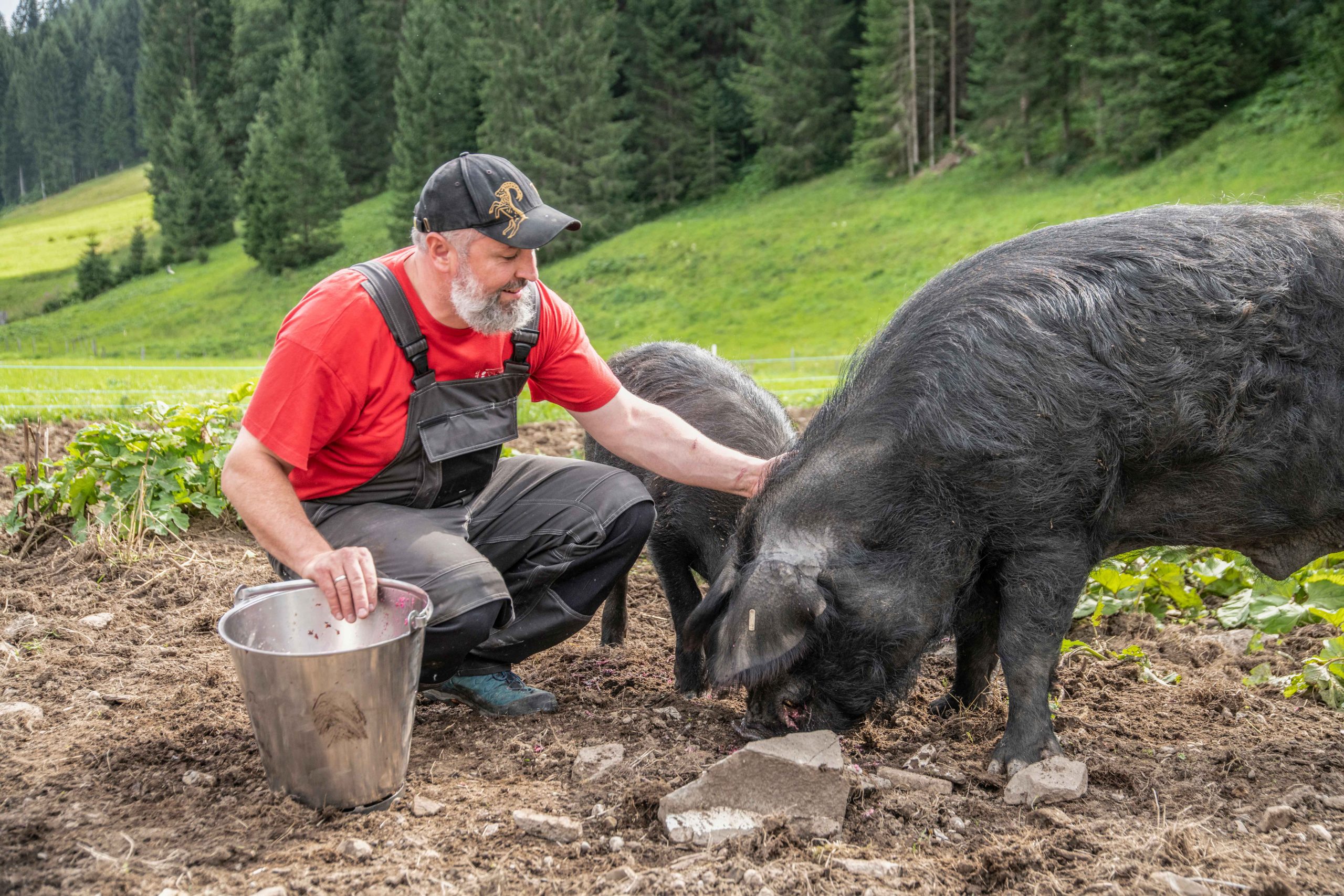
How can the restaurant industry help reduce food waste? “Restaurant Owner of the Year” and award-winning organic chef Jeremias Riezler in conversation with “Sustainability. Rethinking.”
There are certainly some things that could be done. For example, you can turn certain vegetable scraps, such as kohlrabi or beet leaves, into spinach, following the “leaf-to-root” principle. But even white cabbage stalks taste good if you cook them until tender and then fry them. There are many ways to get even more out of food. But many people don’t do this. Because it’s the easier way, and it’s quicker to clean up if the scraps are thrown away. From an economic perspective, every restaurateur is also throwing money away by doing this. The real problem is that they have no respect for food. And food is far too cheap.
With conventional products, like sprayed kohlrabi, I don’t want to eat the leaves either. In the organic sector, throwing them away is a sin. In the conventional sector, on the other hand, people probably prefer to peel them off generously because of the pesticides. You don’t want to eat that either. Factors that come into play here are conventional farming, creativity, and the amount of work involved.
Of course, if you put something like that on the menu—say, kohlrabi and spinach—the guest has to actually try it first; otherwise, it’s pointless. The guest also has to be open to what the chef serves them and sometimes be willing to take a chance. Leafy greens, in particular, aren’t as popular as tomatoes or cucumbers, which, by contrast, fly off the shelves.
When it comes to meat, it’s different. Here, the ingredients are already somewhat more expensive. And here, chefs are also trained much more—whether in apprenticeship or on the job—to work with precision: to cut a 200g piece of meat exactly, to produce as few scraps as possible, to make sauce from small scraps, and so on. But with vegetables, I keep noticing that there’s no respect at all. Chefs should learn in their apprenticeships and vocational schools that these are foods, not just products. Everyone talks about products and premium products, but they are simply foods. We need to deeply instill the understanding that what we have on our plates is essential. Unlike so many consumer goods that we don’t need at all to live. If you value food more, you treat it differently.
My various jobs certainly had a lot to do with it. I once worked at a luxury hotel in Switzerland where an unbelievable amount of food was thrown away. Just the bread and the leftovers from the buffet alone—it was insane. Everything ended up in the organic waste bin. No farmer came to pick anything up—something that happens time and again, not just in luxury hotels. You could make bread dumplings out of stale white bread, even if it were just to feed the staff. But that takes effort.
Buffets are a major factor. Due to hygiene regulations, food must be replaced and discarded very quickly. A lot of food ends up being thrown away. Whether it’s a fast-food restaurant or a hotel, guests expect buffets to be fully stocked from the first guest to the last. If they aren’t, it leads to complaints or poor reviews. Buffets have always been a thorn in my side. That’s why we avoid them as much as possible. Stocking buffets with small containers instead would, of course, require more staff, which is often in short supply.
The“nose-to-tail”concept is actually age-old, but it has fallen victim to industrial agriculture. People started flooding the European market with premium cuts from places like Argentina. No one asks what happens to the rest of the animals. For some time now, a shift seems to be taking place, slowly but surely. In the Kleinwalsertal valley, direct marketing of meat has regained importance in recent decades thanks to the “Walser Buura” association. They have resumed marketing whole animals—such as calves—to restaurants. However, to utilize everything and also make Leberkäse, meat patties, or meatloaf, you need a skilled professional. And as is well known, there is a shortage of such professionals here. Most of it requires know-how and time. Against this backdrop, the “nose-to-tail” approach will likely not catch on widely. A large hotel with 200 beds will find it difficult to cook “nose-to-tail.”
Our “steak culture” is, of course, a problem. We stopped following that trend 14 years ago and now offer only local organic meat. When we revamped the menu accordingly, there was naturally a lot of discussion. Regulars would say, “We’ve been eating steak for the last 30 years.” That takes perseverance and education. A cow yields only 3% steak meat. The rest consists of stewing cuts, sausage meat, and parts used in classic Austrian beef dishes. Strangely enough, Tafelspitz has a pretty good reputation in Austria. But in general, there’s a real need for discussion. For example, we’ve reintroduced the Sunday roast, and on that day we only let hotel guests choose between that and a vegetarian menu. It seems to me that eating steak and beef tenderloin all the time is slowly but surely reaching a saturation point. It’s not exciting to eat that kind of thing.
There are actually quite a few recipes out there. Gröstl, dumplings—they’re really just ways to use up leftovers. Leftover roast meat was used in meat-filled pastries. But from a culinary standpoint, that involves more effort. Paradoxically, though, people often don’t actually use real leftovers. I’ve never worked in a restaurant where they made breadcrumbs for dumplings from old rolls themselves, because that also involves extra work. In the restaurant industry, there’s nothing you can’t buy ready-made as a convenience product.
On top of that, the value of food has shifted dramatically compared to the value of labor. In the past, food was very valuable and hourly wages were low. Today, labor costs are very high and food costs next to nothing in comparison. Naturally, food ends up taking a back seat.
Ever since we started working with organic vegetables, I’ve always felt guilty about throwing away the trimmings. No farmer wanted to take them, so we got our own pigs. They’re out in the pasture in the summer and in the barn with an outdoor run in the winter. They get the vegetable trimmings—like kohlrabi peels and cauliflower leaves. In return, I get bacon, have a blast with the animals, and the animals are doing well.
We pay close attention to seasonality. For example, we buy seasonal fruits in bulk—like strawberries—and turn them into fruit puree for later use. And in winter, it’s simply turnip and beet season. We serve those in every possible variation. But no bell peppers, no tomatoes, and no cucumbers. It’s a similar concept to what we do with steak. People ask why there’s no cucumber salad in winter. And we explain seasonal produce to them—radishes, cabbage, turnips, etc. We need to make people more aware of this. Supermarkets and markets in general don’t make it any easier for us, because everything is always available. Which makes it hard to understand seasonal fluctuations. It takes a lot of conversation. It’s nonsense to buy strawberries at Christmas. And let’s not even get started on exotic fruits.
One tip is definitely to start experimenting. And to think about what you can do with a cabbage stalk. I see a lot of potential in the “leaf-to-root” concept. And with organic vegetables, you can actually eat a lot of the parts, such as the outer leaves of lettuce. And when you factor that in, and consider how much of the outer layers you typically throw away with conventional vegetables, an organic head of lettuce isn’t really that much more expensive.
You can save the trimmings from root vegetables (carrots, celery, parsnips, onions), for example by collecting them in a container in the freezer, and use them to make vegetable broth. Onion scraps can be sautéed, pureed, and reused in sauces and soups. It’s about remembering that what you’re holding in your hands is still food, even if it’s “trimmings” from vegetables. The prerequisite for this kind of reuse, however, is that you cook with fresh ingredients.
It’s all a matter of respect and appreciation. Food should actually be a status symbol. Not the expensive grill on which many people then place cheap meat.
…society is refocusing on food and realizing what is essential for life. Because food is simply a MEANS OF SURVIVAL.
[av_promobox button='no' label='Click me' link='manually,http://' link_target="" color='theme-color' custom_bg='#444444' custom_font='#ffffff’ size=’large’ icon_select=’no’ icon=’ue800’ font=’entypo-fontello’ box_color=“ box_custom_font=’#ffffff’ box_custom_bg=’#444444’ box_custom_border=’#333333’ admin_preview_bg=“]
About Jeremias Riezler
 Jeremias Riezler is an award-winning organic chef and was named "Gourmet Restaurant Owner of the Year" for 2015/16. Together with his wife, he runs the Walserstuba Organic Hotel in Kleinwalsertal, Vorarlberg. In his kitchen, regional and seasonal ingredients are incorporated in a way that is as uncompromising as it is delicious.
[/av_promobox]
[av_notification title=" color='silver' border=" custom_bg='#444444' custom_font='#ffffff' size='normal' icon_select='yes' icon='ue80b' font='entypo-fontello' admin_preview_bg="]
Source: Interview with Jeremias Riezler on June 3, 2020
[/av_notification]
[av_notification title=" color='green' border=" custom_bg='#444444' custom_font='#ffffff' size='normal' icon_select='yes' icon='ue837' font='entypo-fontello' admin_preview_bg="]
Editorial article
[/av_notification]