
Paris dreamed of limiting global warming to 1.5°C; people still think 2°C would be manageable. The report by U.S. authorities was based on a 2°C increase, and reading about the consequences is enough to send anyone into a deep depression. But to be honest… the reality is 3°C, 4°C…
No one knows what the actual, expected consequences will be.
We are heading toward a completely different way of life, different ways of living; we will have entirely different political circumstances, different social conditions, and different forms of production.
How can we remain capable of taking action in the face of the impending disaster? How can we remain capable of responding to all the challenges that lie ahead?
At the end of time, when it will all be over—resources exhausted, the environment littered with trash, fertile soils degraded, the diversity of fauna and flora wiped out, the waters of lakes, rivers, and springs poisoned—when humans and animals, plants and soils have fallen victim to global warming, punctuated by violent storms, when hurricanes sweep across the land, and incredible torrents of rain pour down from the sky; when nothing will be as we know it; when the seas will rise ceaselessly; when people, in their desperation, will turn against one another; when we will have reached the point where only a god could save us, as a philosopher once said—then the dawn of hope will rise on the horizon, albeit without a single bird’s song, but everything will be alright again.
We, the superior human beings, the crown of creation; we, with our superior intelligence; we, with our boundless creativity—we have done it again. We will have ruined everything beyond recognition; we will have driven desolation to every last corner of this earth, but we will still be capable of action.
Robots will till the unrecognizable fields, drones will pollinate what needs pollinating, CRISPR-Cas9 will be used to engineer crops so that they will still yield a harvest even in barren lands, and with the help of chlorophyll fluorescence, the digital operator will be able to detect—even in his sleep—where assistance is needed in the field. Nothing will be assessable by human standards anymore.
The pioneers of digitalization in agriculture have long been working on solutions to the seemingly impossible. Our lifestyle is just great! Why should we change anything?
Technology, digitalization, artificial intelligence, new genetic engineering—all of these, combined with a healthy dose of recklessness, will shape our future; we’ll sort it out for future generations.
[av_heading heading='Industrial Agriculture and Destruction' tag='h3' style=" size=" subheading_active=" subheading_size='15' padding='10' color=" custom_font=" admin_preview_bg="][/av_heading]
Each of you is familiar with the reports on insect die-offs, the decimation of bird populations, the staggering extent of plant extinction—including that of crops—the desolation of fields ravaged by oversized machinery, the scale of soil compaction in agriculture, the destruction of soil microorganisms, land degradation, and the resulting loss of healthy soil. Conventional agriculture is pushing nature to its limits everywhere.
According to the Intergovernmental Science-Policy Platform on Biodiversity and Ecosystem Services (IPBES), land degradation and the loss of healthy soil have exceeded a critical threshold, putting the livelihoods of 3.2 billion people at risk. Rainfall washes away around 970 million tons of loose soil annually in the EU. Slovenia, Italy, and Austria are particularly hard hit by soil erosion. One-third of our arable land is heavily compacted.
Global warming, which is catching the agricultural sector completely off guard, could lead to yield losses of up to 50% in Austria, particularly in the Marchfeld region.
Two-thirds of arable land is used to produce feed for livestock. Western and Central Europe require an additional area the size of Germany to source livestock feed from outside Europe.
I’m sure you’re all well aware of the damage that pesticides and industrial fertilizers are causing to our soil, soil life, groundwater, and surface water.
Nevertheless, this type of agriculture receives massive subsidies. But these payments are merely a smokescreen; in reality, it is the industry behind this agriculture that is being subsidized against all reason.
The research efforts in conventional agriculture are enormous. Incredible amounts of money are being spent, which naturally must be recouped. The proceeds from food sales can never, under any circumstances, offset these investments. Public funds—that is, our tax dollars—will have to make up the difference. The government’s position on this is clear: it avoids revealing the true costs at all costs.
[av_heading heading='Organic Farming' tag='h3' style="" size="" subheading_active="" subheading_size='15' padding='10' color="" custom_font="" admin_preview_bg=""][/av_heading]
The path of biologically sustainable agriculture is less spectacular. But the results are simply compelling. It is a path that protects forests—including rainforests—oceans, wetlands, ecosystems, living creatures, soils, rivers, and the air; a path on which resources are used with care. A path on which people understand the deep interconnectedness and mutual dependence of all things.
And when we engage with nature with open eyes and the necessary curiosity, we can experience nature’s complex system—with its nonlinear dynamics—just as farmers do.
Organic, sustainable agriculture seeks to find answers to these questions and to address this challenge. With us, by God, not everything is complete; far from it, nothing is perfect. We still have a lot to learn, especially when it comes to sustainability.
We are far, very far behind in seed production.
[av_heading heading='Building Humus to SequesterCO2 and Promote Fertile Soils' tag='h3' style=" size=" subheading_active=" subheading_size='15' padding='10' color=" custom_font=" admin_preview_bg="][/av_heading]
Improving soil fertility—specifically, building up humus—is a huge challenge for all of us. We will have to find new farming methods, such as completely eliminating plowing, using no-till farming, agroforestry systems that combine rows of trees with crops, or milpa.
When I was younger, I had good results with this method; the Maya used this system, in which crops such as corn, beans, and squash are planted together. Perhaps agroforestry is one way to cope with global warming. To combat soil erosion, contour farming would be an effective method on slopes with a 2–10% gradient, or strip cropping on long, steep slopes.
In organic, sustainable agriculture, biodiversity, habitat management, soil fertility, and humus formation are increasingly at the center of our efforts.
[av_heading heading='How can we survive in the future?' tag='h3' style=" size=" subheading_active=" subheading_size='15' padding='10' color=" custom_font=" admin_preview_bg="][/av_heading]
Of course, with our approach to agriculture, we will have to learn to increase both quantity and quality—not in opposition to, but in harmony with, ecosystems. Our intelligence, creativity, imagination, and courage will be of no use to us unless moderation becomes our guiding principle.
One in three food items ends up in the trash, crop losses are still too high, and our society’s overall approach to food needs to be reevaluated.
If we observe how farm animals are kept and fed, we know—even without a moral appeal—that things cannot go on this way. When manure and liquid manure are spread, ammonia is released, and in the atmosphere these gases react with sulfur dioxide and nitrogen oxides to form salts such as ammonium sulfate and ammonium nitrate, which contribute to the formation of particulate matter. According to the Max Planck Institute, 45% of particulate matter pollution is caused in this way.
It requires not only a complete transformation of agriculture, but also a change in our meat consumption. The true costs of conventional meat are 196% higher. In our system, these costs are obscured and passed on to the general public without their consent. Just like the 60 billion euros that the BSE scandal cost.
Public funding must be allocated 100% to services for the public—such as clean water, soil fertility, biodiversity, and the careful and responsible use of resources. No more indirect payments to the agribusiness sector.
The exploitation of our environment, animals, and people must come to an end. Farmers must extend the respect they so rightly demand for themselves to others and put it into practice in their dealings with nature.
The Earth and humankind—what a pair!
For us, there is no world other than this one, and the same is true for our descendants. We come from the earth and live off the earth, and we are bound to it as brothers and sisters. It opens up endless possibilities for us, and one of those is our responsibility for the world of the earth!
Let's take notice of them!
Let's end the war against Earth!
[av_promobox button='yes' label='About the Author' link='manually,http://www.wernerlampert.com/wer-ist-werner-lampert/' link_target='_blank' color='theme-color' custom_bg='#444444' custom_font='#ffffff’ size=’snmall’ icon_select=’no’ icon=’ue800’ font=’entypo-fontello’ box_color=“ box_custom_font=’#ffffff’ box_custom_bg=’#444444’ box_custom_border=’#333333’ admin_preview_bg=“]
About Werner Lampert
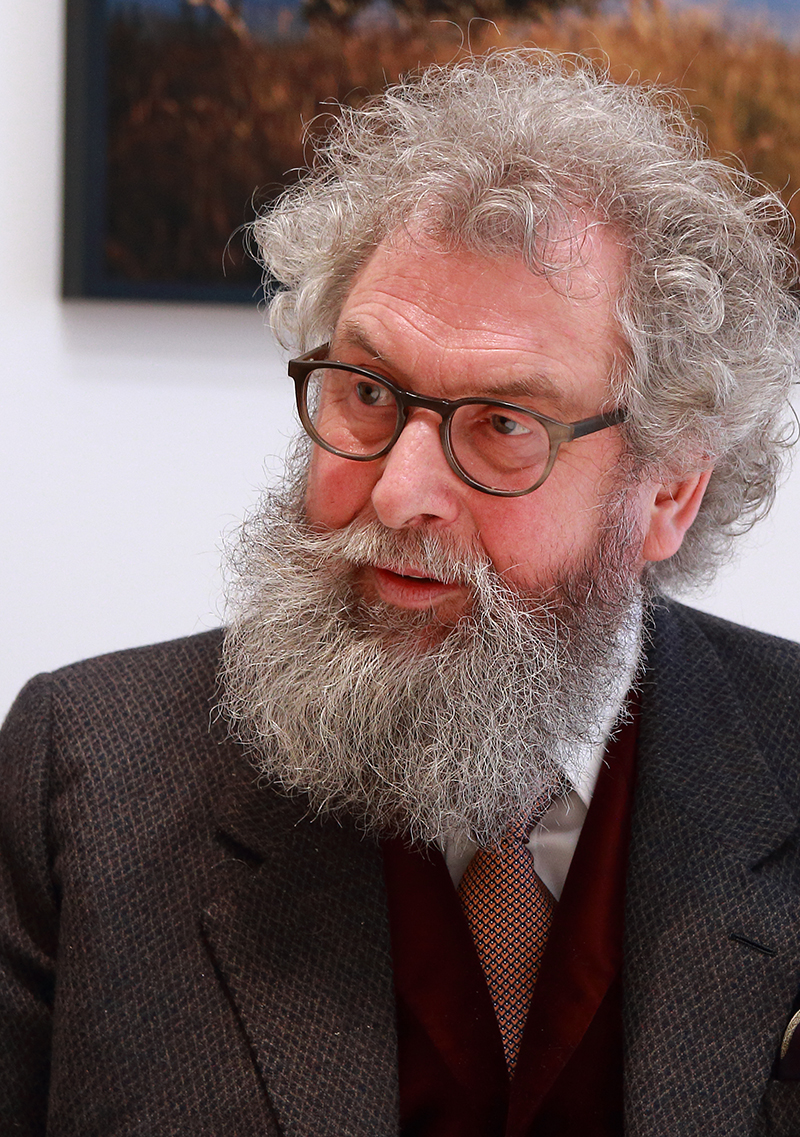 Werner Lampert (born in 1946 in Vorarlberg, Austria) is considered one of the pioneers in the field of sustainable products and their development in Europe. This organic pioneer has been deeply involved in organic farming since the 1970s. With Back to the beginning (Hofer) and Ja! Natürlich—he developed two of the most successful organic brands in the German-speaking world.
[/av_promobox]
Read more articles in our Climate Crisis series now and find out how you can help advance climate protection.