
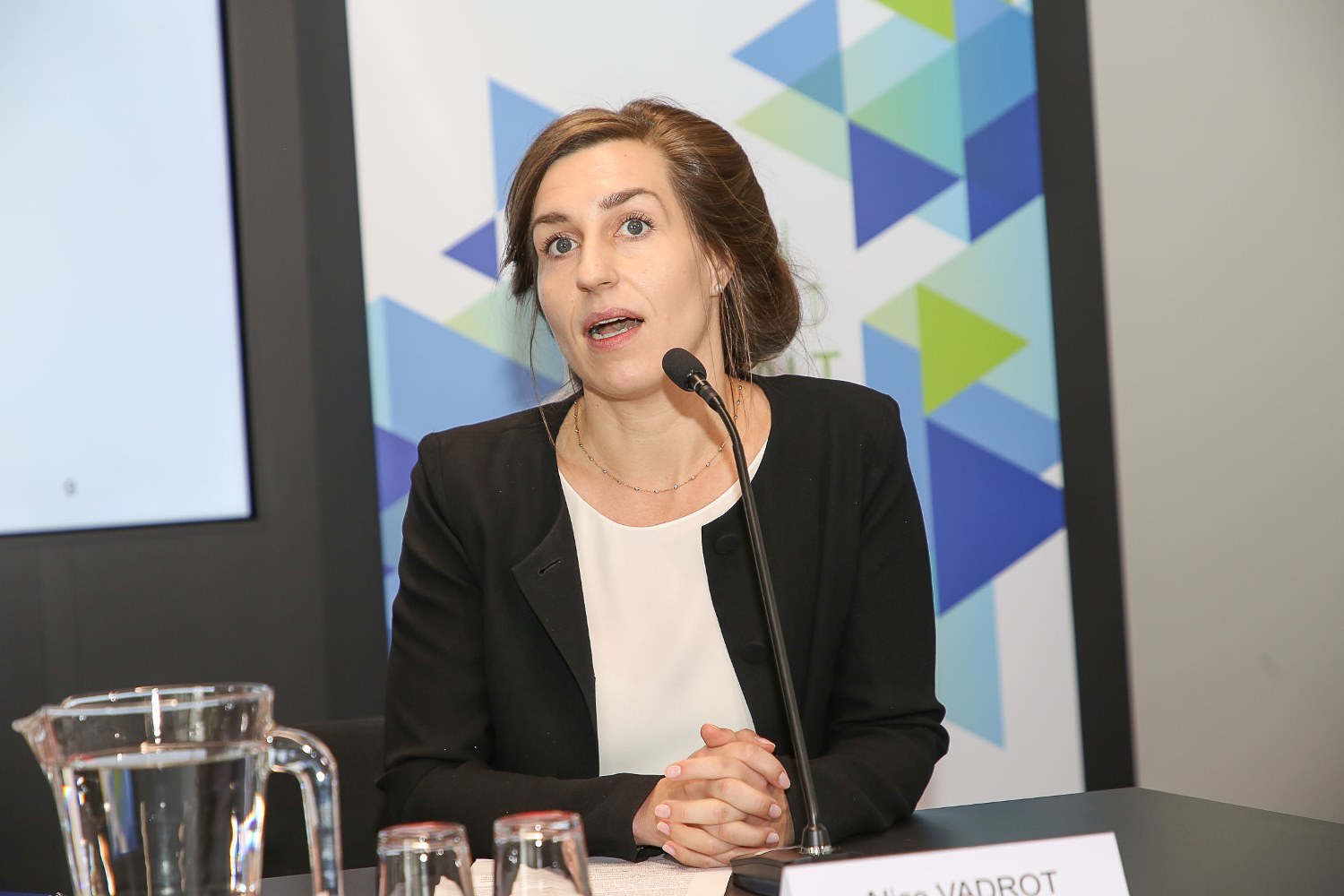
Political scientist Assoc. Prof. Dr. Alice Vadrot has had a love of nature practically since birth. Her research offers solutions for how environmental and nature conservation issues can be communicated and implemented in politics. In Austria, through her involvement in the Biodiversity Council, she advocates for greater public awareness of the diversity of nature.
As a child, I spent many summers at my grandparents’ farm in the Nockberge Mountains. Through everyday life and on long hikes, my grandmother introduced me to biodiversity and explained many phenomena that seemed like little miracles to me. Years ago, my grandmother described and interpreted changes that are now scientifically substantiated as climate change or species extinction.
As a political scientist, I am particularly interested in the question of how scientific and non-scientific knowledge can be harnessed for the protection of nature, and what forms of selectivity arise in this process. Not all knowledge is considered legitimate for depicting nature or for supporting political decisions that may have a negative or positive impact on our environment. In this sense, knowledge about nature is always political as well.
That’s right. We found that there is a consensus that the priority and legitimacy of environmental and nature conservation must be elevated in both political and public discourse. Environmental and nature conservation must not be sidelined in day-to-day politics. Before the survey, we had assumed that the barriers might lie in communication between science, politics, and practice. However, the respondents’ assessment showed that communication actually works very well and that the foundations for evidence-based environmental policy are certainly in place. The problem lies in particular in the fact that the public does not demand enough environmental and nature conservation, which is also evident in voting behavior.
Therefore, the primary focus must be on appealing to people’s “hearts and minds” so that nature conservation measures are implemented more effectively.
The developments of recent months show that we were not wrong: the “Fridays for Future” movement has re-politicized climate change, raised awareness of the issue, and lent new legitimacy to the scientific understanding of climate change.
Essentially, this depends on the specific political system, as well as the political and scientific culture of a country. Austria does not have a long tradition of formalized scientific policy advice in parliament, such as the Parliamentary Office of Science and Technology (POST) in the United Kingdom or the Office for Technology Assessment (TAB) at the German Bundestag. However, scientists can contribute through public review of legislation or during hearings. This, however, requires close attention to what is currently happening in parliament and the establishment of appropriate networks with policymakers.
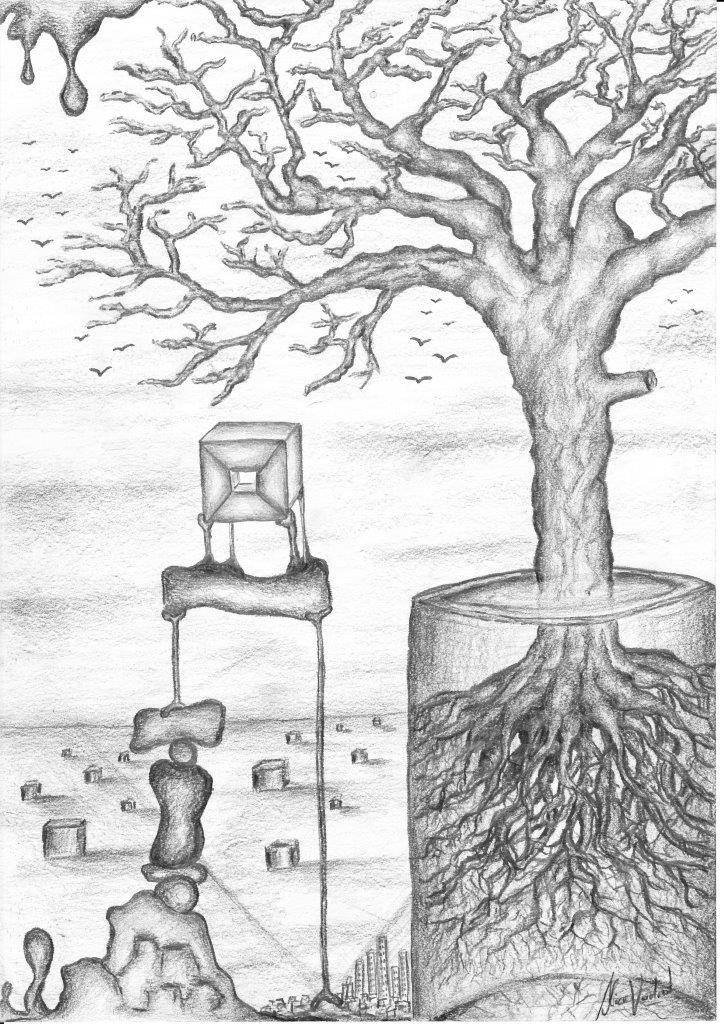
Drawing by Alice Vadrot, created while she was engaging deeply and critically with the concept of ecosystem services
Against this backdrop, we argue that scientists who wish to contribute must be familiar with the political process, the structures, and the substance of environmental policy. Only then can they assess when their expertise is relevant and how they can apply it.
That is precisely why it is important in Austria to keep an eye on international developments and to take advantage of opportunities that arise internationally as a result of the discussion or politicization of environmental issues.
The release of the global report on species extinction, for example (LINK: Interesting Facts), has created an opportunity to bring the issue to the forefront of the national agenda and call on the government to take action so that international goals can be achieved.
There are also many opportunities at the local level, such as through participation in the preparation of reports that assess the environmental impacts of infrastructure projects and make them visible to the general public. Developments surrounding the third runway have shown how difficult and protracted such processes can be, and how little weight is given to scientific expertise.
A few years ago, I served as the lead author on a TAB report. The topic was the significance of the concept of ecosystem services and its implementation in German nature conservation policy. The concept, which emphasizes the benefits that people derive from ecosystems, had gained new momentum at the time and was seen by many scientists as a way to economically quantify nature’s societal relevance and make the costs of inaction tangible.
It was important to me that the concept be portrayed not only in its positive aspects but also in terms of its potential negative impacts, which we ultimately succeeded in doing. Particularly in the Global South, the concept is also used to legitimize changes in land and resource use, which sometimes even results in local communities being dispossessed and effectively excluded from accessing certain resources essential to their survival.
On a more abstract level, we must also ask ourselves whether portraying nature as a service provider is the right path toward an ecologically sustainable society, or whether there are other ways to make environmental protection and conservation priorities.
In a way, yes. The 1992 Earth Summit led to the establishment of the Convention on Biological Diversity and the United Nations Framework Convention on Climate Change. While the climate science community had already been speaking with a more or less unified voice since the establishment of the Intergovernmental Panel on Climate Change in 1988 and had an institutional framework at its disposal, the biodiversity community lagged behind.
The lack of internationally consolidated scientific evidence on species decline was long seen as the reason for the low priority given to the issue and the lack of implementation of the Convention on Biological Diversity. The idea of establishing a World Biodiversity Council gained new momentum around 2005 and following the publication of the Millennium Ecosystem Assessment (MA). The MA closely linked biodiversity to the concept of ecosystem services and highlighted the connection between species decline and human well-being. Coupled with the idea of an institutional framework designed to enable the formal recognition of the reports by policymakers, the Biodiversity Council was born.
Moreover, from the very beginning, he recognized the central role of local and indigenous knowledge in the conservation of biodiversity. In this respect, he differs significantly from the IPCC and offers a new model for global knowledge production.
I am currently a member of the Scientific Advisory Board. I am particularly committed to promoting interdisciplinarity in biodiversity research and increasing the social and political relevance of research. I am also dedicated to highlighting the contribution that the social sciences can make by identifying and analyzing the social and political causes of environmental problems.
The platform’s primary goal is to make a significant contribution to the conservation of biodiversity. This will be achieved by better consolidating, presenting, and representing the scientific research and data on biodiversity available in Austria. On this basis, the aim is to strengthen not only the scientific community but also the interface between science, politics, and society. A key part of this is to consolidate existing scientific knowledge, make it visible, and communicate it in a way that resonates with the public.
I want to emphasize that knowledge about nature is not only important in a scientific context, but should also play a more significant role both in educational institutions and in everyone’s daily lives.
[av_promobox button='yes' label='More about this person' link='manually,http://www.alicevadrot.eu/' link_target='_blank' color='theme-color' custom_bg='#444444' custom_font='#ffffff’ size=’medium’ icon_select=’no’ icon=’ue800’ font=’entypo-fontello’ box_color=” box_custom_font=’#ffffff’ box_custom_bg=’#444444’ box_custom_border=’#333333’ admin_preview_bg=”]
About Alice Vadrot
 Alice Vadrot is an assistant professor of international politics at the University of Vienna. Her research focuses on the role of science in international environmental policy, and she has examined the history and functioning of the World Biodiversity Council. Since November 2018, she has been leading a five-year research project funded by the European Research Council (ERC) with 1.4 million euros, in which she and her team are developing an empirical approach to study the role of science in international marine conservation policy (www.maripoldata.eu).
[/av_promobox]
[av_notification title=" color='silver' border=" custom_bg='#444444' custom_font='#ffffff' size='normal' icon_select='yes' icon='ue80b' font='entypo-fontello' admin_preview_bg="]
Source: Abridged version of an interview with Alice Vadrot on July 9, 2019
[/av_notification]
[av_notification title=" color='green' border=" custom_bg='#444444' custom_font='#ffffff' size='normal' icon_select='yes' icon='ue837' font='entypo-fontello' admin_preview_bg="]
Editorial article
[/av_notification]