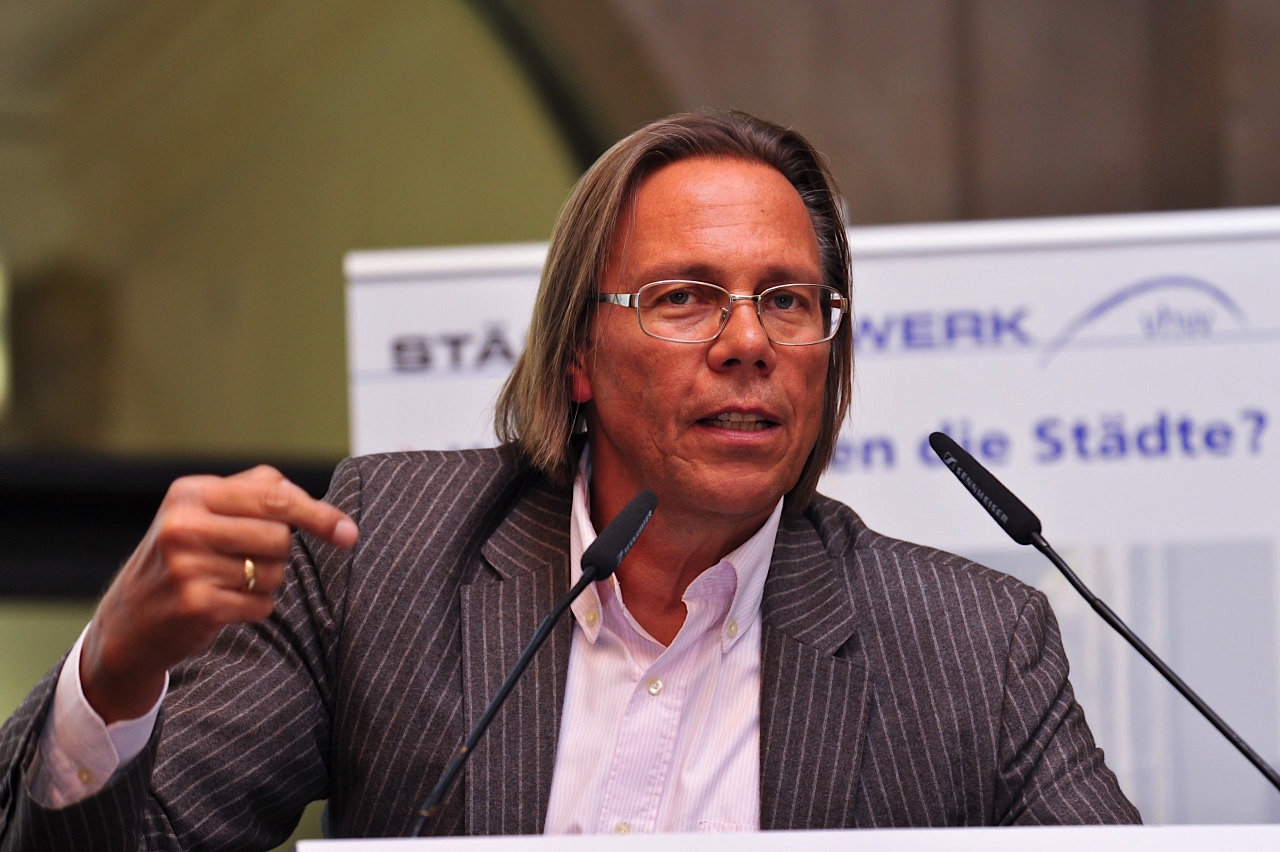
Harald Welzer: Because “sustainability” isn’t a positive term. The message behind it is really: We have to change things so that everything stays the way it is. And that’s unappealing—after all, things are already the way they are. If you want to change something, you need a positive vision of the future. But we don’t have one. We should, for example, talk much more about the appeal of a car-free city or reduced working hours. Painting a picture of an attractive new world. And if that results in fewer cars on the roads, less consumption, or lower emissions, then we’re actually making progress toward the sustainability goal, even though a different primary benefit might be the main focus.
[av_hr class='custom' height='50' shadow='no-shadow' position='center' custom_border='av-border-thin' custom_width='100%' custom_border_color=" custom_margin_top='1px' custom_margin_bottom='20px' icon_select='no' custom_icon_color=" icon='ue808' font='entypo-fontello' admin_preview_bg="]
Welzer: A movement exists when its cause is shared by different social groups. Social movements are never subcultures. The women’s movement, for example, gains strength when men find it reasonable. The labor movement gains strength when there are capitalists who approve of it. You won’t achieve that with a term like “sustainability.” Just hearing that word is enough to put you to sleep.
[av_hr class='custom' height='50' shadow='no-shadow' position='center' custom_border='av-border-thin' custom_width='100%' custom_border_color=" custom_margin_top='1px' custom_margin_bottom='20px' icon_select='no' custom_icon_color=" icon='ue808' font='entypo-fontello' admin_preview_bg="]
Welzer: It’s used for everything—sustainable economic growth, sustainable investing, and so on. The term is actually dead. And it never really lived in the first place. There’s a completely different connotation when I say “sustainability” than there is, for example, with the words “revolution” or “sex.” We simply have to become more playful. A sustainability movement, whatever it may be called, must not be as joyless as it has been for the past 30 years. It’s not about morality or a new form of monasticism. It’s about looking at life from a different angle and asking: What’s actually so great about sex, drugs, and rock ’n’ roll? Having fun isn’t a bad thing.
[av_hr class='custom' height='50' shadow='no-shadow' position='center' custom_border='av-border-thin' custom_width='100%' custom_border_color=" custom_margin_top='1px' custom_margin_bottom='20px' icon_select='no' custom_icon_color=" icon='ue808' font='entypo-fontello' admin_preview_bg="]
Welzer: Plenty. Just recently, I read the book by that young woman who founded the“Original Unverpackt” supermarkets. These are supermarkets where the goods are no longer packaged. Milena Glimbowski is 26 years old. Reading her book was so interesting because she describes in detail just how incredibly exhausting and crazy it was to turn her idea into reality. Constant financial problems, the recurring fundamental question of whether any of this was even feasible. But she knew from the very beginning why she wanted to carry out her project. Because, in her opinion, it’s simply better to consume differently and, accordingly, to do without certain things.
[av_hr class='custom' height='50' shadow='no-shadow' position='center' custom_border='av-border-thin' custom_width='100%' custom_border_color=" custom_margin_top='1px' custom_margin_bottom='20px' icon_select='no' custom_icon_color=" icon='ue808' font='entypo-fontello' admin_preview_bg="]
Welzer: (laughs) There are always two levels to this. If you look at the world on an abstract level, you’ll say: For heaven’s sake, this is all terrible! It’s getting worse and more hopeless by the day. The other side is our own personal state of mind. And there—compared to a seamstress in Bangladesh—we really should be ashamed of ourselves if we say our lives are bad.
[av_hr class='custom' height='50' shadow='no-shadow' position='center' custom_border='av-border-thin' custom_width='80%' custom_border_color=" custom_margin_top='1px' custom_margin_bottom='20px' icon_select='no' custom_icon_color=" icon='ue808' font='entypo-fontello' admin_preview_bg="]
Welzer: When your own life is good, you have the opportunity to do something, to change things. On a personal level, the only answer to that question is that it’s more fun to change things than to leave them as they are. And in that regard, I’m optimistic. On a global scale, I’m pessimistic. But there’s a nice saying: It’s too late for pessimism.
[av_promobox button='no' label='Click me' link='manually,http://' link_target="" color='theme-color' custom_bg='#444444' custom_font='#ffffff’ size=’large’ icon_select=’no’ icon=’ue800’ font=’entypo-fontello’ box_color=“ box_custom_font=’#ffffff’ box_custom_bg=’#444444’ box_custom_border=’#333333’ admin_preview_bg=“]
About Harald Welzer
Prof. Dr. Harald Welzer (born in 1958 in Bissendorf near Hanover, Germany) is a social psychologist and sociologist. Welzer is a co-founder and director of the nonprofit FUTURZWEI Foundation for Sustainability and a co-initiator ofthe “Open Society” initiative. He teaches at the University of St. Gallen and at the European University of Flensburg. He is the editor of futurzwei. Magazine for the Future and Politics. Harald Welzer’s books, including “Think for Yourself: A Guide to Resistance” (2014) and “The Smart Dictatorship: The Attack on Our Freedom” (2016), have been translated into 22 languages.
[/av_promobox]
[av_notification title=" color='silver' border=" custom_bg='#444444' custom_font='#ffffff' size='normal' icon_select='yes' icon='ue80b' font='entypo-fontello' admin_preview_bg="]
Source: This text is an abridged version of an interview with Harald Welzer on July 25, 2017.
[/av_notification]
[av_notification title=" color='green' border=" custom_bg='#444444' custom_font='#ffffff' size='normal' icon_select='yes' icon='ue837' font='entypo-fontello' admin_preview_bg="]
Editorial article
[/av_notification]