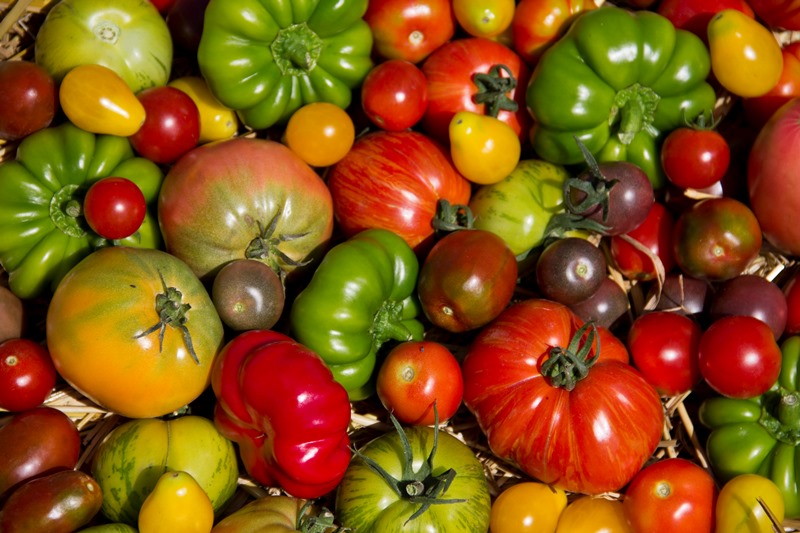
Organic seed companies such as ReinSaat® KG specialize in the production and marketing of open-pollinated vegetable, herb, and flower seed varieties. These seeds come exclusively from certified organic, biodynamic, and Demeter-certified organic cultivation (Demeter and Bio-Austria) and are free from genetic engineering and hybrid breeding.
[av_heading heading='What are open-pollinated seeds?' tag='h3' style=" size=" subheading_active=" subheading_size='15' padding='10' color=" custom_font=" admin_preview_bg="][/av_heading]
The advantage of open-pollinated seeds over conventional seeds is that the seeds from the ripe fruits can be harvested and used to grow young plants. As a result, open-pollinated varieties provide excellent yields and quality year after year.
Hybrid varieties (identified by the suffix “F1” added to the variety name), which are permitted in conventional agriculture as well as in organic production under the EU Organic Regulation, deliver the desired results when grown once for a single season. Hybrid seeds are the end product of a multi-stage propagation cycle using biotechnological methods. Through forced self-pollination, parent lines are bred that are distinguished by a single outstanding trait. By crossing these, hybrids are produced that inherit traits such as uniformity, fruit color, and (pest) resistance from these parent lines. However, the very next generation—the seedlings grown from the seeds of the hybrid plants—lose these optimized traits.
[av_heading heading='Regional Diversity' tag='h3' style="" size="" subheading_active="" subheading_size='15' padding='10' color="" custom_font="" admin_preview_bg=""][/av_heading]
Developing regionally adapted, open-pollinated (self-pollinating) crop plants and making them available to both commercial growers and home gardeners is always at the heart of our work.
The primary breeding method is selection. In this process, plants from a vegetable crop that match the desired variety profile are selected, and their seeds are propagated further if they meet the high standards for vigor and hardiness, diversity, and quality of the plants—and, consequently, the marketability of the fruit. High standards are set for the shape, color, taste, aroma, as well as the vitality and nutritional quality of the various varieties. Yield reliability, marketable quality, processing quality, and transport and storage suitability are given equal weight and incorporated into seed breeding.
ReinSaat® KG continuously works with propagation farms throughout Austria and European partners to further develop its range of open-pollinated varieties at its main facility and at the propagation farms.
In doing so, special attention is paid to the crops’ varying adaptability to diverse climatic, environmental, and site conditions. Every year, traditional and regional vegetable specialties are tested and further developed in various regions to assess this potential. The result is robust seed that copes well with varying weather and water conditions as well as pests and offers reliable yields.
[av_heading heading='What are the differences compared to conventional seeds?' tag='h3' style=" size=" subheading_active=" subheading_size='15' padding='10' color=" custom_font=" admin_preview_bg="][/av_heading]
ReinSaat® KG produces open-pollinated varieties, drawing on the genetic heritage of the vegetable varieties cultivated by our ancestors. This means that the parent plant passes on its variety-specific traits to the next generation through a natural genetic flow. Through continuous breeding, plants with very specific, desired characteristics are developed. However, a reservoir of trait information remains stored in all plants, ensuring future natural adaptability.
The ecological development of open-pollinated varieties does not take place in a laboratory. Natural developments, including accidental cross-pollination—which occurs naturally in the wild—are fully permitted. Plant diversity and vitality, as well as the promotion and utilization of the wide-ranging potential of open-pollinated varieties, are just as essential for successful seed breeding as obvious plant and fruit characteristics. To this end, different growth patterns and the influence of external factors within a growing season are closely monitored and, if necessary, adapted during further trial cultivation to ensure the best possible variety quality.
Open-pollinated varieties are the result of years of breeding work. They are not released onto the market until they have remained stable over several generations (years) and subsequent generations exhibit the same desired traits.
The highest standards for seed quality require extensive experience and a significant time investment, which is what makes open-pollinated organic seed production so special. There are no shortcuts; natural development is allowed to take its course. Plants are allowed to go through their natural life cycle, thrive, and mature, as are their offspring.
[av_gallery ids='4207,4210,4209,4208’ style=’thumbnails’ preview_size=’portfolio’ crop_big_preview_thumbnail=’avia-gallery-big-crop-thumb’ thumb_size=’portfolio’ columns=’4’ imagelink=’lightbox’ lazyload=’avia_lazyload’ admin_preview_bg=“]
[av_heading heading='Diversity Over Uniformity' tag='h3' style=" size=" subheading_active=" subheading_size='15' padding='10' color=" custom_font=" admin_preview_bg="][/av_heading]
The diversity and outstanding quality of open-pollinated seed varieties are the result of many years of responsible conservation breeding. To this end, all organic seed producers in Austria engage in professional exchanges with similarly structured seed companies and organizations, including at the international level.
A diverse selection of flavorful vegetables is no longer just a hobby! Producing for the market in a way that conserves resources is the sensible approach. The unparalleled variety of vegetables and the growing number of nutrition- and environmentally-conscious consumers justify the comparatively higher labor and input costs involved in production.
This is the only way to ensure that valuable seed resources are not lost. Hardy plants will continue to provide a healthy and flavorful variety of vegetables for both commercial and home gardeners, thereby safeguarding individual self-sufficiency.
[av_promobox button='no' label='Click me' link='manually,http://' link_target="" color='theme-color' custom_bg='#444444' custom_font='#ffffff’ size=’large’ icon_select=’no’ icon=’ue800’ font=’entypo-fontello’ box_color=“ box_custom_font=’#ffffff’ box_custom_bg=’#444444’ box_custom_border=’#333333’ admin_preview_bg=“]
 About the Author
Since 1998, ReinSaat® KG has been committed to offering a wide range of varieties for commercial horticulture and home gardens that are suited to organic farming practices.
[/av_promobox]