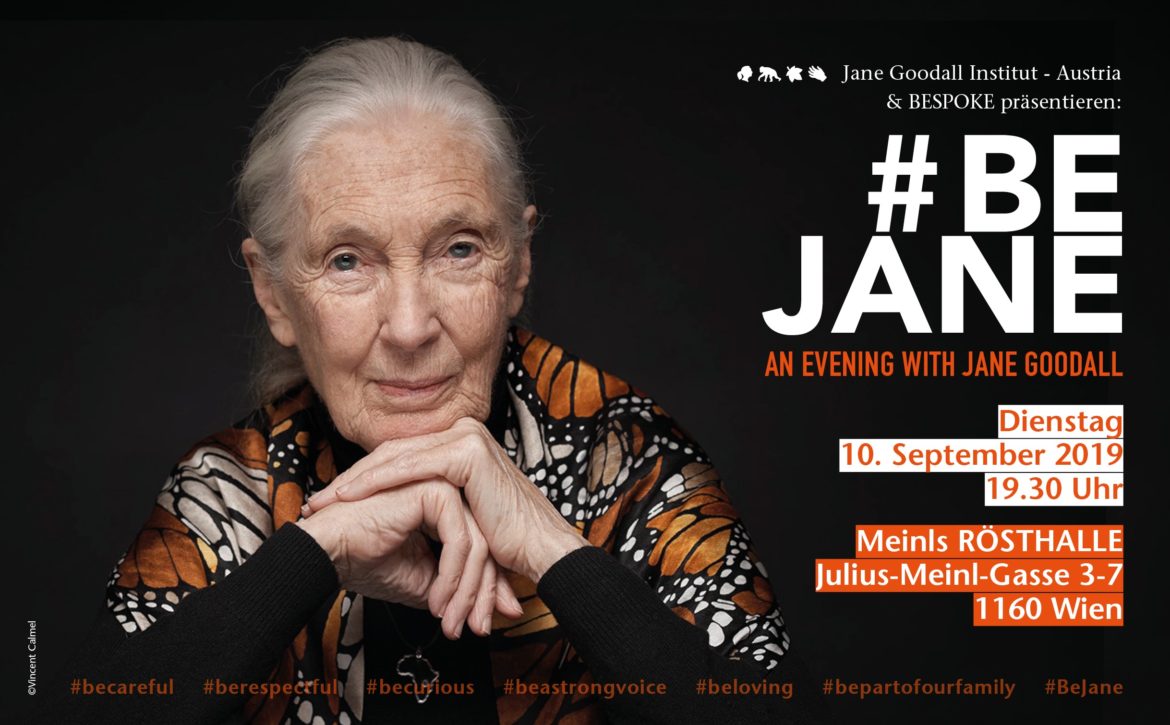
“I went to that conference as a scientist, and left it as an activist,” Jane Goodall told an audience of 1,100 people in Vienna. A conference that would change her life and the lives of many others. Dr. Jane Goodall is one of the most renowned conservationists of our century; her incredible perseverance and the determination with which she follows her path make her extraordinary. At 85 years old, she still stands before audiences for hours on end, because it is her calling to give us hope.
On September 10, 2019, the activist and primatologist visited Vienna. Join us as we delve into Jane Goodall’s story and discover the four reasons why she will never give up.
Jane Goodall was born in London in 1934 with a love of nature; as soon as she could read, she soaked up information about animals like a sponge. With her savings, she bought a used copy of *Tarzan of the Apes*. This book would shape her entire career, for she fell head over heels in love with the Jungle King, who, to her regret and envy, married the wrong Jane. Through this literary tale, a desire took root in her to go to Africa, live among wild animals, and write books about them. Everyone around her advised her to choose a more realistic dream, since she was just a little girl and World War II was raging. But her mother told her: “If you really want to do something like this, you’re going to have to work awfully hard. Take advantage of every opportunity you get, but don’t give up!” (“If you really want to do something like this, you’re going to have to work awfully hard. Take advantage of every opportunity, but don’t give up.”)
Well, she certainly did! Because today, 75 years later, we all know that she made her dream come true. At the age of 23, Jane Goodall traveled by ship to Kenya, where she landed a secretarial position with Dr. Louis Leakey, curator of the Natural History Museum. He was impressed by this curious young woman and would go on to become her mentor. He sent her into the forest in Gombe, Tanzania, to observe chimpanzees. After her breakthrough—the discovery that chimpanzees use tools just like we humans do—he secured her a spot at Cambridge, where she earned her doctorate.
Jane Goodall developed an indescribable love for the subjects of her study, the chimpanzees. Completely unconventional for her time, she gave them names and recognized their emotions. The rainforest surrounding her completely captivated her. She realized that all living beings are interconnected, that every species, no matter how insignificant, has its purpose. She felt the great energetic power of nature (“great spirit of power”).
But in 1986, a life-changing conference on the ethical treatment of animals took place in Chicago. There, she became so acutely aware of the threat to her beloved chimpanzees that she left the conference as an activist. For her, this meant leaving behind the place where she had found happiness and setting out into the world. Since then, she has fought tirelessly for the preservation of biodiversity, with great success. She achieves these successes by putting the tools directly into people’s hands. In small villages in Africa, she asked people how their lives could be improved. Residents received training to practice better agriculture, so that hunting chimpanzees and deforestation were no longer necessary. Young people approached her on their own because they wanted to get involved. A movement called Roots & Shoots emerged, which launches nature and environmental conservation projects. Today, there are institutes around the world that carry on Jane Goodall’s message.
[av_heading heading='We are destroying our only home' tag='h3' style="" size="" subheading_active="" subheading_size='15' padding='10' color="" custom_font="" admin_preview_bg=""][/av_heading]
And yet Jane Goodall shows no signs of slowing down. The room fell silent, and a sense of solemnity hung in the air as she addressed us with the following words.
We can’t compare the brain of the smartest chimpanzee to the brain that designed a rocket that flew to Mars to take photos. When we look at those photos, I’m sure we all agree that we wouldn’t want to live on Mars.
How is it possible that the most intelligent being to ever inhabit the Earth is destroying its only home?
It seems to me that this clever mind is disconnected from the human heart, from love and passion.
Instead of considering how our actions affect our children, we think about how they will impact our careers. Our lives are becoming increasingly cut off from the natural world—even though we are part of it!
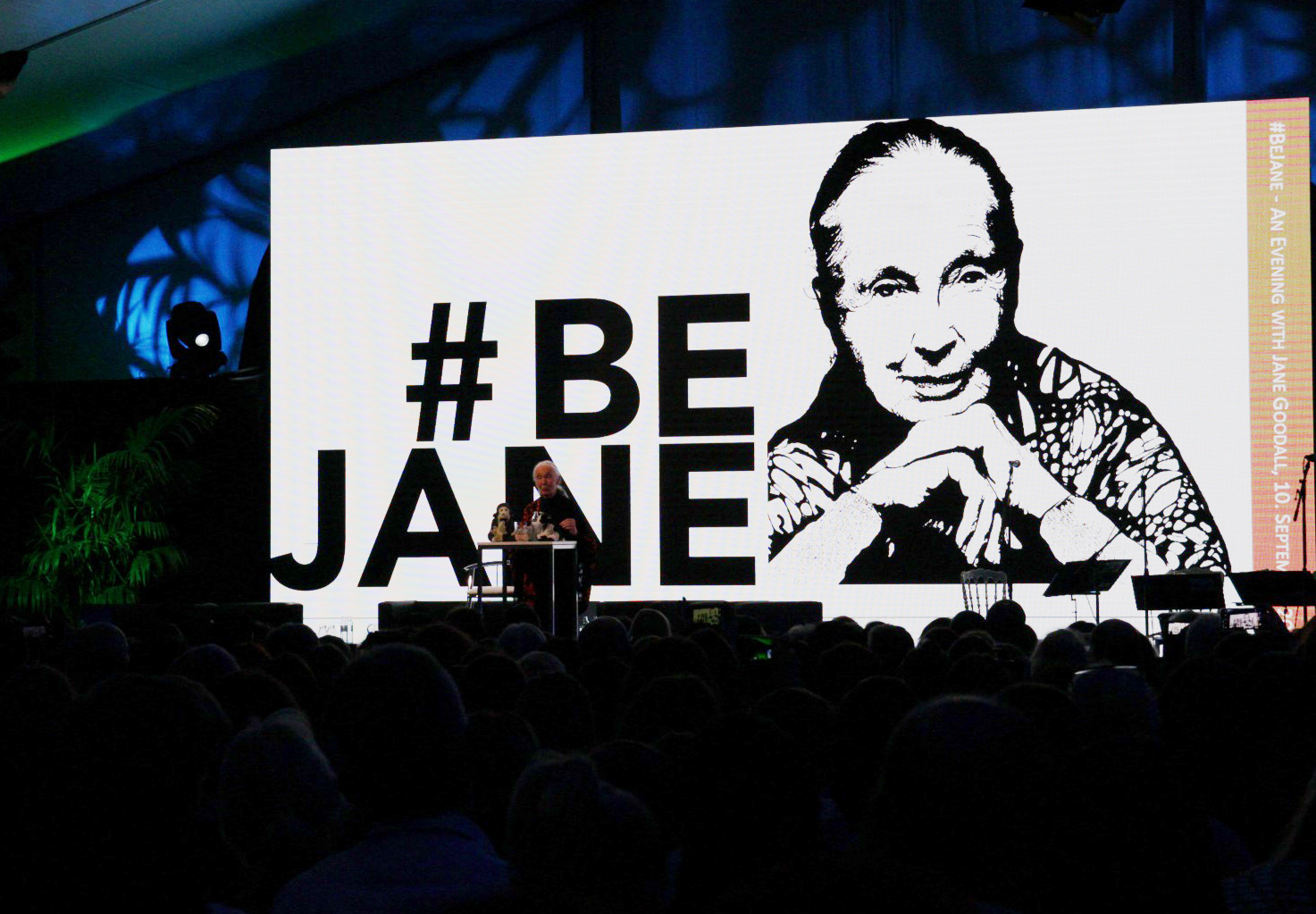
But then she turned the heaviness in our hearts into lightness; full of confidence, she looked out at the crowd, who listened to her spellbound, and shared four reasons why she has hope despite these dark times.
(Note: Jane Goodall often mentions a fifth reason: the power of social media. However, she did not mention this point that evening.)
If Jane Goodall, at 85 years old, can stand for an hour to rally, inspire, and motivate 1,100 people, why can’t we do the same? Jane Goodall is convinced that together we can bring about change.“But will we?” she asks us all. Will we?
She had no doubts and immediately had an answer ready, which is why she asked everyone in the room to say the following words together. When spoken aloud, the words took on a special power, and heart and mind were reunited.
Talk to us about it:
Yes, we can, and yes, we will!
[av_promobox button='no' label='Click me' link='manually,http://' link_target="" color='theme-color' custom_bg='#444444' custom_font='#ffffff’ size=’large’ icon_select=’no’ icon=’ue800’ font=’entypo-fontello’ box_color=“ box_custom_font=’#ffffff’ box_custom_bg=’#444444’ box_custom_border=’#333333’ admin_preview_bg=“]
Recommended by Jane Goodall: Check out Pigcasso—it will change your perspective:
https://www.youtube.com/watch?v=in4NKrB5D8Q
A video showing the indomitable spirit of Wounda, a female chimpanzee.
https://www.youtube.com/watch?v=YzC7MfCtkzo
[/av_promobox]
[av_notification title=" color='silver' border=" custom_bg='#444444' custom_font='#ffffff' size='normal' icon_select='yes' icon='ue80b' font='entypo-fontello' admin_preview_bg="]
Source: Lecture by Jane Goodall in Vienna on September 10, 2019; the entire evening is available on video; Jane Goodall’s lecture begins at 2:10: https://www.facebook.com/janegoodall.at/videos/417006308942720/
[/av_notification]