
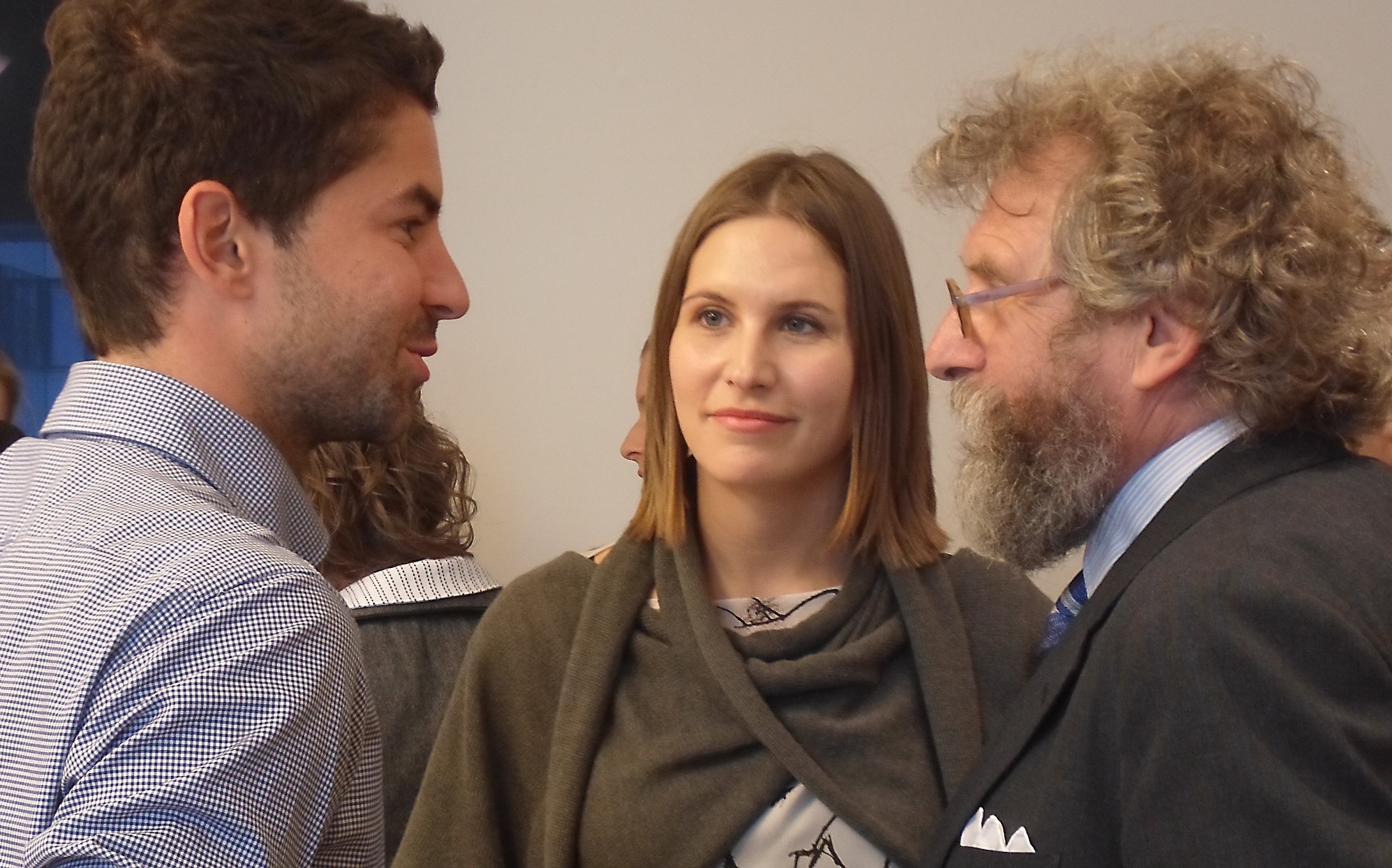
Werner Lampert: To make progress on sustainability, we need to address the issue from a socio-political perspective. How do we treat the most vulnerable members of society? I don’t want to talk about sustainability as long as the school system and education are in shambles; I don’t want to talk about sustainability when I see that social services are the first to be cut during every economic crisis!
We won’t make any headway if we just sit quietly at home! Young people must show solidarity on a socio-political level.
[av_hr class='custom' height='50' shadow='no-shadow' position='center' custom_border='av-border-thin' custom_width='100%' custom_border_color=" custom_margin_top='1px' custom_margin_bottom='20px' icon_select='no' custom_icon_color=" icon='ue808' font='entypo-fontello' admin_preview_bg="]
Susanne Mairhofer: Protests arise when something affects us personally. The outcry comes when things are really bad for us; that’s when we realize we have to take action. Still, I believe it’s important to take small steps, such as choosing organic food. I can’t change society on my own, but I can change the people around me!
Lampert: The truly meaningful changes happen when people are free; otherwise, fear and anger take the wheel. The conditions you have today are ideal! Right now, we’re still in a position to make a difference. In the future, no matter which politicians you elect, we won’t be able to negotiate with climate change.
Lisa Vockenhuber: Everyone needs to start thinking today about how to pass on a commitment to sustainability to the next generation.
Manuel Hahn: It is important to implement educational measures as early as preschool.
Christina Steinbacher: We need to appreciate what we have and not live wastefully! This applies to food and clothing.
Lampert: When it comes to clothing, we’re already delving into socio-political issues. When you buy a garment for a few euros, you know full well that its production was based on exploitation. Couldn’t we combine emotion and awareness to motivate people to learn more?
Katharina Skarabela: But where do we instill that awareness? I know from teacher friends of mine that parents today send their kids to school with a Leberkäs sandwich and chips because it’s convenient. On top of that, people buy way too much and just throw it away.
Katharina Knapp: We need to point out that, while we may still be doing well for now, we’re already on the brink! Let’s make the general public aware of the long-term damage we’re heading toward if we don’t act immediately!
Lampert: One option would be to address the issue of greenwashing by spreading the word online. That could raise awareness and spark a public outcry.
Raphaela Steiner: I believe that positive communication is key. “Greenwashing” has too many negative connotations.
Let’s take a look at the Styrian Volcanic Region. Twenty-five years ago, it was one of the poorest regions in Austria. Today, the region has a distinct cultural and culinary identity and is now aiming to become a bioregion. Shared visions can bring about change!
Knapp: It will also benecessary to implement laws in a holistic manner—ecologically, socially, and economically. The Economy for the Common Good would be one approach, though not many people are familiar with it yet.
Lampert: Sustainability for countries and companies is much like our personal sustainability. There are certain areas where we’re very sustainable, and then there are others we’d rather not talk about—where our sustainability record looks pretty dismal. There’s no need to be embarrassed; we just have to understand that sustainability is a process and tackle one issue at a time.
Mairhofer: But that brings us back to the topic of positive communication, which is important for people's mental well-being.
[av_hr class='custom' height='50' shadow='no-shadow' position='center' custom_border='av-border-thin' custom_width='100%' custom_border_color=" custom_margin_top='1px' custom_margin_bottom='20px' icon_select='no' custom_icon_color=" icon='ue808' font='entypo-fontello' admin_preview_bg="]
Mairhofer: For years, I worked on a project in schools that aimed to teach children about energy conservation through play. Then the economic crisis hit, and the first thing to be cut was the school project!
Skarabela: My parents run a driving school where we place a strong emphasis on electric vehicles. This helps us raise awareness among young drivers.
Plank: WU offers a wide variety of fantastic lectures, but unfortunately, they are all electives.
Lisa Knapp: I’ve been a vegetarian for a long time myself. We had a required course where we visited a slaughterhouse. Supposedly, the animals were just as calm as they were in the barn, but they had foam coming out of their mouths. The smell of blood and disinfectant was overwhelming; even just through their senses, these animals must have been aware of their dire situation. That experience had a profound impact on all of us.
[av_hr class='custom' height='50' shadow='no-shadow' position='center' custom_border='av-border-thin' custom_width='100%' custom_border_color=" custom_margin_top='1px' custom_margin_bottom='20px' icon_select='no' custom_icon_color=" icon='ue808' font='entypo-fontello' admin_preview_bg="]
[av_gallery ids='3869,3870,3871,3872’ style=’thumbnails’ preview_size=’portfolio’ crop_big_preview_thumbnail=’avia-gallery-big-crop-thumb’ thumb_size=’portfolio’ columns=’4’ imagelink=’lightbox’ lazyload=’avia_lazyload’ admin_preview_bg=“]
[av_hr class='custom' height='50' shadow='no-shadow' position='center' custom_border='av-border-thin' custom_width='100%' custom_border_color=" custom_margin_top='1px' custom_margin_bottom='20px' icon_select='no' custom_icon_color=" icon='ue808' font='entypo-fontello' admin_preview_bg="]
Lampert: Consumers hold all the power! As soon as a movement gains momentum, retailers won’t put up any resistance. Take genetic engineering, for example—consumers in Europe don’t want it.
Hahn: The goal would be to shift consumption from unconscious to conscious. The use of digital channels—such as mobile apps—would be important.
Ralph Kropfreiter: The more you know, the harder it gets; then you stand in the supermarket and don't know what to buy anymore.
Skarabela: I'm just afraid that many people can't afford sustainable goods.
Lampert: But if you take a look inside the shopping carts of people who are struggling financially, you’ll be surprised.
Vockenhuber: That's right, it's a matter of priorities! Seasonal foods are affordable!
Steinbacher: A kilo of organic potatoes from the Waldviertel region costs 60 cents! Potato chips and fast food are more expensive!
Mairhofer: A shift in thinking is taking place in our generation. I see it happening around me—more and more people are cooking at home. For some, it’s not just about learning to eat more mindfully, but also about financial education.
[av_hr class='custom' height='50' shadow='no-shadow' position='center' custom_border='av-border-thin' custom_width='100%' custom_border_color=" custom_margin_top='1px' custom_margin_bottom='20px' icon_select='no' custom_icon_color=" icon='ue808' font='entypo-fontello' admin_preview_bg="]
Hahn: What is your vision for the future?
Werner Lampert: At the beginning, I wanted to explore the concept of Back to the Roots for countries that had public institutions , but lacked the courage. My goal is for two to three countries in Europe to have adopted this concept within twenty years.
Organic farming must be linked to regionality and regional value creation. Farmers should understand who they are producing for, and consumers should know the farmers—that is what we are working on.
Steinbacher: Why do advertisements always paint an idyllic picture that no longer exists at all?
Lampert: You can reach consumers either through “low prices” or through emotions.
In our case, however, we’ve never staged a farmer. For example, we have a farmer who’s driven by the fact that his cows have horns. He was seriously injured by a cow that had been startled, yet for him there’s no question that his cows will not be dehorned. That passion, that connection—it still exists! We don’t have to invent it for advertising.
[av_hr class='custom' height='50' shadow='no-shadow' position='center' custom_border='av-border-thin' custom_width='100%' custom_border_color=" custom_margin_top='1px' custom_margin_bottom='20px' icon_select='no' custom_icon_color=" icon='ue808' font='entypo-fontello' admin_preview_bg="]
Lampert: The initial momentum in the organic sector came from farmers; now it has to come from consumers. You’re all at a wonderful stage in your lives! A bright future lies ahead of you!
[av_hr class='custom' height='50' shadow='no-shadow' position='center' custom_border='av-border-thin' custom_width='100%' custom_border_color=" custom_margin_top='1px' custom_margin_bottom='20px' icon_select='no' custom_icon_color=" icon='ue808' font='entypo-fontello' admin_preview_bg="]
[av_video src='https://youtu.be/sXiz6QAu2Oc' format='16-9' width='16' height='9']
[av_video src='https://youtu.be/t8GJe6T_QFw' format='16-9' width='16' height='9']
[av_promobox button='no' label='Click me' link='manually,http://' link_target="" color='theme-color' custom_bg='#444444' custom_font='#ffffff’ size=’large’ icon_select=’no’ icon=’ue800’ font=’entypo-fontello’ box_color=“ box_custom_font=’#ffffff’ box_custom_bg=’#444444’ box_custom_border=’#333333’ admin_preview_bg=“]
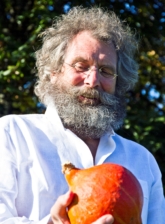 Werner Lampert (born in 1946 in Vorarlberg, Austria) is considered one of the pioneers in the field of sustainable products and their development in Europe. This organic pioneer has been deeply involved in organic farming since the 1970s. With Back to the beginning (Hofer) and Ja! Natürlich—he developed two of the most successful organic brands in the German-speaking world.
[/av_promobox]
[av_notification title=" color='silver' border=" custom_bg='#444444' custom_font='#ffffff' size='normal' icon_select='yes' icon='ue80b' font='entypo-fontello' admin_preview_bg="] Source: This text is an abridged version of a conversation between Werner Lampert and young people about sustainability.
[/av_notification]
[av_notification title=" color='custom' border=" custom_bg='#e2e8ca' custom_font='#444444' size='normal' icon_select='yes' icon='ue837' font='entypo-fontello' admin_preview_bg="]
Editorial article
[/av_notification]