Anfang April kam ich von einer Reise aus den USA zurück, dem Land der unbegrenzten Möglichkeiten. Trotz kultureller Ähnlichkeiten ist die nordamerikanische Lebensweise sehr unterschiedlich verglichen mit einem kleinstrukturierten Land wie Österreich.
Abgesehen davon, dass in den USA einfach alles größer ist, die Autos, die Häuser, die Schokoriegel, die Getränke, fiel mir vor allem eines auf: Plastic is everywhere!
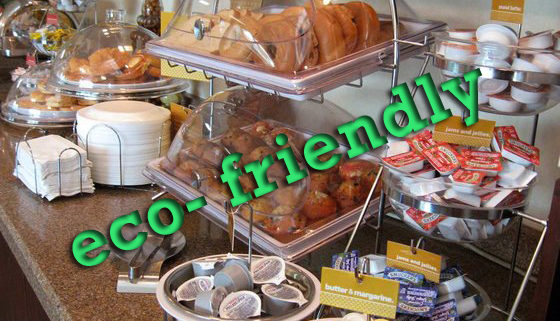
Am Morgen beim Frühstücksbüffet suchte man vergeblich nach Metall, Keramik oder Papier. Alles, aber wirklich alles war aus Plastik. Sogar der Apfel glänzte so unnatürlich, dass er aus Kunststoff zu sein schien.
Die Frühstückscerealien, die Butter, die Marmelade etc., amerikanische Lebensmittel sind portionsweise in Plastik verpackt. Die Teller, das Besteck, die Becher, selbstverständlich auch die Stühle und Tische waren aus diesem für mich höchst unsympathischen Material- Polyethylen, PVC, Polypropylen und wie sie alle heißen.
Gleichzeitig findet man wohl nirgends so viele Produkte in biologisch abbaubarer („ecofriendly“) Plastikverpackungen wie dort.
Sind diese Bio-Kunststoffe wirklich besser? Was verbirgt sich hinter den Begriffen „biologisch abbaubar“ und „basierend auf nachwachsenden Rohstoffen“?
Seit 20 Jahren gibt es weltweite Bemühungen Plastik nicht aus Erdöl zu erzeugen. Vor diesen Kunststoffen steht dann der kleine und kurze Begriff „bio“, der meiner Ansicht nach verfänglich und irreführend ist.
Der Begriff „bio“, der im Lebensmittelbereich biologische Landwirtschaft bedeutet und positiv behaftet ist, ist nicht geschützt und bedeutet vor dem Wort Kunststoff „biobasiert“ oder „biologisch abbaubar“.
Hinter „biobasiert“ verstecken sich Kunststoffe, die teilweise oder selten vollständig aus nachwachsenden Rohstoffen stammen. Der restliche Bestandteil ist hingegen wieder ein Erzeugnis aus Erdöl.
„Biologisch abbaubar“ sind (laut DIN EN 13432) Stoffe, die nach einer festgeschriebenen Zeit unter definierten Temperatur-, Sauerstoff- und Feuchtebedingungen in der Anwesenheit von Mikroorganismen oder Pilzen zu mehr als 90 Prozent zu Wasser, Kohlendioxid und Biomasse abgebaut werden.
Biologisch abbaubares Plastik muss demnach keineswegs aus nachwachsenden Rohstoffen sein, und darf somit zu 100% aus Erdöl sein. Das Labelling Bioplastik ist daher höchst unzureichend.
Am häufigsten zu finden sind derzeit Folien und Verpackungen aus Mais- und Kartoffelstärke. Ein Großanbieter für diese Stärke ist Cargill, ein amerikanischer Saatgutproduzent, der zu einem Großteil Monsanto gehört. Ergo, bei Verpackungen aus Mais- und Kartoffelstärke kann man nicht garantieren, dass die Stärkeprodukte nicht von gentechnisch veränderten Pflanzen stammen.
Ein Biosackerl aus gentechnisch veränderten Pflanzen.
Ein weit verbreiteter Biokunststoff namens PLA (Polyactid) wird aus Milchsäure hergestellt, das Patent dafür hält der US-amerikanische Konzern DuPont, dem unter anderem auch der größte Saatgutproduzent Pioneer gehört, den mancheiner aus dem österreichischen Dokumentarfilm „We feed the World“ kennt.
Bei diesen Kunststoffen muss man sich die ethische Frage stellen, ob man Lebensmittel als Verpackungsstoff nutzen soll! Hinsichtlich der Tatsache, dass 870 Millionen Menschen unterernährt sind, sind sie sehr kritisch zu betrachten.
Gibt es somit wirklich keine gute Alternative zu Plastik aus Erdöl, welches unsere Weltmeere verschmutzt, Böden verseucht und dessen Weichmacher wie Bisphenol A, uns krank machen?
Es ist wichtig, dass wir die Entwicklungen kritisch betrachten und bewusst verfolgen. Es gibt viele Innovationen, die in die richtige Richtung gehen.
So kann Zellulosefolie zu 100% aus dem nachwachsenden Rohstoff Holz hergestellt werden, welches nachhaltig gewonnen ethisch unbedenklich ist. Auch Gentechnik ist hier nicht im Spiel.
Biologisch abbaubare Kunststoffe sollten genauso wie herkömmliches Plastik recycelt werden, denn sie werden unter einem hohen Energieaufwand produziert. Sie zu kompostieren, bloß weil es möglich ist, wäre eine Verschwendung.
Noch besser hingegen ist es Plastik überhaupt zu vermeiden. Immer noch greifen viel zu viele Menschen zu dem optionalen Plastiksackerl im Geschäft.
Ein langer Weg zur perfekten Alternativverpackung liegt noch vor uns, die ersten Schritte haben wir aber bereits zurückgelegt!